

 Post by
 A software development analyst is a tech professional who turns business needs into software requirements, supports developers, tests features, and helps teams deliver software that solves real user problems.
Software Development Analyst at a Glance
| Category | Details |
|---|---|
| Main role | Turns business needs into clear software requirements |
| Also called | Software analyst, systems analyst, technical business analyst, application development analyst |
| Coding required | Sometimes, but not always |
| Main skills | Analysis, documentation, SQL, testing, communication |
| Common tools | Jira, Confluence, SQL, Postman, Lucidchart, Excel |
| Best for | Students, freshers, job seekers, and career switchers who like tech and problem-solving |
| Career growth | Senior analyst, product owner, product manager, project manager, solution analyst |
What Is a Software Development Analyst?
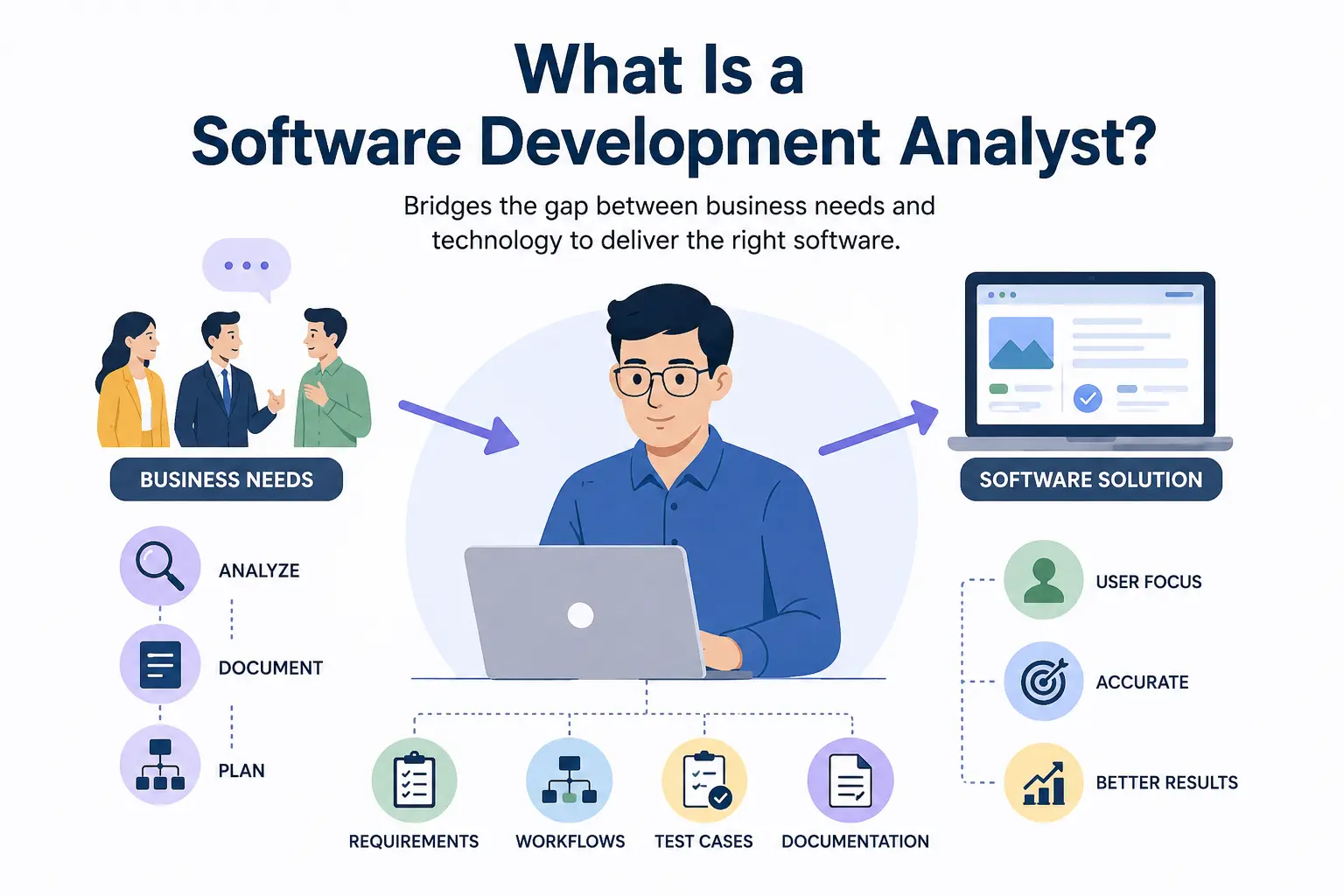
A software development analyst is a technology professional who helps companies plan, build, test, and improve software. The role sits between business users and software teams.
In simple terms, this person helps answer one important question:
What should the software do, and why?
For example, imagine a hospital wants a new appointment booking system. Doctors want fewer scheduling errors. Reception staff want faster patient registration. Managers want reports on missed appointments. Developers need clear instructions before they build the system.
A software development analyst studies all these needs and turns them into clear requirements. They may create user stories, process flows, screen notes, test cases, and acceptance criteria. They also check whether the finished software works the way users expect.
This role can look different from company to company. In one company, the analyst may focus on requirements and testing. In another, they may also write SQL queries, review APIs, support releases, or help with configuration.
Common job titles include:
- Software analyst
- Software development analyst
- Application development analyst
- Systems analyst
- Technical business analyst
- Business systems analyst
- Programmer analyst
The role is common in banking, healthcare, retail, insurance, logistics, SaaS, telecom, government, and enterprise IT.
A good analyst does not only ask, “Can we build this?”
They ask:
- Who will use this software?
- What problem are we solving?
- What happens if something fails?
- What data does the system need?
- What should developers build first?
- How will we know the feature works?
That is why this role matters. A software project can have clean code and still fail if it solves the wrong problem. The analyst helps prevent that.
What Does a Software Development Analyst Do?

A software development analyst studies user needs, writes requirements, works with developers, supports testing, tracks issues, and helps improve software during the development lifecycle.
The day-to-day work depends on the project.
On one day, the analyst may meet with a sales team that wants a better customer dashboard. On another day, they may write user stories for developers. Later in the week, they may test whether the dashboard filters work, review bugs with QA, and prepare release notes for users.
Here is a real software project example.
A retail company wants to add a “buy online, pick up in store” feature. The analyst must understand how customers place orders, how inventory updates, how store staff receive pickup requests, and what should happen if an item goes out of stock.
A developer may ask:
“Should the item be reserved when the customer adds it to the cart, or only after payment?”
The analyst helps answer that by checking business rules, user needs, and system limits.
Typical daily tasks include:
- Meeting users and stakeholders
- Understanding business problems
- Writing user stories
- Creating acceptance criteria
- Explaining requirements to developers
- Reviewing software designs
- Testing features before release
- Tracking bugs and change requests
- Checking reports and data
- Supporting product releases
- Updating documentation
This role is not only about meetings. It requires investigation, logic, clear writing, testing, and technical judgment.
A strong analyst can spot gaps before they become expensive mistakes. For example, if a team builds a payment feature but forgets refund rules, the analyst should catch that early.
Software Development Analyst Responsibilities
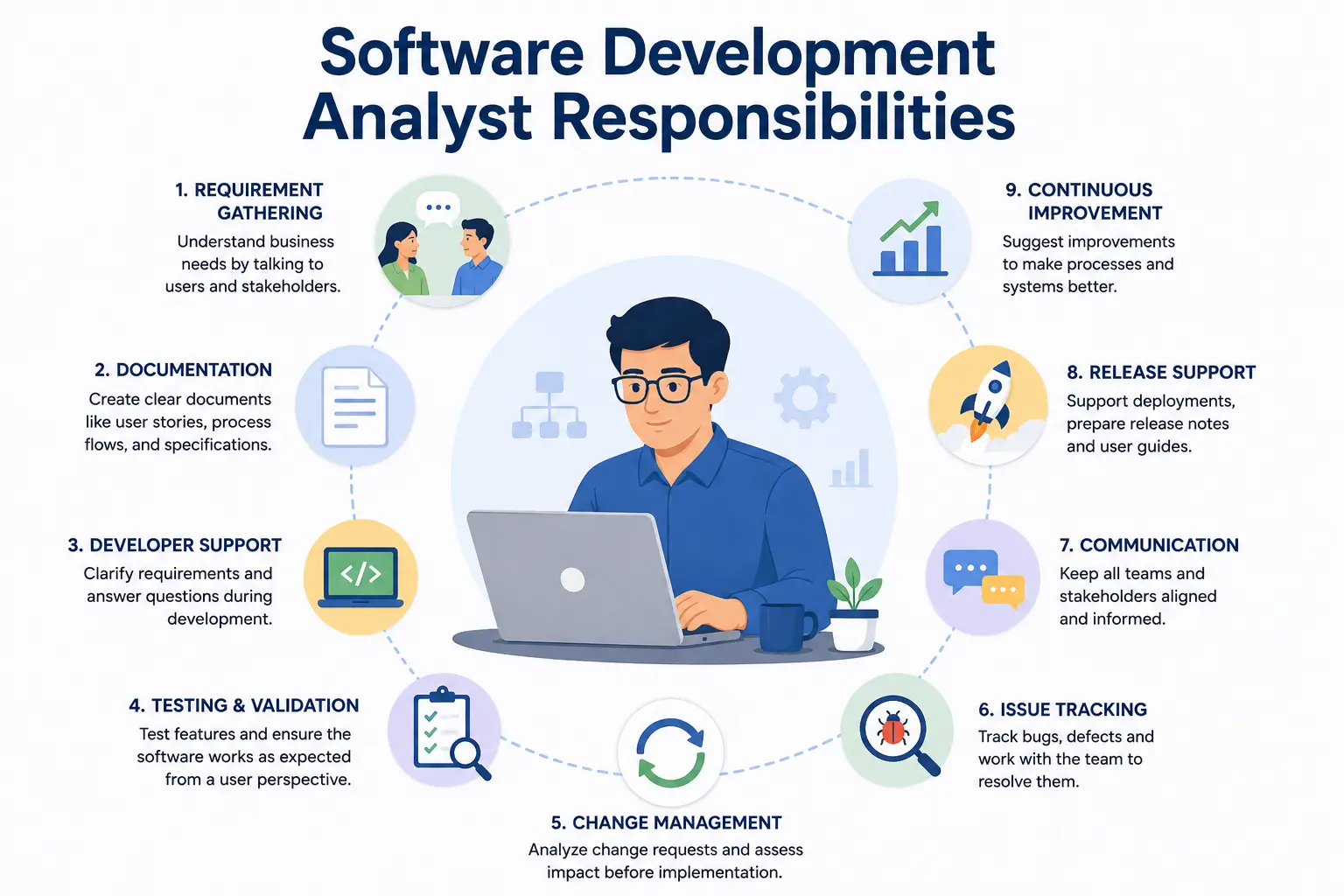
While the previous section explains daily work, this section breaks down the responsibilities usually found in a software development analyst job description.
The main responsibility is to make software requirements clear enough that developers can build the right solution and users can trust the final product.
Requirement gathering
The analyst talks to users, managers, customers, developers, testers, and product owners to understand what the software must do.
Example:
A bank wants to improve its loan application portal. The analyst interviews loan officers, customers, compliance staff, and developers to understand the full workflow from application to approval.
Requirement documentation
A software development analyst writes documents that guide the project.
Common documents include:
- Business requirement documents
- Functional specifications
- User stories
- Acceptance criteria
- Process flows
- Data mapping documents
- API requirement notes
- Test scenarios
- Release notes
- User guides
Clear documentation reduces confusion. It also helps new team members understand the system later.
Developer support
Developers often need quick answers during development.
For example, while building an ecommerce checkout feature, a developer may ask:
“What should happen if a discount code expires during payment?”
The analyst checks the rule and confirms the expected behavior.
Testing and validation
Many analysts support user acceptance testing, also called UAT. They check whether the software works from a user and business point of view.
They may test:
- Login flows
- Form validations
- Reports
- Payment flows
- Email notifications
- Role-based access
- Data exports
- Error messages
Change request analysis
Software projects change often. Users may request new features, laws may change, or technical limits may appear. The analyst reviews the impact before the team accepts the change.
Communication
The analyst keeps business users, developers, testers, project managers, and support teams aligned.
In short, this role reduces confusion. That is one of its biggest values.
Key Software Development Analyst Skills Required
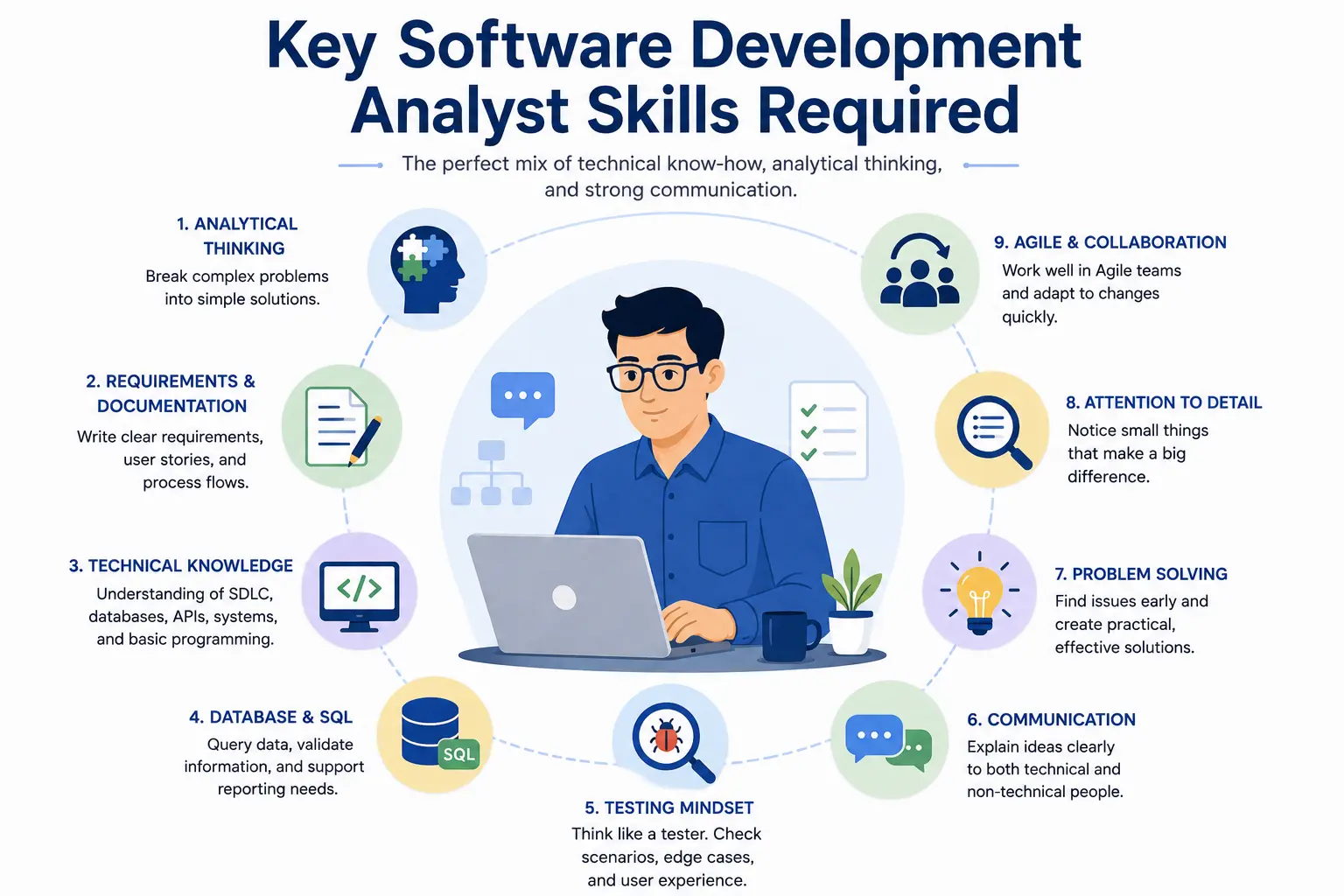
The most important software development analyst skills include analytical thinking, communication, software development knowledge, documentation, SQL basics, testing, problem-solving, and the ability to understand both business and technical language.
You do not need to be an expert coder to start in this role. But you should understand how software works.
Technical skills
A software development analyst should understand:
- Software development lifecycle, also called SDLC
- Agile and Scrum basics
- Databases and SQL
- APIs and system integrations
- Basic programming logic
- Testing methods
- Version control basics
- Cloud and web application concepts
- Security and data privacy basics
For example, if a project includes a mobile app, backend API, and database, the analyst should understand how data moves between them.
They may not build the API, but they should know what the API needs to send, receive, and validate.
Analytical skills
This role requires strong thinking skills. Analysts break large problems into smaller parts.
Example:
“Customers cannot complete checkout” is too broad.
A good analyst checks whether the issue happens during login, cart update, payment gateway redirection, coupon validation, address selection, or order confirmation.
Communication skills
An analyst must explain technical topics in simple language and business topics in clear technical terms.
They may explain a database field to a sales manager, then explain a sales policy to a backend developer.
Documentation skills
Clear writing matters.
Weak requirement:
“The app should be fast.”
Better requirement:
“The product search results page should load within three seconds for up to 500 matching products.”
That second version is specific and testable.
Testing mindset
A good analyst thinks about normal cases and edge cases.
For example:
- What happens if the user enters the wrong password?
- What happens if payment succeeds but order creation fails?
- What happens if two users edit the same record?
- What happens if a required field is left blank?
- What happens if the system loses internet connection?
Soft skills
Helpful soft skills include:
- Listening
- Patience
- Attention to detail
- Time management
- Confidence in asking questions
- Team collaboration
- Adaptability
The best analysts are curious. They do not accept vague answers. They ask better questions until the requirement becomes clear.
Software Development Analyst vs Software Developer
A software development analyst focuses on requirements, workflows, testing, documentation, and communication. A software developer focuses on writing, debugging, and maintaining code.
Both roles work together, but they solve different parts of the same problem.
| Area | Software Development Analyst | Software Developer |
|---|---|---|
| Main focus | Requirements, analysis, testing, communication | Coding, debugging, and technical implementation |
| Daily work | User stories, meetings, UAT, documentation, system analysis | Writing code, fixing bugs, reviewing code, building features |
| Coding required? | Sometimes, depends on the company. | Yes |
| Works closely with | Users, product managers, developers, testers | Analysts, architects, testers, DevOps |
| Main output | Requirements, workflows, test cases, documentation | Code, APIs, UI components, database logic |
| Best fit for | People who like tech plus communication | People who enjoy programming deeply |
Here is a simple example.
A company wants to add refund tracking to its ecommerce platform.
The analyst defines the refund rules:
- Customers can request refunds within 30 days.
- Refunds above $500 need manager approval.
- Digital products cannot be refunded after download.
- Customers should receive email updates.
The developer turns those rules into working software.
They may create database tables, backend services, user interface screens, and email triggers.
In small companies, one person may do both jobs. In larger companies, these roles are usually separate because the work becomes more complex.
Neither role is better. They suit different strengths.
Choose the analyst path if you like understanding problems, talking to people, designing workflows, testing logic, and staying close to both business and technology.
Choose the developer path if you enjoy building software through code and solving technical problems for most of the day.
Software Development Analyst vs Business Analyst
A software development analyst and a business analyst have overlapping work, but they are not always in the same role.
A business analyst usually focuses on business processes, goals, operations, and stakeholder needs. A software development analyst works closely with software systems, technical requirements, development teams, testing, and implementation.
| Area | Software Development Analyst | Business Analyst |
|---|---|---|
| Main focus | Software requirements and system behavior | Business needs and process improvement |
| Technical depth | Usually higher | Varies by role |
| Common deliverables | Functional specs, user stories, test cases, system workflows | Business cases, process maps, and requirement documents |
| Works with developers? | Often | Sometimes |
| Testing involvement | Common | Sometimes |
| Best environment | Software product teams, IT teams, application teams | Operations, strategy, product, finance, IT |
Example:
A logistics company wants to reduce late deliveries.
A business analyst may study route planning, driver availability, warehouse delays, customer complaints, and cost impact.
A software development analyst may work on the software side. They may improve the delivery tracking system, add route alerts, update driver app workflows, or define how GPS data should sync with the central dashboard.
In many companies, the titles blend. A business analyst in an IT team may do software analyst work. A software development analyst may also handle business analysis.
The difference comes down to focus.
A business analyst asks:
“What does the business need?”
A software development analyst asks:
“How should the software support those needs?”
Both roles need communication, process thinking, and documentation. The software development analyst usually needs more comfort with databases, APIs, testing, system design, and development workflows.
Tools Used by Software Development Analysts
Software development analysts use tools for project tracking, documentation, diagrams, databases, testing, communication, and collaboration.
The exact tools depend on the company, but most analysts work with a similar stack.
| Tool category | Examples | Why analysts use it |
|---|---|---|
| Project management | Jira, Azure DevOps, Trello, Asana | Track user stories, bugs, sprints, and tasks |
| Documentation | Confluence, Notion, Google Docs, Microsoft Word | Write requirements, notes, and guides |
| Diagramming | Lucidchart, Miro, Draw.io, Visio | Create workflows, process maps, and system flows |
| Databases | MySQL, PostgreSQL, SQL Server, Oracle | Query data and validate records |
| API testing | Postman, Swagger | Test API requests and responses |
| Testing | TestRail, Zephyr, BrowserStack | Manage test cases and test results |
| Communication | Slack, Microsoft Teams, Zoom | Discuss requirements and project updates |
| Design review | Figma, Adobe XD | Review screens and user flows |
| Version control | GitHub, GitLab, Bitbucket | Understand code changes and releases |
| Analytics | Excel, Power BI, Tableau | Analyze reports, usage data, and defects |
A beginner does not need to master every tool.
Start with:
- Jira or Azure DevOps
- Excel or Google Sheets
- SQL basics
- Confluence or Notion
- Draw.io or Lucidchart
- Postman basics
Here is how these tools work in a real project.
In a banking app project, the analyst may use Jira to write user stories, Confluence to document business rules, Draw.io to map the approval process, SQL to check transaction records, and Postman to test whether the payment API returns the right response.
Tools help, but they do not replace clear thinking.
A strong analyst with basic tools can still outperform someone who knows many platforms but cannot ask the right questions.
Qualifications and Education Needed

Most software development analyst roles require a bachelor’s degree in computer science, information technology, software engineering, information systems, business analytics, or a related field.
Some companies also accept candidates with strong project experience, certifications, bootcamp training, or proven technical skills.
Common degrees include:
- Computer Science
- Information Technology
- Software Engineering
- Information Systems
- Business Information Systems
- Data Analytics
- Business Administration with an IT focus
A technical degree helps, but it is not the only path.
Career switchers from support, QA testing, operations, business analysis, data analysis, and customer success can move into this role by learning software project basics.
Useful certifications include:
- Certified ScrumMaster
- Professional Scrum Master
- PMI Professional in Business Analysis
- IIBA Entry Certificate in Business Analysis
- ISTQB Foundation Level
- Microsoft Azure fundamentals
- AWS Cloud Practitioner
- SQL certifications
- Product owner certifications
For students and freshers, internships and sample projects matter a lot. A small project with clear documentation can show more skill than a long list of courses.
Good portfolio projects include:
- Requirements for a food delivery app
- User stories for a library management system
- Workflow for an online appointment booking system
- Test cases for a login and payment feature
- SQL queries for a sample sales database
- Current and future process flows for an HR leave system
Employers want to see that you can think through real software problems.
A simple project with clear user stories, workflows, and test cases can make your resume stronger.
Software Development Analyst Career Path and Growth Opportunities
The software development analyst career path can lead to senior analyst, product owner, business systems analyst, solution analyst, project manager, product manager, QA lead, technical consultant, or software development manager.
This role gives you broad exposure because you work with users, developers, testers, managers, and sometimes customers.
A typical path may look like this:
| Career stage | Common title | Focus |
|---|---|---|
| Entry level | Junior Software Analyst, Associate Development Analyst | Learning requirements, testing, and documentation |
| Mid level | Software Development Analyst, Systems Analyst | Owning features, working with teams, and solving system problems |
| Senior level | Senior Software Development Analyst | Leading analysis for large modules or projects |
| Lead level | Lead Analyst, Product Owner, Business Systems Lead | Managing scope, roadmap, stakeholder decisions |
| Advanced path | Product Manager, Solution Architect, Project Manager | Strategy, architecture, delivery, leadership |
Some analysts move closer to technology.
They may become:
- Software developer
- QA automation engineer
- DevOps analyst
- Data analyst
- Solutions architect
- Technical product owner
Others move closer to business and leadership.
They may become:
- Product manager
- Business analyst manager
- Project manager
- Delivery manager
- IT consultant
- Operations technology lead
This flexibility is one of the strongest parts of the career.
For example, someone who starts by documenting features for an insurance claims system may later become the product owner for the full claims platform. Another person may enjoy APIs and databases, then move into backend development or solutions architecture.
The wider software job market also supports long-term demand. The U.S. Bureau of Labor Statistics projects employment for software developers, quality assurance analysts, and testers to grow 15% from 2024 to 2034, with about 129,200 openings each year on average.
That does not mean every analyst job is guaranteed. It does show that software-related careers remain a strong area for people who keep learning.
Software Development Analyst Salary
The software development analyst salary depends on location, industry, experience, technical skills, company size, and whether the role includes coding.
Salary data also changes often, so use multiple sources before negotiating pay.
In the United States, ZipRecruiter lists the average annual pay for a Software Development Analyst at about $110,380 as of June 19, 2026. Salary.com reports a higher U.S. average of about $134,324 as of June 1, 2026. The difference shows why job scope matters so much for this title.
Some companies use this title for a mostly analysis-focused role. Others use it for a more technical role involving configuration, release support, code repositories, systems, and development tasks.
A practical U.S. salary guide may look like this:
| Level | Typical experience | Possible U.S. salary range |
|---|---|---|
| Entry level | 0 to 2 years | $65,000 to $90,000 |
| Mid level | 2 to 5 years | $85,000 to $120,000 |
| Senior level | 5 to 8 years | $110,000 to $150,000 |
| Lead or specialist | 8+ years | $140,000+ |
For India, salary can vary widely by city, company, and whether the role is closer to software analysis, development, QA, or business systems. Glassdoor’s India data for software engineering roles shows broad ranges across software-related titles, which is useful as context but not a perfect match for every software development analyst job.
Skills that can improve salary potential include:
- SQL
- Java, Python, or C#
- API testing
- Cloud basics
- Agile delivery
- Data analysis
- QA automation
- Cybersecurity awareness
- Finance, healthcare, insurance, or enterprise software domain knowledge
The best way to judge salary is to compare job descriptions, not only job titles.
A “software development analyst” role that requires SQL, APIs, cloud, testing, and release support may pay more than a role focused only on documentation.
How to Become a Software Development Analyst
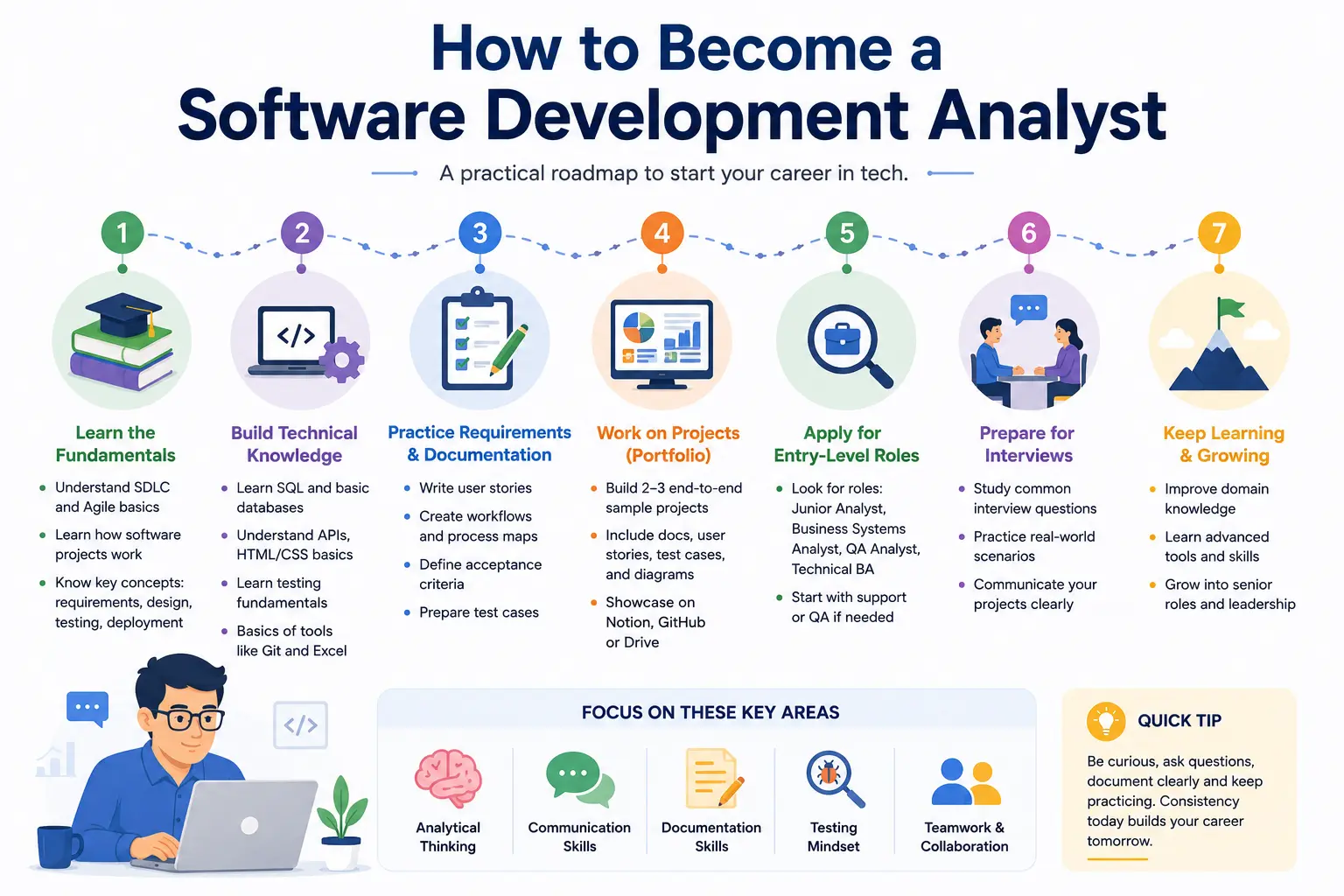
To become a software development analyst, learn software development basics, practice requirements writing, build documentation skills, learn SQL and testing, create sample projects, and apply for junior analyst, QA analyst, systems analyst, or technical business analyst roles.
Here is a practical path.
1. Learn the software development lifecycle
Understand how software moves from idea to release.
Learn these concepts:
- Requirements
- Design
- Development
- Testing
- Deployment
- Maintenance
- Agile sprints
- Backlogs
- User stories
- Bugs
- Releases
You should know what happens before developers write code and what happens after the code is released.
2. Build basic technical knowledge
Start with:
- SQL
- HTML and CSS basics
- JavaScript or Python basics
- API basics
- Git basics
- Cloud basics
- Software testing basics
You do not need to become an expert developer first. But you should understand technical conversations.
3. Practice writing requirements
Pick a simple app idea, such as a movie ticket booking app.
Write:
- User roles
- User stories
- Acceptance criteria
- Screen requirements
- Error cases
- Workflow diagrams
- Test cases
Example user story:
“As a customer, I want to select seats before payment so that I can choose where I sit.”
Acceptance criteria:
- The user can see available and booked seats.
- The user cannot select already booked seats.
- Selected seats remain reserved for 10 minutes.
- User receives a timeout message if payment is not completed.
This is the kind of clear thinking employers value.
4. Build a beginner portfolio
A beginner portfolio should not only list tools. It should show how you think.
Create two or three sample projects. Each project should include:
- Problem statement
- Requirements document
- User stories
- Workflow diagram
- Test cases
- Sample SQL queries
- Screenshots or mockups
Example portfolio project:
Online appointment booking system
Include:
- User roles: patient, doctor, admin
- Main workflow: search doctor, select slot, book appointment, receive confirmation
- Five user stories
- Ten test cases
- One cancellation rule
- One simple database table design
- One workflow diagram
You can host the portfolio on Google Drive, Notion, GitHub, or a personal website.
5. Apply for entry-level roles
Search for titles such as:
- Junior software analyst
- Associate software development analyst
- Business systems analyst
- Technical business analyst
- QA analyst
- Application support analyst
- Systems analyst
- Product analyst
Many people enter this field through QA testing or application support. Those roles teach you how software behaves in real situations.
6. Prepare for interviews
Expect questions such as:
- How do you gather requirements?
- How do you handle unclear requirements?
- What is a user story?
- What is acceptance criteria?
- How do you test a login feature?
- What is the difference between frontend and backend?
- How would you explain an API to a non-technical user?
- How do you manage scope changes?
Use project examples when you answer. Interviewers want proof that you can think, not only repeat definitions.
Is Software Development Analyst a Good Career?
Yes, a software development analyst can be a good career for people who enjoy technology, problem-solving, communication, and structured thinking.
It is especially suitable for students, freshers, job seekers, and career switchers who want a tech career but do not want a role focused only on coding.
This career is a good fit if you:
- Like understanding how systems work
- Enjoy asking questions
- Can explain ideas in simple language
- Notice small details
- Like working with both people and technology
- Are comfortable with documentation
- Want a flexible path into product, project, QA, development, or consulting roles
It may not be the best fit if you:
- Hate meetings
- Dislike writing
- Prefer working alone all day
- Do not enjoy clarifying messy requirements
- Want a role focused only on coding
The role can be challenging because analysts often sit between different groups.
Users may want fast changes. Developers may need more detail. Managers may push deadlines. Testers may find defects late in the sprint.
A good analyst stays calm, asks clear questions, and keeps the project focused on the real goal.
The best part is career flexibility. You can grow into senior analysis, product ownership, project management, software development, QA leadership, or solution consulting.
For many people, it is one of the most practical entry points into the software industry.
Final Thoughts
A software development analyst career is a strong choice if you want a tech role that combines problem-solving, communication, systems thinking, and practical software knowledge.
This career may suit you if you enjoy asking questions, organizing messy ideas, writing clear requirements, testing features, and helping teams build software people can use with confidence.
It may not suit you if you want to code all day with little stakeholder contact.
For students, freshers, and career switchers, this role offers a useful path into technology without requiring you to become a full-time developer from day one.
Frequently Asked Questions
A software development analyst is a professional who studies business needs, writes software requirements, works with developers, supports testing, and helps deliver software that solves real user problems.
A software development analyst job description usually includes gathering requirements, writing user stories, supporting developers, testing features, documenting workflows, tracking bugs, reviewing change requests, and communicating with business users.
Not always. Some roles need basic coding or scripting, while others focus on requirements, testing, documentation, and coordination. Learning SQL, APIs, and basic programming logic will still help you stand out.
The most important skills are analytical thinking, communication, documentation, SDLC knowledge, SQL, testing, Agile methods, problem-solving, and the ability to understand both business and technical needs.
No. A software developer mainly writes and maintains code. A software development analyst focuses more on requirements, workflows, testing, stakeholder communication, and making sure the software meets business needs.
The career path can lead to a senior software development analyst, business systems analyst, product owner, product manager, QA lead, project manager, technical consultant, solution analyst, or software development manager.