

 Post by
 Software testers check whether the software works as expected before users get it. They review requirements, write test cases, run tests, report bugs, verify fixes, perform regression testing, and help teams improve software quality across real projects.
If you have ever used an app that crashed during payment, showed the wrong price, or refused to let you log in, you have seen what happens when software testing fails.
So, what do software testers do in real projects?
Software testers help teams find problems before customers do. They check websites, mobile apps, business software, APIs, forms, dashboards, payment flows, user accounts, reports, and many other features.
Their job is not only to “click around.” A good software tester studies how the product should work, designs test cases, checks risky areas, reports bugs, confirms fixes, and protects the user experience.
The software tester role sits at the intersection of business needs, user expectations, and technical delivery. Testers ask practical questions:
- Does this feature work as promised?
- What happens when the user enters the wrong data?
- Will this update break an older feature?
- Is the bug fixed, or has it only disappeared in one place?
- Can a real user complete the task without confusion?
ISTQB describes software testing as a way to assess software quality and reduce the risk of software failure in operation. That is the heart of software quality assurance: helping teams release safer, clearer, and more reliable software.
This guide explains what software testers do in daily work, what skills you need, which software testing tools matter, how manual testing and automated testing differ, and what a software testing career can look like.
Read More On Software Developer Salary Without Degree: Pay & Skills
What Do Software Testers Do?
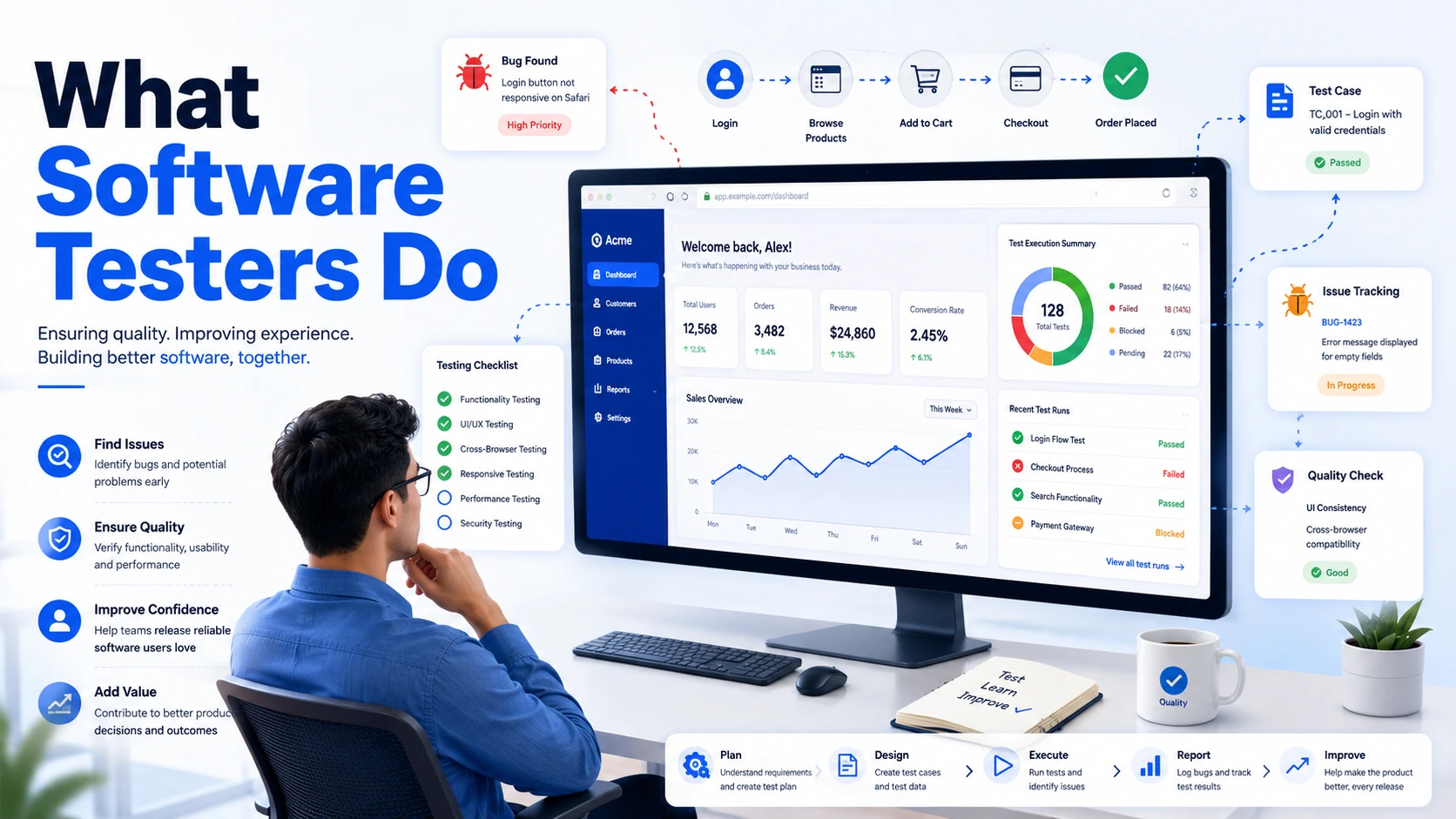
Software testers evaluate software to find defects, confirm expected behavior, and help teams release products with fewer risks. In real projects, they work from requirements, user stories, designs, acceptance criteria, and business rules. Then they turn that information into test cases, test scenarios, and practical checks.
For example, imagine your team is building a food delivery app. A developer builds the checkout screen. A software tester checks whether the user can add items to the cart, apply a coupon, choose delivery, pay with a card, and receive confirmation. But the tester does not stop there.
They also check what happens when the coupon is expired, the payment fails, the address is incomplete, the restaurant is closed, or the internet connection drops.
That is why software testing tasks are more thoughtful than many beginners expect. A QA tester needs to think like a user, a business owner, and a problem solver at the same time.
A typical software tester may:
- Review requirements before development starts
- Identify missing or unclear details
- Create test cases and test data
- Run manual testing on new features
- Perform regression testing after code changes
- Report bugs with clear steps and evidence
- Retest fixed bugs
- Join sprint meetings and release discussions
- Use software testing tools to track test results
- Help developers understand user-facing issues
The role changes from company to company. In a small startup, one tester may handle manual testing, API testing, bug reporting, release checks, and some automated testing. In a larger company, testers may specialize in functional testing, performance testing, security testing, mobile testing, or test automation.
At its best, software testing is not about blaming developers. It is about reducing risk. Developers build the product. Testers challenge the product. Together, they help users receive something that works.
Read More On Best Colleges for Software Development in 2026
Why Software Testers Are Important
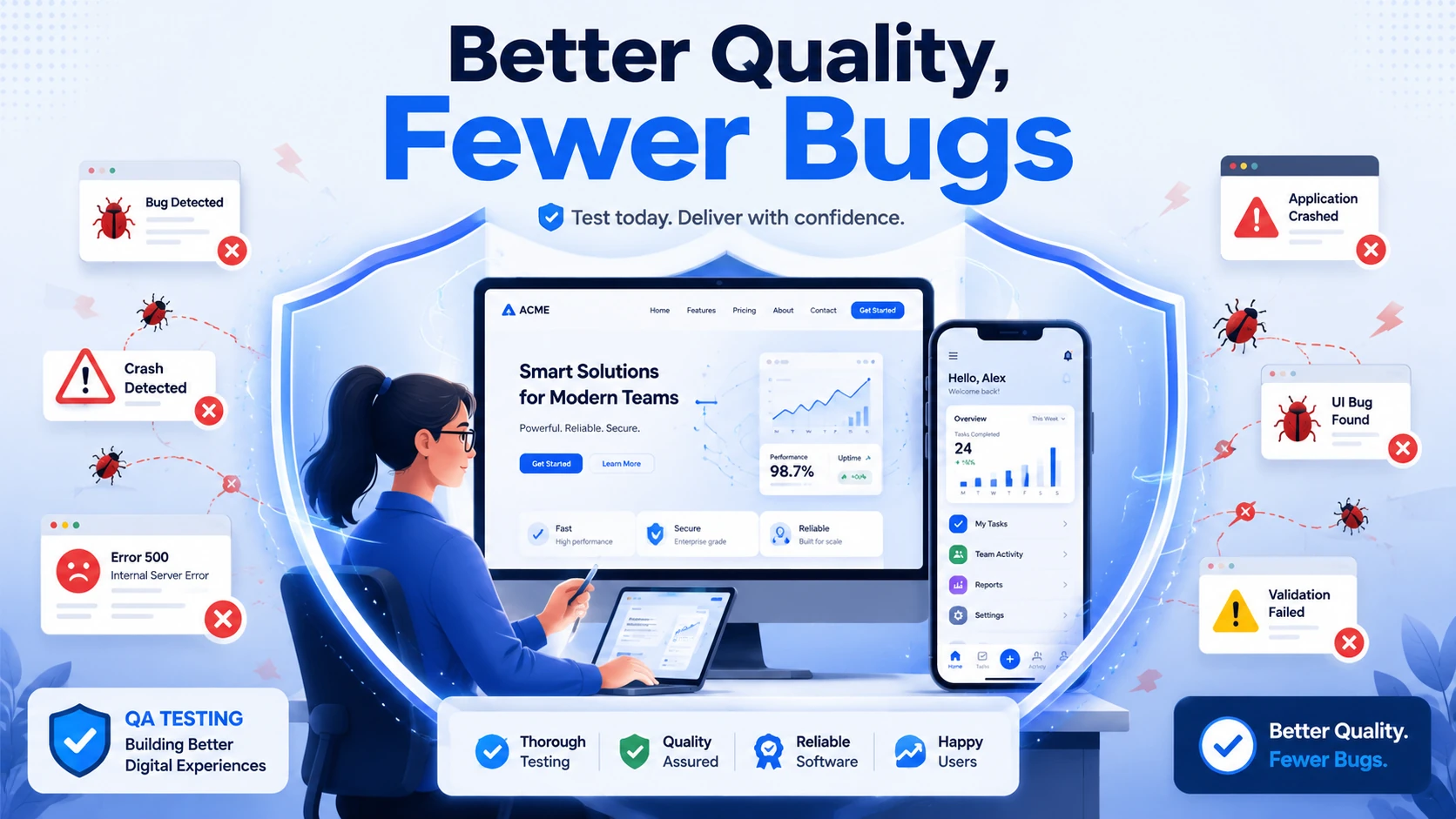
Software testers are important because every software product carries risk. A small bug can block a sale, expose private data, damage trust, or create support costs. Testing helps teams catch problems before those problems reach customers.
Think about an online banking app. A broken button is annoying. A wrong account balance is serious. A failed transfer can become a business-critical issue. Software testers help teams find these risks through planned checks, edge case testing, regression testing, and careful bug reporting.
The value of a QA tester becomes clear when you look at how software teams work. Developers often focus on building a feature according to technical requirements. Product managers focus on user needs and business goals. Designers focus on layout and experience. Testers connect these views by asking whether the finished feature works in real use.
A software tester helps answer questions such as:
- Can the user complete the main task?
- Does the feature match the requirement?
- Are error messages clear?
- Does the app behave correctly with invalid input?
- Does the update break existing features?
- Is the issue serious enough to block the release?
Testing also saves time. When a tester finds a bug early, the team can fix it before the feature reaches production. Late defects are harder to investigate because they may involve live users, customer complaints, urgent patches, and business pressure.
The U.S. Bureau of Labor Statistics describes software quality assurance analysts and testers as professionals who identify software problems and their causes, test system changes, document defects, and report issues to developers.
That description shows why testing is not a minor support task. It is part of the software delivery process.
Good testers improve communication, too. A vague bug report like “payment is not working” wastes time. A clear report with steps, expected result, actual result, screenshots, device details, test data, and severity helps the developer fix the issue faster.
For business owners and hiring managers, software testers protect reputation. For students and career switchers, the role offers a practical path into tech because it blends analysis, communication, product thinking, and technical growth.
If you are planning a software project, our guide to the software development discovery phase explains how to define requirements, assess technical feasibility, and estimate project costs before development begins.
Main Responsibilities of a Software Tester
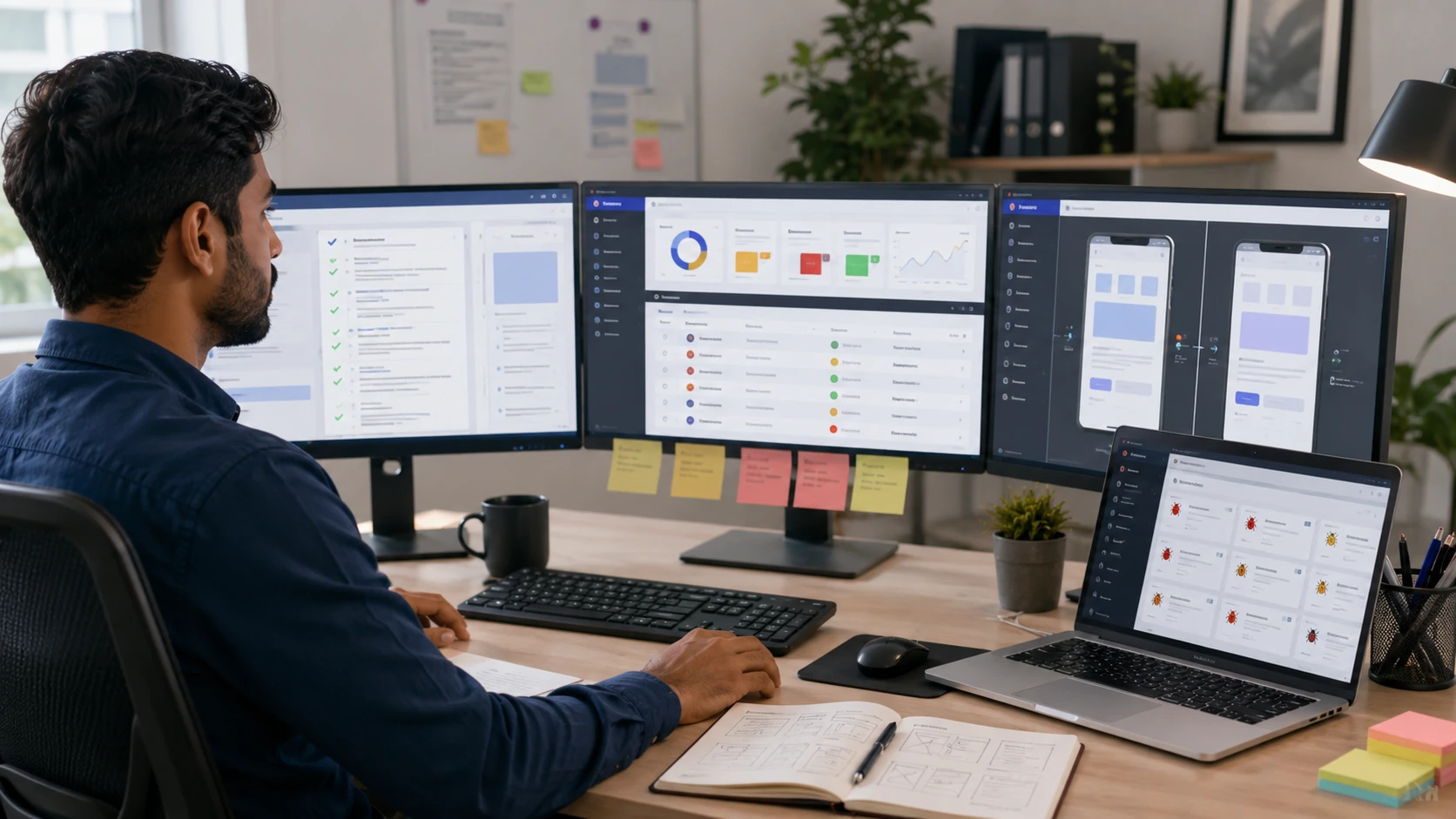
The main responsibilities of a software tester cover much more than running tests after development. In modern teams, testers often join early so they can spot unclear requirements, improve acceptance criteria, and prevent defects before code is written.
One of the first responsibilities is requirement analysis. A tester reads user stories, business rules, design files, and technical notes. They look for gaps. For example, a requirement may say, “Users can reset their password.” A tester will ask: What happens if the email address does not exist? How long is the reset link valid? Can the same link be used twice? What message appears after success?
This early questioning improves quality before testing begins.
Next comes test planning. The tester decides what needs to be tested, how deep the testing should go, which areas are risky, and what test data is needed. In smaller projects, this may be a simple checklist. In larger projects, it may involve test plans, test suites, environments, test cycles, and release criteria.
Another core duty is writing test cases. Test cases explain what to test, what data to use, what steps to follow, and what result to expect. Strong test cases help teams repeat important checks during regression testing.
Bug reporting is also central to the software tester role. A tester must report issues in a way that developers can understand and reproduce. A good bug report usually includes:
- Clear title
- Steps to reproduce
- Expected result
- Actual result
- Screenshots or screen recording
- Browser, device, app version, or environment
- Severity and priority
- Test data used
Testers also verify fixes. When a developer marks a bug as fixed, the tester checks the same scenario again. They may also test nearby areas because one fix can break another feature.
Other responsibilities may include API testing, database checks, usability feedback, accessibility checks, performance observations, automation script maintenance, release sign-off, and post-release smoke testing.
A strong tester does not ask, “Did I finish my assigned cases?” They ask, “What could still go wrong for the user?”
Daily Tasks of a Software Tester
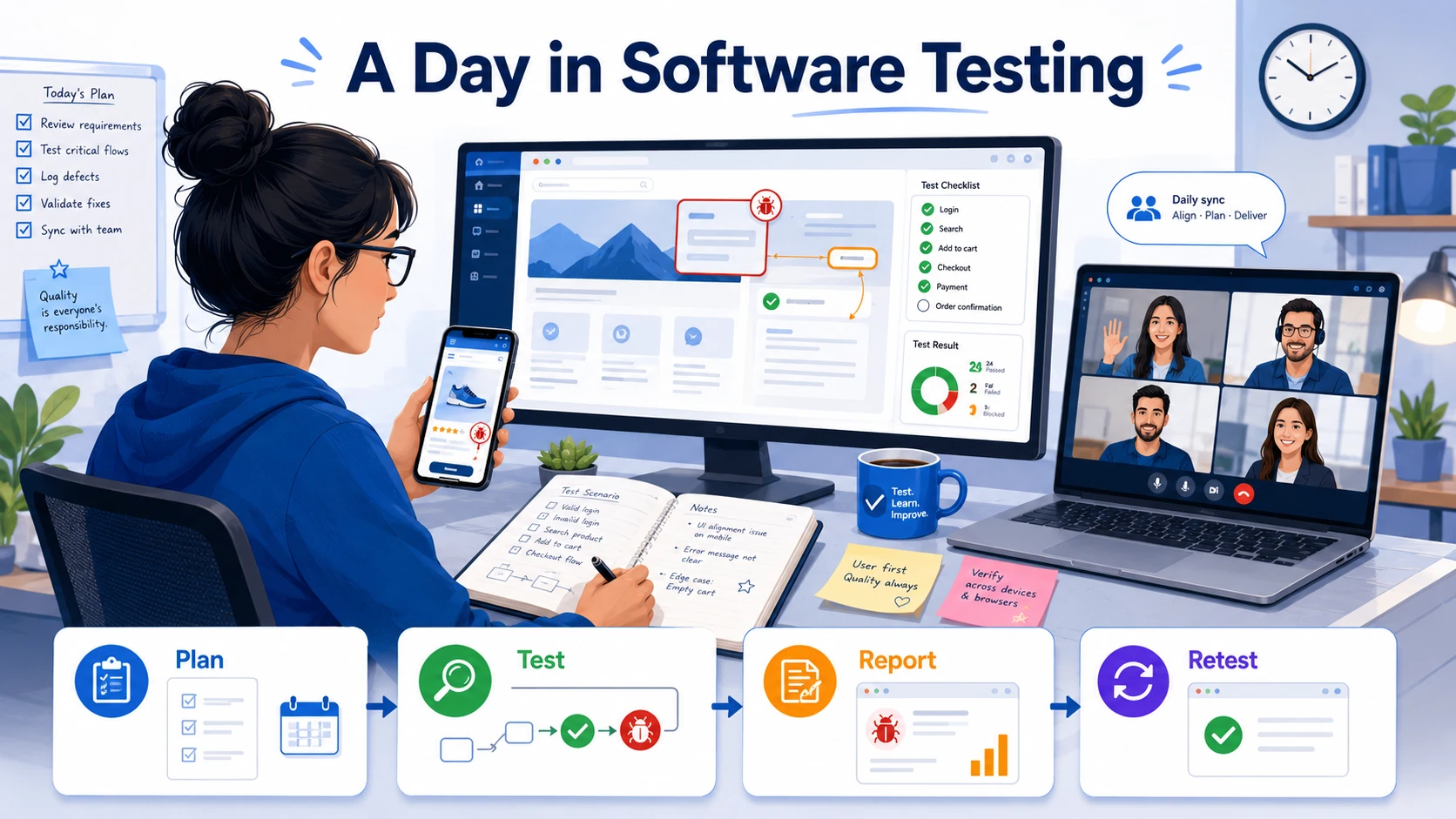
Daily software testing tasks depend on the company, product, project stage, and team size. Still, many testers follow a rhythm that combines meetings, analysis, test execution, bug reporting, retesting, and communication.
Your day may start with a stand-up meeting. In this short meeting, you share what you tested yesterday, what you plan to test today, and whether anything is blocked. For example, you may say that checkout testing is blocked because the payment gateway test account is not working.
After that, you may review a new user story. Suppose the team is adding a “save address” feature to an ecommerce app. You read the acceptance criteria and check whether the rules are clear. You might notice that the requirement explains how to add an address but not how to edit or delete one. You raised that question before the test started.
Then you write or update test cases. For the address feature, your test cases may cover:
- Add a valid home address
- Add a work address
- Leave required fields blank
- Enter an invalid postal code
- Edit an existing address
- Delete an address
- Set one address as the default
- Check the address display during checkout
Once the build is ready, you begin test execution. You follow planned cases, but also explore the features like a real user. You may find that the “default address” label appears in the profile page but not during checkout. That becomes a bug.
A practical bug report may look like this:
Title: Default address is not selected during checkout
Steps: Log in, add two addresses, mark one as default, add an item to the cart, and open checkout
Expected result: Default address should be selected
Actual result: No address is selected
Environment: Chrome, Windows 11, staging build 2.4.1
Severity: Medium
Later, you retest bugs fixed by developers. You also perform regression testing to confirm that older address, cart, and checkout features still work after the update.
A tester’s day may include documentation, test data setup, API checks, automation script review, defect triage, sprint planning, or release sign-off. The work is practical, detailed, and communication-heavy.
Manual Testing vs Automated Testing
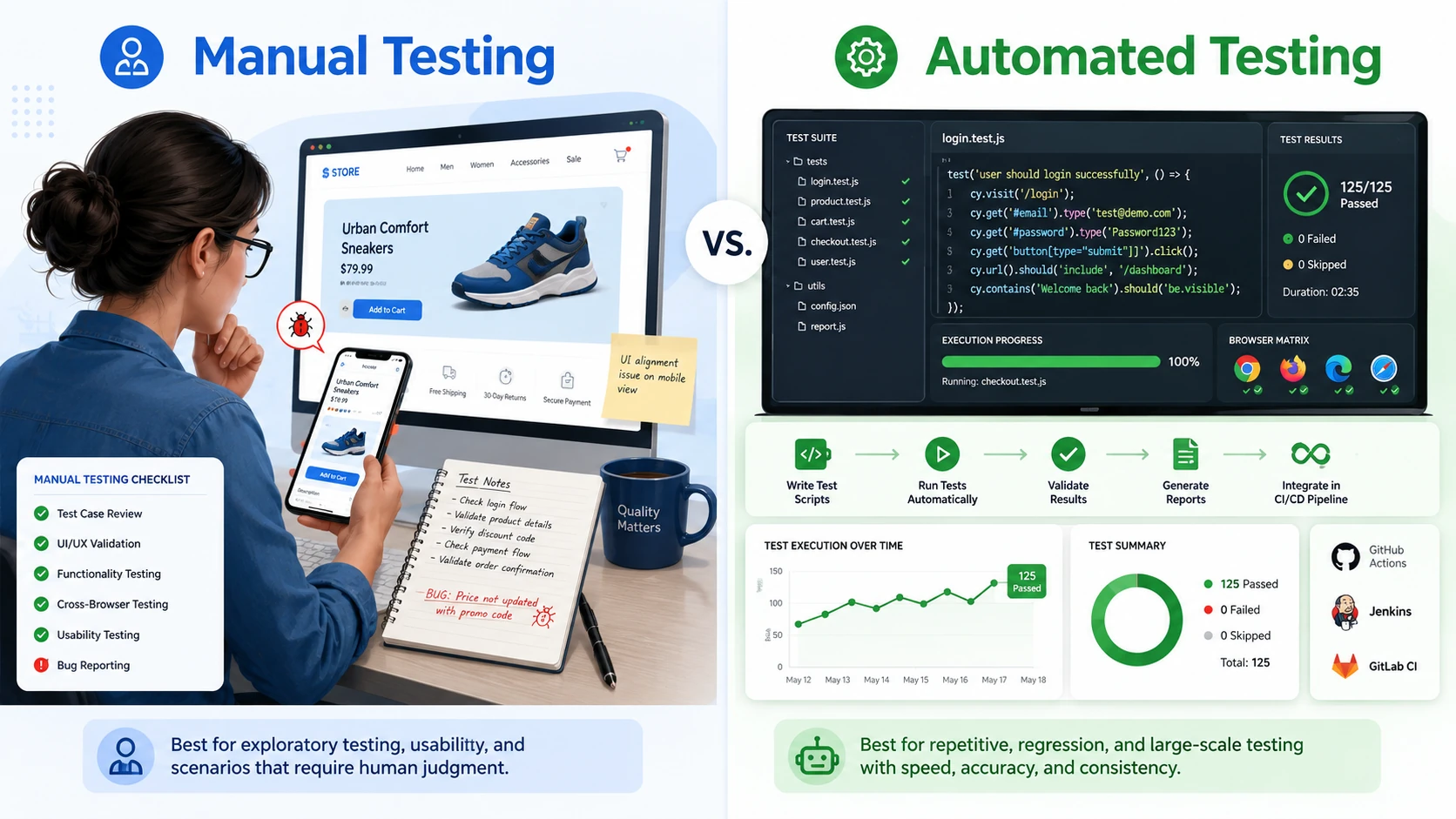
Manual testing and automated testing are both important. They solve different problems, and most real software teams use a mix of both.
Manual testing means a human tester checks the software by using it directly. You open the app, follow test steps, enter data, observe results, and judge whether the behavior makes sense. Manual testing is useful when features are new, requirements are changing, or human judgment matters.
For example, if your team redesigns a signup page, a manual tester can check layout, field behavior, error messages, mobile view, user confusion, and unexpected flows. A script can confirm that a button works, but a human can notice that the error message sounds unclear or the form feels awkward.
Automated testing uses scripts and tools to run checks without manual effort each time. Automated testing is useful for repeated checks, stable features, regression testing, and large test suites. For example, your team can automate login, search, cart, checkout, and account update flows so they run after every code change.
Selenium is a browser automation project often used for automating web application tests. Playwright is another modern tool used for reliable web automation and end-to-end testing across major browser engines.
Here is a simple comparison:
| Area | Manual Testing | Automated Testing |
|---|---|---|
| Best for | New features, exploratory testing, usability checks | Repeated checks, regression testing, stable workflows |
| Done by | Human tester | Scripts written by a tester or a developer |
| Speed | Slower for repeated tasks | Faster after setup |
| Cost | Lower setup cost | Higher setup effort, lower repeat cost |
| Flexibility | High when requirements change | Lower if scripts need frequent updates |
| Human judgment | Strong | Limited |
| Example | Testing a new checkout design | Running login tests after each build |
A common mistake is thinking that automated testing replaces manual testing. It does not. Automation checks what you tell it to check. Manual testing helps you discover what you did not expect.
For beginners, manual testing is often the best starting point. Once you understand test design, bug reporting, and product behavior, automated testing becomes easier to learn.
Types of Testing Software Testers Perform
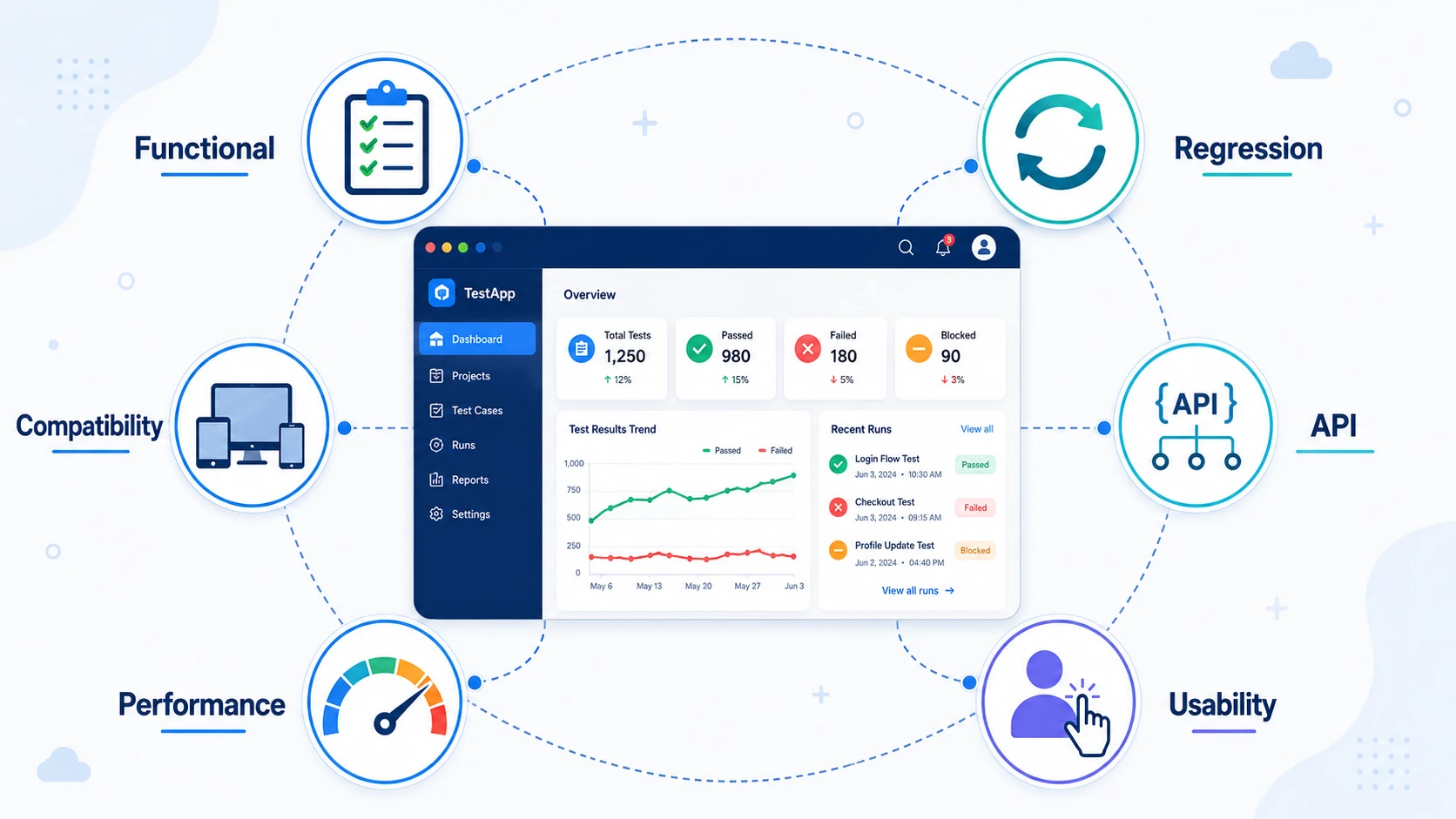
Software testers perform different types of testing depending on the project. You do not need to master every type on day one, but you should understand the common ones.
Functional Testing
Functional testing checks whether a feature works according to requirements. If a login page should allow valid users to sign in, functional testing verifies that behavior. It also checks invalid passwords, blank fields, locked accounts, and error messages.
This is one of the most common software testing tasks for a QA tester.
Regression Testing
Regression testing checks whether new changes broke existing features. For example, after developers update the payment page, testers may recheck the cart, coupons, taxes, address selection, order confirmation, and email notifications.
Regression testing matters because software is connected. A small change in one area can create a bug somewhere else.
Smoke Testing
Smoke testing is a quick check to see whether the main features work well enough for deeper testing. If the app cannot open, login fails, or the main page crashes, the build may be rejected before full testing starts.
Exploratory Testing
Exploratory testing means you test while learning the product. You do not only follow fixed test cases. You investigate, try unusual flows, and think like a curious user.
For example, you may add 100 items to a cart, use special characters in a name field, switch tabs during payment, or refresh the page after submitting a form.
API Testing
API testing checks how systems communicate behind the scenes. A tester may send requests to an API and verify status codes, response data, error handling, authentication, and business rules.
Usability Testing
Usability testing checks whether the software is easy to use. A feature can work from a technical point of view, but still confuse users. Testers may report unclear labels, poor error messages, missing guidance, or unnecessary steps.
Performance Testing
Performance testing checks how software behaves under load. This may include page speed, response time, server behavior, or system stability when many users act at once.
Compatibility Testing
Compatibility testing checks whether software works across browsers, devices, operating systems, and screen sizes. This is important for public websites, mobile apps, and customer-facing platforms.
Together, these testing types help teams look at quality from several angles: function, reliability, speed, usability, compatibility, and risk.
Tools Software Testers Use
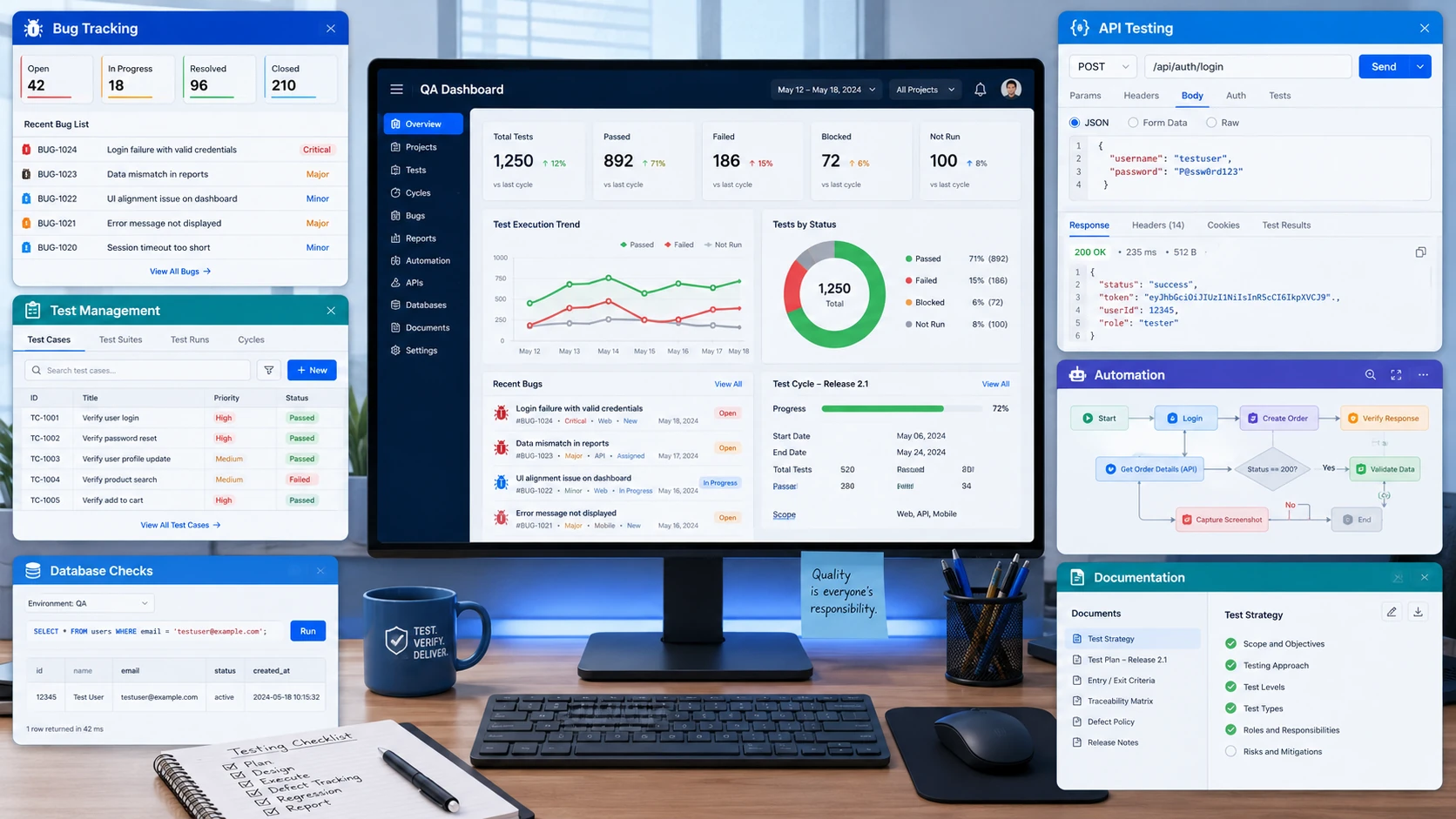
Software testing tools help testers manage test cases, report bugs, automate checks, test APIs, inspect data, and communicate with teams. The exact toolset depends on the company.
For test management, teams may use tools such as TestRail, Zephyr, Xray, PractiTest, or Qase. These tools help you organize test cases, group them into test suites, record pass or fail results, and track coverage.
For bug tracking, many teams use Jira, Azure DevOps, GitHub Issues, Linear, or ClickUp. A bug tracking tool stores defect reports and helps teams discuss severity, priority, ownership, and status.
For API testing, testers often use Postman, Insomnia, Swagger UI, or built-in API clients. These tools help you send requests, inspect responses, test authentication, and confirm that backend services return the right data.
For automated testing, common software testing tools include Selenium, Playwright, Cypress, WebdriverIO, Appium, JUnit, TestNG, Pytest, and Cucumber. Selenium supports browser automation for web testing, while Playwright supports end-to-end testing and browser automation across Chromium, Firefox, and WebKit.
For database checks, testers may use SQL tools such as MySQL Workbench, pgAdmin, DBeaver, or SQL Server Management Studio. You do not always need deep database knowledge, but basic SQL can help you verify records, user accounts, order details, and logs.
For communication and documentation, testers may use Slack, Microsoft Teams, Confluence, Notion, Google Docs, or Loom. Clear communication is part of testing because a defect that no one understands will not get fixed fast.
Here is how tools fit into daily work:
- Test case management: TestRail, Zephyr, Xray, Qase
- Bug reporting: Jira, Azure DevOps, GitHub Issues
- API testing: Postman, Insomnia, Swagger UI
- Automation: Selenium, Playwright, Cypress, Appium
- Database checks: DBeaver, pgAdmin, MySQL Workbench
- Documentation: Confluence, Notion, Google Docs
- Screen capture: Loom, Snagit, browser recording tools
Tools matter, but they do not replace testing judgment. A skilled tester can find important bugs with a browser, clear thinking, and good questions. Tools help you work faster and document better.
Key Skills Software Testers Need
To become a software tester, you need a mix of analytical, communication, technical, and product skills. You do not need to be a coding expert at the start, but you do need curiosity and discipline.
The first skill is attention to detail. Testers notice small mismatches: a wrong calculation, a missing validation message, a broken link, a date format issue, or a button that works on desktop but not on mobile.
The second skill is logical thinking. You need to break a feature into conditions, steps, inputs, and outcomes. For example, a discount rule may depend on user type, cart value, product category, coupon expiry, and region. A tester turns those rules into clear test cases.
Communication is equally important. You must explain bugs in a way that helps developers reproduce and fix them. You also need to ask product managers clear questions when requirements are missing.
A good QA tester also needs user empathy. You should care about how the product feels to a real user. Does the error message help? Is the form too long? Can someone recover after making a mistake?
Technical skills become more important as your career grows. Useful technical skills include:
- Basic understanding of web and mobile apps
- HTML, CSS, and browser developer tools
- HTTP methods, status codes, and APIs
- SQL basics
- Test data creation
- Git basics
- Scripting with JavaScript, Python, Java, or TypeScript
- Automation framework basics
- CI/CD awareness
You also need patience. Testing can involve repeating flows, checking fixes, documenting details, and investigating bugs that do not appear every time.
For beginners, these are the most useful skills to learn first:
- Write clear test cases.
- Report bugs with strong evidence.
- Understand functional testing and regression testing.
- Learn basic API testing with Postman.
- Learn basic SQL.
- Practice exploratory testing.
- Understand agile workflows.
- Start automation after you understand manual testing.
Software testing is not only about finding bugs. It is about asking better questions, reducing risk, and helping the team make informed release decisions.
Software Tester vs Developer vs QA Engineer
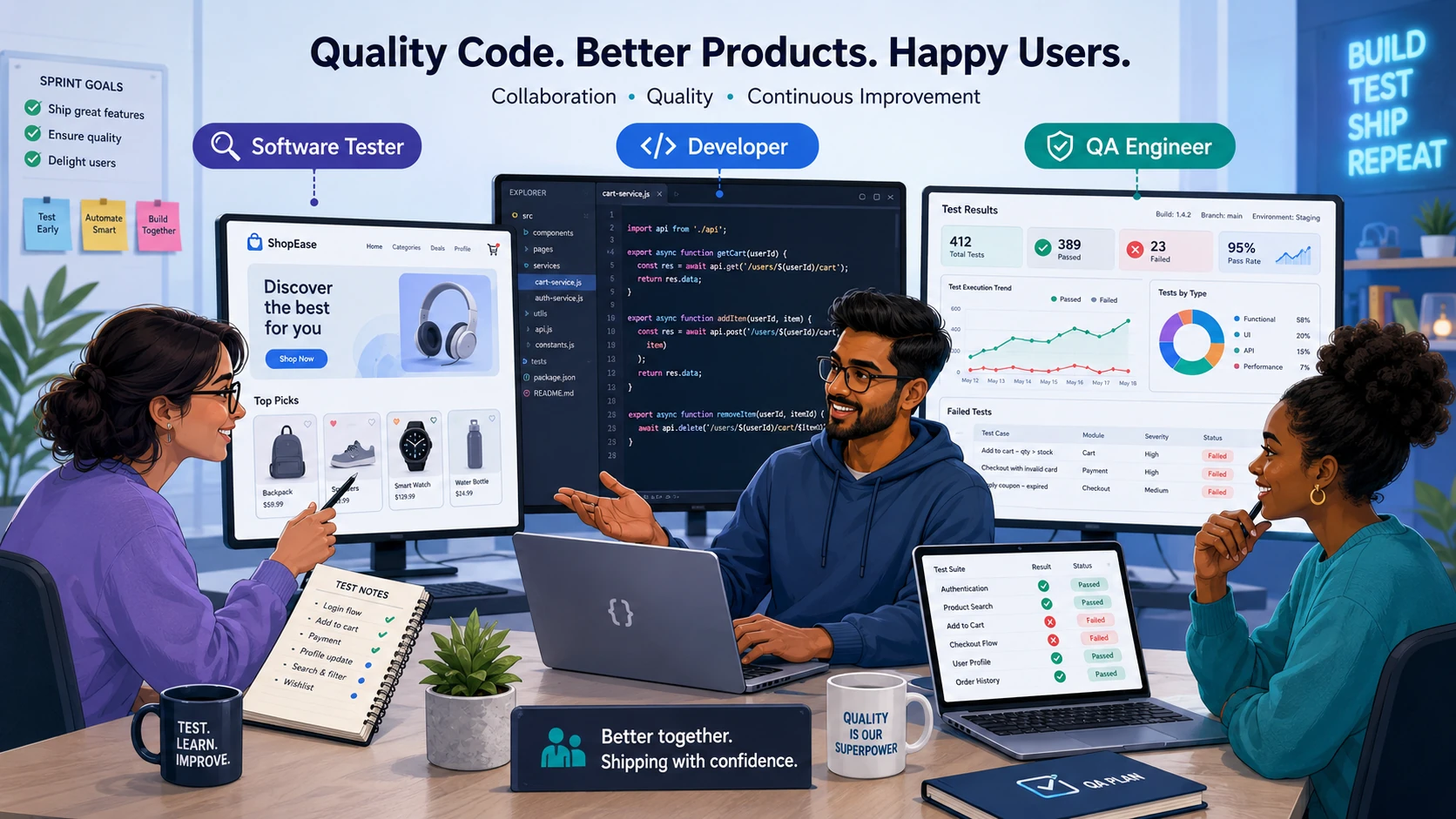
Software testers, developers, and QA engineers often work together, but their focus is different.
A developer builds the software. They write code, implement features, fix bugs, review code, and improve technical architecture. Developers also test their own work through unit tests, local checks, and code reviews.
A software tester checks the software from a quality and user perspective. They design test scenarios, run tests, report defects, verify fixes, and check whether the product meets requirements.
A QA engineer may do everything a software tester does, but the title often suggests a broader or more technical role. In some companies, QA engineers write automation scripts, improve testing processes, set up test environments, review CI/CD pipelines, and help define quality standards.
The job titles are not always consistent. One company may call the role “QA tester.” Another may use “software tester,” “test engineer,” “QA analyst,” “SDET,” or “quality engineer.” You should read the job description, not only the title.
Here is a practical breakdown:
- Software tester: Focuses on test cases, manual testing, bug reporting, regression testing, and product checks.
- QA tester: Often similarto a software tester, with a focus on quality assurance activities.
- QA engineer: May include manual testing, automation, process improvement, and technical testing.
- SDET: Usually writes code to build test automation frameworks and tools.
- Developer: Builds product features and fixes code-level defects.
The best teams do not treat quality as one person’s job. ISTQB notes that software testing should involve everyone in the software development process, not only full-time testers.
Still, dedicated testers add value because they bring a different mindset. Developers often know how the feature was built. Testers focus on how the feature might fail.
That difference is useful. A developer may check the happy path. A tester will check the happy path, the wrong path, the strange path, and the path nobody mentioned in the requirement.
How Software Testers Work With Developers
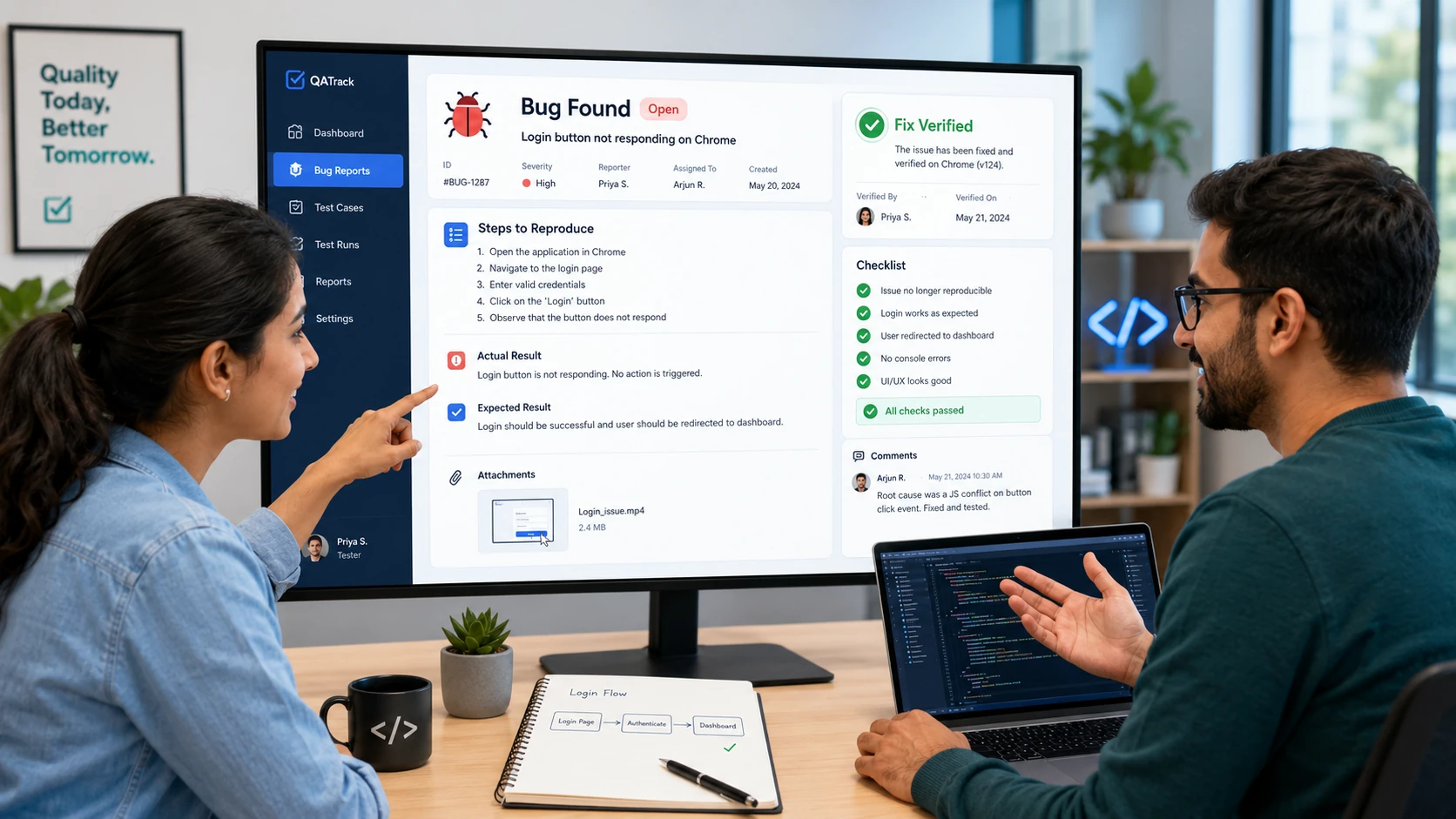
Software testers and developers work together throughout the software development life cycle. The relationship works best when both sides see testing as collaboration, not criticism.
Before development begins, testers may review requirements with developers and product managers. This helps the team catch unclear logic early. For example, if a user story says, “The user can upload a profile photo,” the tester may ask about file size, file type, image dimensions, error messages, and default photos. These questions help developers build the feature with fewer gaps.
During development, testers may clarify expected behavior, prepare test data, create test cases, and review design changes. In agile teams, testers often work one or two steps ahead so they are ready when the build is available.
After a feature is built, the tester runs planned test cases and exploratory checks. When a bug appears, the tester reports it with details. A strong bug report avoids blame and focuses on facts.
For example, instead of writing:
“The checkout is broken.”
A tester writes:
“Checkout fails when a user applies coupon SAVE10 and pays with a saved Visa card. The page shows a blank error message after clicking Pay Now. Expected result: order confirmation should appear, or a clear payment failure message should display.”
That level of detail saves developer time.
Developers may ask testers to confirm whether a bug is reproducible, whether it happens in production, whether it affects all users, or whether it appears only in one browser. Testers investigate and update the report.
Once the developer fixes the issue, the tester retests it. If the fix works, the tester closes the bug. If not, they reopen it with new evidence. The tester may also perform regression testing around nearby features.
Healthy tester-developer collaboration depends on trust. Testers should avoid vague reports. Developers should avoid dismissing user-facing defects too quickly. Both should care about the same outcome: reliable software that serves users well.
Software Tester Career Path
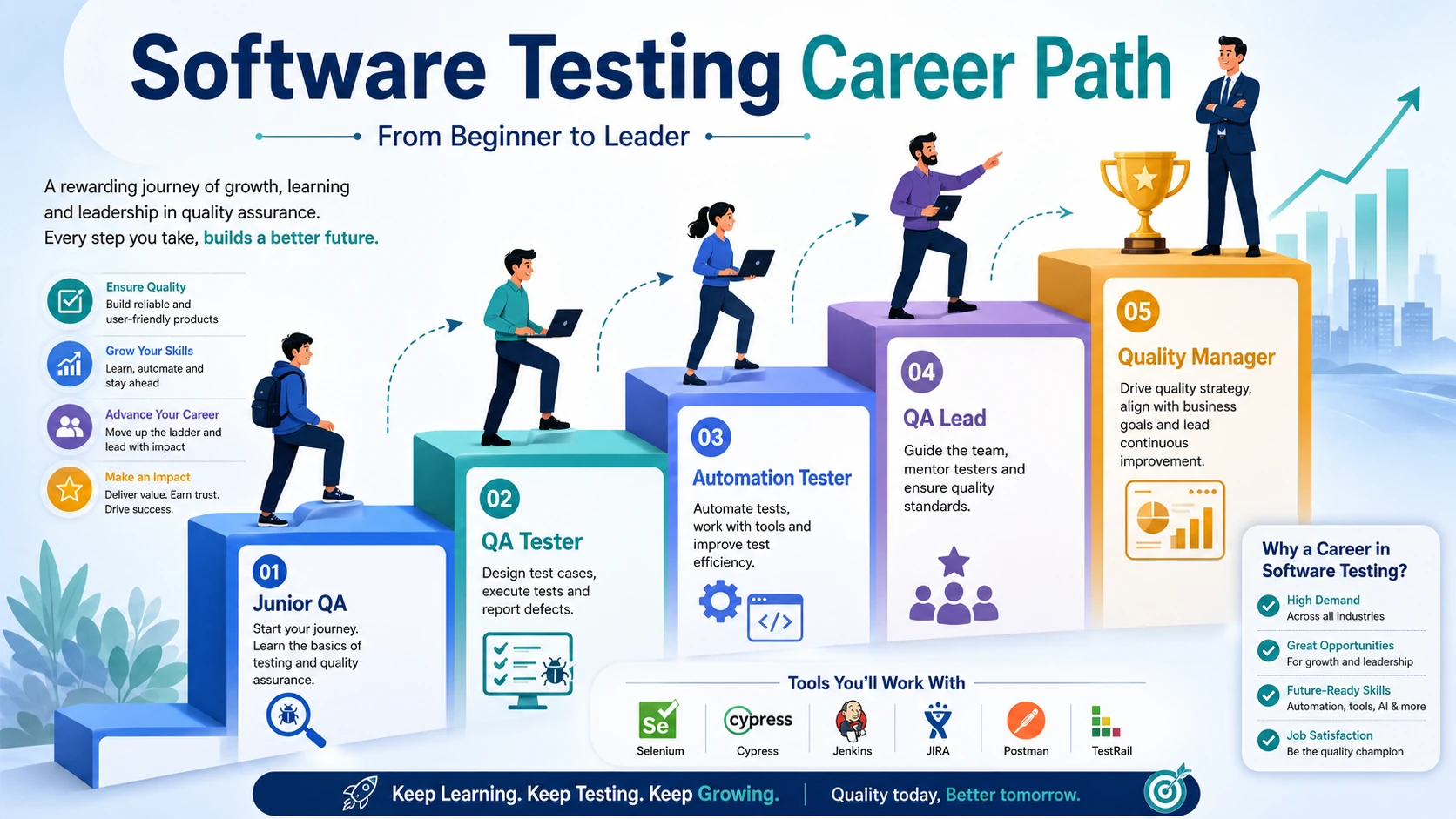
A software testing career can start with manual testing and grow into several paths. You can stay close to product quality, move into automation, specialize in technical testing, or become a QA leader.
A common beginner path looks like this:
Junior QA Tester or Junior Software Tester
You learn test cases, manual testing, bug reporting, regression testing, agile basics, and software testing tools. You work under guidance and test smaller features.
QA Tester or Software Test Analyst
You handle full features, write stronger test scenarios, join requirement reviews, report defects with better detail, and manage test execution for releases.
Senior QA Tester or Senior QA Engineer
You test complex systems, mentor junior testers, improve test strategy, review risks, coordinate with developers, and guide release quality.
Automation Tester or Test Automation Engineer
You write automated tests using tools such as Selenium, Playwright, Cypress, Appium, JavaScript, Python, Java, or TypeScript. You maintain test scripts and connect tests to CI/CD pipelines.
SDET or Software Development Engineer in Test
You focus on code-heavy testing work. You may build test frameworks, create internal tools, test APIs, improve automation architecture, and support developer testing.
QA Lead or Test Manager
You manage testing scope, people, timelines, test strategy, quality metrics, release risks, and stakeholder communication.
Quality Engineering Manager or Head of QA
You shape quality practices across teams, improve processes, hire testers, define standards, and align testing with business goals.
Some testers move into related roles such as product manager, business analyst, scrum master, DevOps engineer, security tester, performance engineer, or developer.
The career path is flexible because testing teaches you how software works from the user side and the delivery side. You learn requirements, defects, releases, team communication, and product risk. Those skills transfer well across tech roles.
The BLS groups software quality assurance analysts and testers with software developers and reports that software quality assurance analysts and testers had a median annual wage of $102,610 in May 2024 in the United States. Salary varies by country, experience, industry, and technical skill level.
Is Software Testing a Good Career?
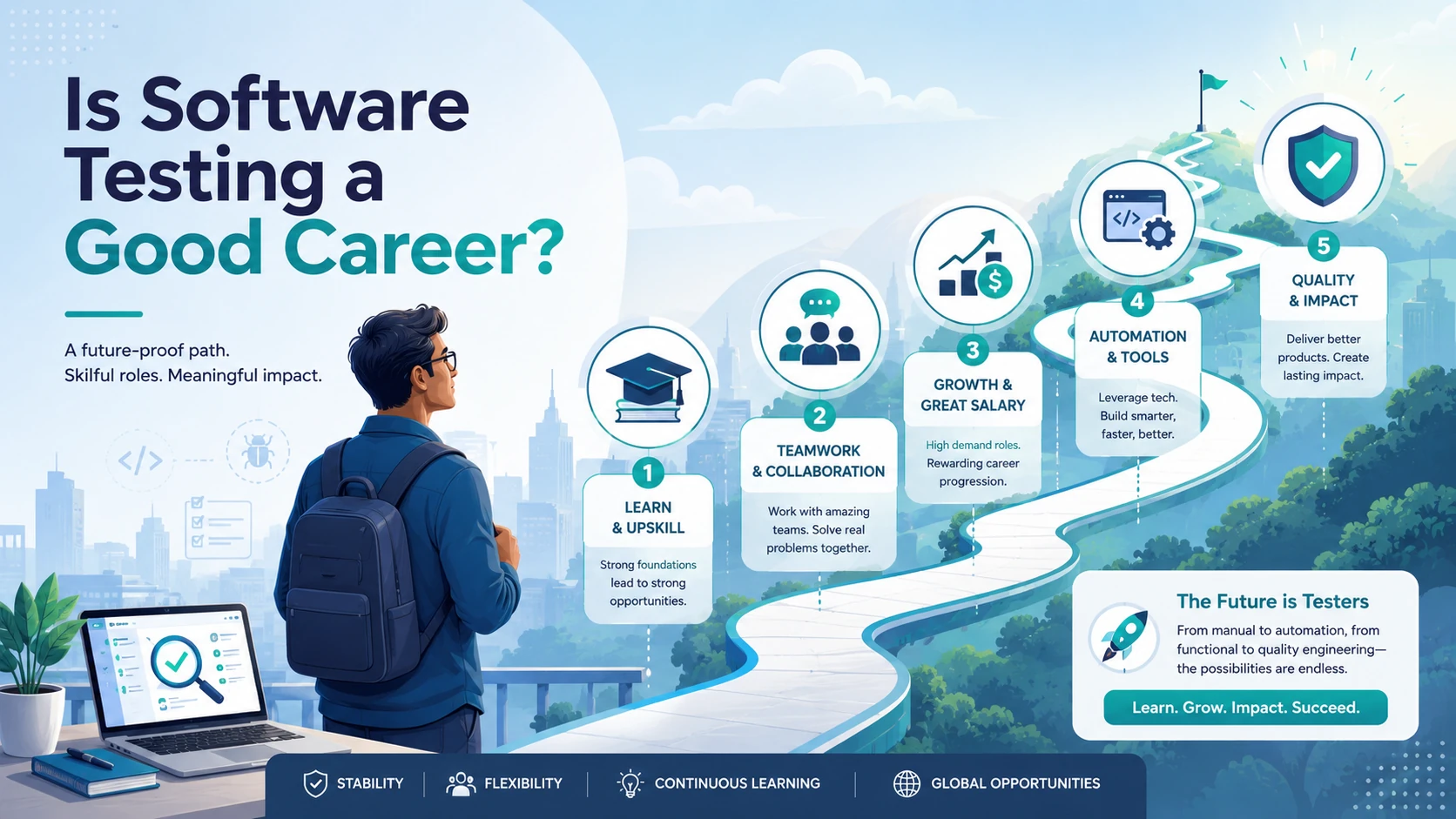
Software testing can be a good career if you enjoy problem-solving, product thinking, communication, and continuous learning. It is a practical entry point into tech, but it is not an “easy job” in the way many people assume.
The good part is that you can begin with manual testing skills and grow step by step. You do not need to start as an expert programmer. You can learn requirements analysis, test cases, bug reporting, functional testing, regression testing, and API basics first. Then you can add automation, SQL, scripting, performance testing, security basics, or cloud tools.
Software testing is also satisfying because your work has a clear impact. You find bugs that could frustrate users. You improve flows that could block revenue. You help teams avoid rushed releases. You protect the product from avoidable mistakes.
For students and career switchers, testing offers a structured learning path. You can practice on real websites, write test cases, report sample bugs, use Jira-style templates, test APIs in Postman, and build a portfolio. That makes the career more approachable than some roles that require years of coding before you can show practical work.
But there are challenges.
Testing can become repetitive if you only run the same manual checks every day. Some teams bring testers too late into the project, which creates pressure near release dates. In weak company cultures, testers may be blamed for bugs they did not create or ignored when they raised risks. Automation also changes expectations. Many companies now prefer testers who can learn technical tools and contribute beyond manual testing.
Pros of software testing as a career:
- Beginner-friendly entry into tech
- Strong demand across software teams
- Clear path into automation and QA engineering
- Good mix of technical and communication work
- Useful experience for product and business roles
- Direct impact on user experience
Cons of software testing as a career:
- Repetitive work in poorly managed teams
- Release pressure near deadlines
- Need to keep learning tools and technology
- Misunderstood role in some companies
- Manual-only roles may offer slower growth
Software testing is a good career when you treat it as a craft. Learn the basics well, build technical depth over time, and focus on business value, not only finding defects.
Common Myths About Software Testers
Software testing has many myths. These myths make the role look smaller than it is and can confuse beginners, hiring managers, and software teams.
Myth 1: Software testers only click buttons
Clicking is part of testing, but it is not the job. A tester studies requirements, designs test cases, checks data, investigates defects, performs regression testing, writes reports, and communicates risks. The visible action may be clicking, but the real work is thinking.
Myth 2: Testers are responsible for product quality alone
Quality belongs to the whole team. Developers, testers, designers, product managers, business owners, and support teams all affect quality. Testers help reveal risks, but they do not create every requirement, design every flow, or write every line of code.
Myth 3: Manual testing is outdated
Manual testing is still valuable. New features, changing requirements, usability checks, exploratory testing, and visual review often need human judgment. Automated testing is powerful, but it cannot replace human investigation.
Myth 4: Automated testing finds every bug
Automation checks known scenarios. It is excellent for repeated checks, but it does not think like a user unless a human designs strong tests. Poor automated tests can pass while serious user problems remain.
Myth 5: You do not need technical skills to be a tester
You can start without deep coding knowledge, but technical skills help you grow. API testing, SQL, browser developer tools, logs, automation, and CI/CD knowledge make you more useful to modern teams.
Myth 6: Testing happens only at the end
Old teams often tested near the end. Modern teams involve testers earlier. Testers review requirements, ask questions, prepare test data, help define acceptance criteria, and reduce defects before development finishes.
Myth 7: Testers and developers are opponents
Good testers and developers are partners. Testers do not find bugs to embarrass developers. They find risks so the team can fix them before users suffer.
Understanding these myths helps you see the real value of the software tester role. Testing is not a backup task. It is a key part of building software that people can trust.
Final Thoughts
So, what do software testers do?
Software testers help teams understand whether software works, where it fails, and what risks remain before release. They review requirements, create test cases, perform manual testing, support automated testing, report bugs, verify fixes, run regression testing, and communicate quality concerns.
The best testers are not random bug hunters. They are structured thinkers who understand users, business rules, product behavior, and technical limits. They know when to follow test cases and when to explore. They know how to write bug reports that developers can act on. They know how to protect user trust without slowing the team for no reason.
For beginners, the path starts with the basics: functional testing, test cases, bug reporting, regression testing, and clear communication. From there, you can grow into API testing, automation, performance testing, security testing, QA engineering, or leadership.
For software teams and business owners, the lesson is simple: involve testers early. A tester who joins only at the end can find problems. A tester who joins at the start can help prevent them.
Software testing is a practical, valuable, and flexible career. It rewards curiosity, patience, clear thinking, and the courage to ask, “What happens if this does not work?”
Frequently Asked Questions
Software testers review requirements, write test cases, run manual testing, check new features, perform regression testing, report bugs, retest fixes, attend team meetings, and communicate release risks. Daily work depends on the product, but the main goal is to help the team release reliable software.
Developers mainly build software, while testers focus on checking software from a user, business, and risk perspective. Testers try different inputs, edge cases, broken flows, and regression scenarios. Developers also test their code, but testers bring independent quality thinking.
Not always at the beginner level. Many QA tester roles start with manual testing, test cases, bug reporting, and functional testing. Coding becomes more useful as you move into automated testing, SDET roles, API testing, and advanced QA engineering.
Manual testing is a strong starting point, but it may not be enough for long-term growth. You should also learn API testing, SQL basics, browser developer tools, agile workflows, and at least one automation tool such as Selenium, Playwright, or Cypress.
In automated testing, software testers write or maintain scripts that check repeated workflows such as login, search, checkout, and account updates. They choose scenarios, prepare test data, review failures, update scripts, and use automation to support faster regression testing.