

 Post by
 When a business decides to build or upgrade software, one of the first questions that surfaces is whether to start from scratch or work with what already exists. These two paths have names in the software industry: greenfield and brownfield development. Understanding the real differences between them, and knowing which one suits your specific situation, can be the difference between a smooth product launch and a costly, drawn-out engineering challenge.
What Greenfield Software Development Actually Means
The term “greenfield” comes from construction and urban planning, where it describes building on land that has never been developed before. In software, the meaning translates cleanly: a greenfield project is one where development starts on a completely blank slate, with no existing codebase, no legacy systems to work around, and no inherited technical decisions to accommodate.
A startup building its first SaaS product is a classic greenfield scenario. So is an established company that decides to retire an old system entirely and commission a brand-new replacement built from the ground up. In both cases, the engineering team gets to make every architectural decision fresh, choosing the tech stack, database structure, API design, and infrastructure without being constrained by choices made years ago.
This creative freedom is one of the most appealing aspects of greenfield work. Developers can adopt modern frameworks, apply current best practices in security and scalability, and design the system with the actual product requirements in mind rather than retrofitting solutions around old code. There is no existing technical debt inherited on day one.
However, greenfield development comes with its own set of pressures. Because nothing exists yet, every decision carries weight. Architectural mistakes made early in a greenfield project can compound quickly, becoming expensive to fix once the codebase grows. Teams also face the challenge of building foundational infrastructure, authentication systems, data models, and core workflows before they can deliver any visible product features. This makes the early phases of greenfield projects feel slow, even when the team is working hard.
For businesses, greenfield development typically requires a larger upfront investment and a longer runway before the product reaches users. The payoff, when the project is well-managed, is a clean, maintainable system that is easier to scale and extend over time.
What Brownfield Software Development Actually Means
Brownfield development is the opposite scenario. The term refers to working within or alongside an existing system, whether that means adding new features to a live application, modernizing legacy code, integrating new components into an established architecture, or gradually replacing parts of an older system while keeping it operational.
Most software work in the real world is brownfield work. When a company hires a development team to add a new payment flow to their existing web app, migrate their monolithic backend toward microservices, or refactor a WordPress site to improve performance, that is brownfield territory. The existing code, database schema, and system architecture are facts on the ground that the team must understand and respect.
Brownfield projects carry the weight of history. Every system accumulates technical decisions over time, some good, some made under deadline pressure, some simply outdated by the time a new team arrives. These inherited constraints shape what is possible, how fast work can move, and what risks need to be managed. Legacy dependencies, undocumented logic, tightly coupled modules, and inconsistent coding patterns are all common features of brownfield environments.
That said, brownfield work also offers real advantages. An existing system already has users, real-world data, and proven business logic baked in. Rather than speculating about how users will behave, the team can observe actual usage patterns and make targeted improvements. There is also less upfront investment required compared to rebuilding from scratch, and businesses can see incremental improvements delivered continuously rather than waiting for a full rebuild to complete.
The core skill in brownfield development is understanding what is already there before changing anything. Rushing into modifications without mapping the existing system is one of the most common causes of regressions and outages in legacy modernization projects.
Greenfield vs Brownfield: A Direct Comparison
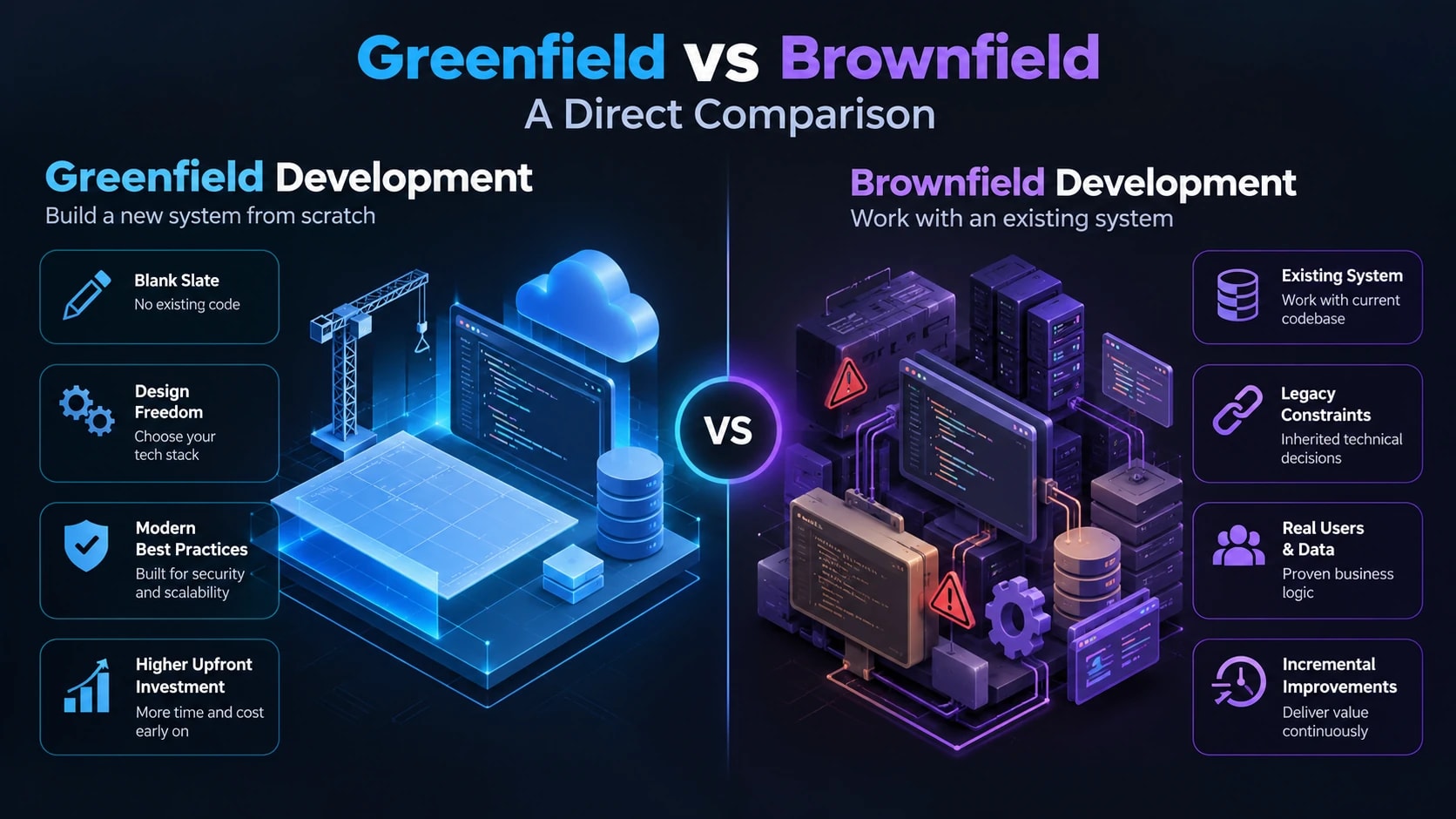
Putting these two approaches side by side reveals the practical trade-offs that engineering teams and business stakeholders need to weigh before committing to a direction.
Starting Conditions
Greenfield projects begin with full design freedom and zero inherited constraints. Brownfield projects begin with an existing system that defines the boundaries of what can be changed and at what pace.
Speed to First Delivery
Brownfield work often delivers value faster in the short term because it builds on top of infrastructure that already exists. Greenfield projects require foundational work before any user-facing feature can ship, which pushes the first delivery further out.
Technical Risk Profile
Greenfield carries the risk of early architectural mistakes that can be difficult to reverse once the system grows. Brownfield carries the risk of unexpected interactions with legacy code, hidden dependencies, and the possibility that changes in one part of the system break something unrelated elsewhere.
Cost and Investment
Greenfield development generally demands a higher upfront budget and longer timeline before return on investment becomes visible. Brownfield work tends to be more budget-predictable in the short term, though ongoing maintenance of legacy systems can accumulate significant cost over time highng problems are not addressed.
Team Experience Required
Both approaches need strong engineers, but brownfield projects specifically require developers who are comfortable reading unfamiliar code, tracing system behavior without full documentation, and making careful changes in environments where mistakes have immediate consequences for live users.
Long-Term Maintainability
A well-executed greenfield project, built with scalability and maintainability in mind, typically produces a cleaner system that is easier to extend over time. Brownfield projects that layer improvements onto legacy foundations can gradually improve the codebase, but they may also accumulate new technical debt alongside the old unless the team is disciplined about refactoring as they go.
Neither approach is universally better. The right choice depends on the current state of the system, the business timeline, the available budget, and the strategic goals behind the project. The next sections explore how to identify which path is the right one for a given situation, and what each approach looks like in practice across common software projects.
How to Decide Which Approach Fits Your Project
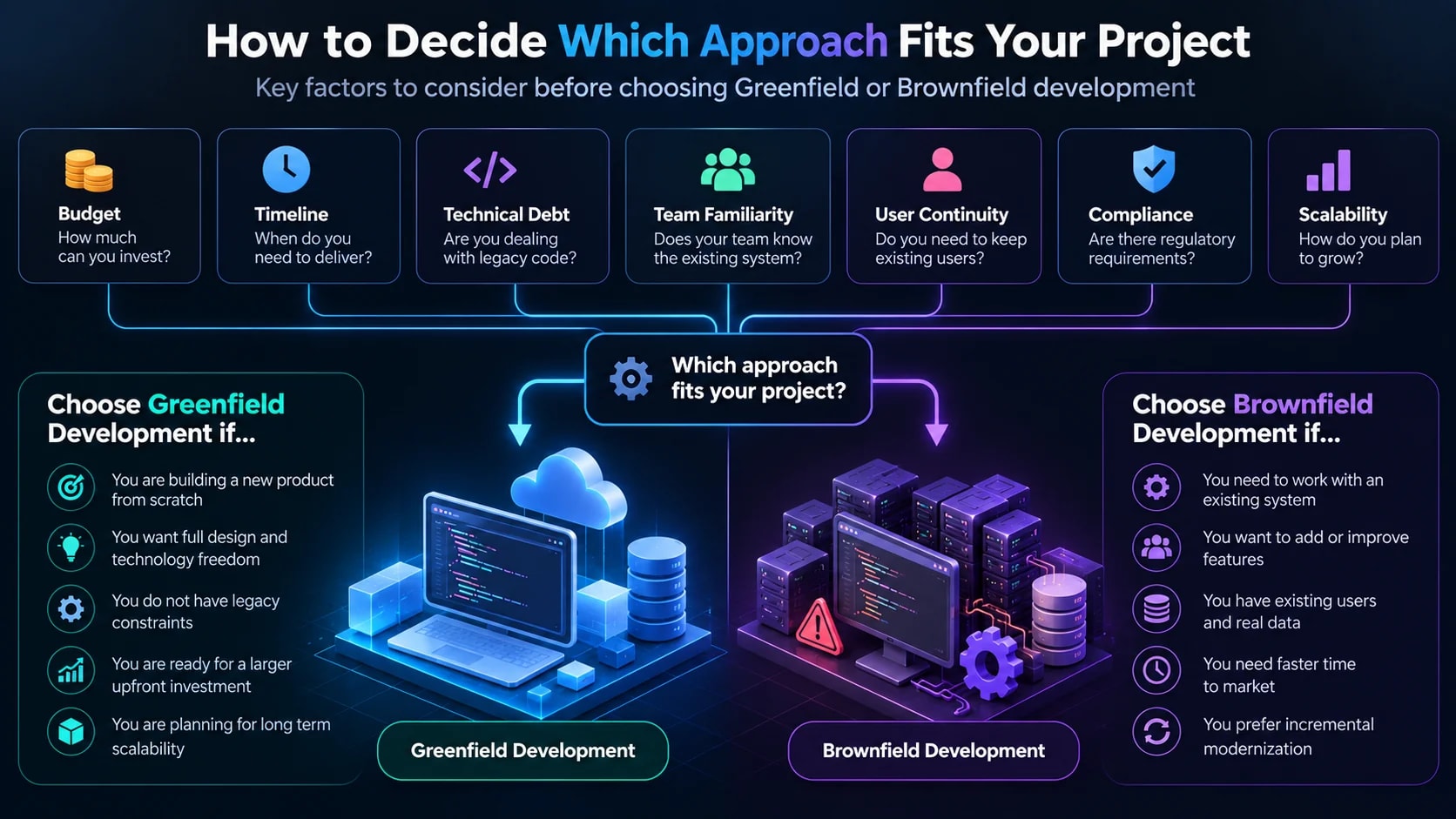
Choosing between greenfield and brownfield development is rarely a simple yes or no decision. It depends on your budget, timeline, technical debt load, team capacity, and business goals. Asking the right questions upfront saves you from costly pivots later.
Start by auditing what you already have. If you have a working product with real users and revenue, discarding it entirely is almost never the right call. Rarely does starting fresh with no legacy constraints, greenfield, give you the freedom to build the right foundation from the start.
Here are the key factors to weigh before committing to either path:
- Budget and timeline: Greenfield projects require more upfront investment and longer delivery timelines. Brownfield work can deliver value incrementally at a lower initial cost.
- Technical debt severity: If your existing codebase is so unstable that adding a feature breaks three others, greenfield or a full rewrite may be justified. If debt is manageable, brownfield modernization is usually faster.
- Team familiarity: A team that knows the existing system inside out can modernize it more efficiently than rebuilding from scratch. New teams unfamiliar with legacy code often favor greenfield, but that comes with its own learning curve.
- User continuity: Brownfield work allows existing users to keep operating with minimal disruption. Greenfield migrations require careful cutover planning to avoid losing users or data.
- Regulatory and compliance constraints: Some industries require you to maintain audit trails or data in existing systems, making full greenfield replacement legally complex.
- Scalability ceiling: If your current architecture physically cannot scale to meet demand, brownfield patches become band-aids. A greenfield rebuild may be the only long-term option.
| Decision Factor | Choose Greenfield | Choose Brownfield |
|---|---|---|
| Existing product | None or prototype only | Live users and active data |
| Technical debt | Codebase is beyond repair | Debt is isolated and manageable |
| Budget | Higher upfront spend is feasible | Incremental spend is preferred |
| Time to market | Longer runway is acceptable | Fast delivery is critical |
| User disruption tolerance | Migration window is possible | Zero downtime is required |
| Scalability needs | Current system cannot scale | Current system can be extended |
Common Mistakes Teams Make with Both Approaches
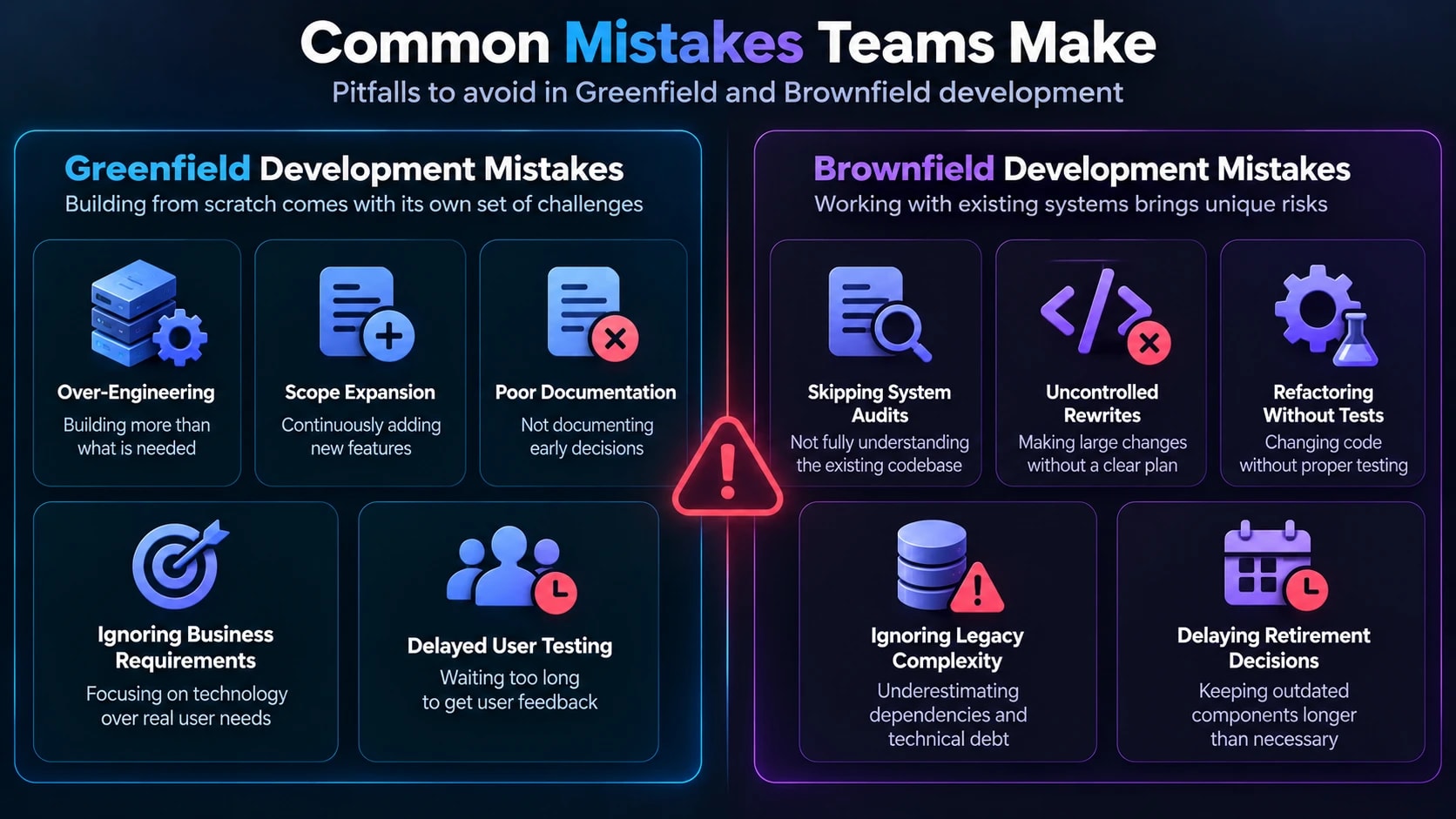
Even experienced development teams fall into predictable traps when working on either type of project. Knowing these pitfalls in advance helps you avoid expensive rework and missed deadlines.
Mistakes in Greenfield Projects
- Over-engineering from day one: Building a microservices architecture for a product with ten users is wasteful. Start simple, then scale as actual demand emerges.
- Ignoring business logic from existing systems: If you are replacing a legacy product, that old system contains years of encoded business rules. Skipping the discovery phase means rebuilding them from scratch after launch, when users start complaining.
- Underestimating scope: Greenfield projects consistently take longer than initial estimates. Without legacy constraints, teams often expand scope mid-build, leading to ballooning timelines.
- Skipping documentation: Because everything feels fresh and obvious to the team building it, documentation gets deprioritized. This becomes a serious problem when team members change six months later.
- Delaying user testing: Building in isolation without user feedback until launch is a classic startup mistake. Ship early, gather feedback, and iterate.
Mistakes in Brownfield Projects
- Skipping a proper audit: Jumping into modernization without mapping out dependencies first leads to broken integrations and unexpected downtime.
- Treating it like a greenfield rewrite mid-project: Teams sometimes start a brownfield upgrade and gradually replace so much that it becomes an undeclared full rebuild, with none of the planning that should accompany one.
- Not writing tests before refactoring: Modifying legacy code without a test suite is risky. Even basic integration tests catch regressions before they reach production.
- Underestimating the emotional cost: Working in legacy codebases is mentally draining. Teams burn out faster on brownfield projects if management does not acknowledge the additional complexity.
- Delaying the hard decisions: Some components need to be retired, not patched. Postponing that decision keeps technical debt alive and growing.
Conclusion
Greenfield and brownfield development are not competing philosophies, they are tools suited to different situations. Greenfield gives you the freedom to build something right from the ground up, which is invaluable when starting a new product or when an existing system is genuinely beyond saving. Brownfield development lets you protect existing investment, reduce disruption, and deliver improvements faster when the foundation is still worth building on. The real skill lies in honestly assessing which situation you are actually in, rather than defaulting to the approach your team finds more exciting or comfortable.
Most mature software businesses will encounter both approaches at different stages. A startup begins greenfield, ships fast, accumulates technical debt, and eventually faces brownfield modernization decisions. Understanding both puts you in a stronger position to plan, budget, and communicate with stakeholders. If you are working through this decision for your own product and want an honest technical assessment of your options, the team at Techlad can help you evaluate your current architecture and map a practical path forward.
Frequently Asked Questions
Can a project be both greenfield and brownfield at the same time?
Yes, this is common in large organizations. A company might build a new microservice from scratch (greenfield) while simultaneously modernizing an existing monolith (brownfield). The two efforts can run in parallel, with the new service eventually absorbing functionality from the legacy system over time.
Is greenfield development always more expensive than brownfield?
Not always, but it typically requires higher upfront investment. Brownfield work can become more expensive over time if technical debt keeps accumulating. The total cost depends on how severe the legacy issues are, the scope of modernization needed, and how long each approach is expected to sustain the product.
How long does a typical brownfield modernization project take?
Timelines vary widely depending on codebase size and complexity. Small brownfield upgrades can take a few weeks. Full legacy modernization projects for enterprise systems often run six months to two years. Incremental approaches, where you modernize one component at a time, generally deliver value faster than big-bang replacements.
What is the strangler fig pattern and how does it relate to brownfield development?
The strangler fig pattern is a brownfield modernization strategy where new functionality is built alongside the legacy system. Over time, the new system gradually replaces old components until the legacy system is fully retired. It reduces risk by keeping the existing product live during the transition rather than doing a single cutover.
Should startups always choose greenfield development?
Usually yes, since startups are building from scratch with no legacy constraints. However, if a startup acquires another product or merges with an existing business, it may immediately face brownfield decisions. The key is matching the approach to the actual technical situation rather than assuming startups always build fresh and enterprises always modernize.