

 Post by
 Every software project, whether a two-week MVP or a multi-year enterprise platform, carries risk. The teams that ship on time and within budget are rarely the luckiest ones; they are the ones who spotted their biggest threats early, planned around them, and kept a close eye on new ones as they emerged. This guide walks you through exactly how to run a software development risk assessment in 2027, with frameworks you can apply immediately, scoring methods compared side by side, and a risk register format that your team will actually open more than once.
What Software Development Risk Assessment Actually Means in 2027
Risk assessment in software development is the structured process of identifying what could go wrong during a project, estimating how likely each problem is to happen, measuring the impact if it does, and deciding what to do about it. That definition has not changed much over the decades. What has changed is the environment your software lives in.
In 2027, a risk assessment has to account for things that barely existed five years ago. AI-generated code introducing subtle security vulnerabilities. Third-party API dependencies that can sunset with 30 days’ notice. Distributed teams operating across a dozen time zones. Regulatory frameworks like the EU AI Act and updated data privacy laws creating compliance obligations that shift mid-project. Cloud cost overruns that can double an infrastructure budget in a single traffic spike.
A risk assessment that does not account for these modern pressures is not a risk assessment; it is a wishlist. The goal in 2027 is to build a living process, not a one-time document you file away after kickoff. The most effective teams treat risk assessment as a recurring activity baked into sprint planning, architecture reviews, and stakeholder updates, not something reserved for the project proposal stage.
Done properly, risk assessment does three practical things. First, it forces honest conversations about uncertainty before money and time are spent. Second, it creates a shared language across developers, product managers, and business stakeholders so everyone understands what is at stake. Third, it gives you a documented basis for decisions when something does go wrong, which protects the team and the project relationship.
The 5 Core Risk Categories Every Software Team Must Evaluate
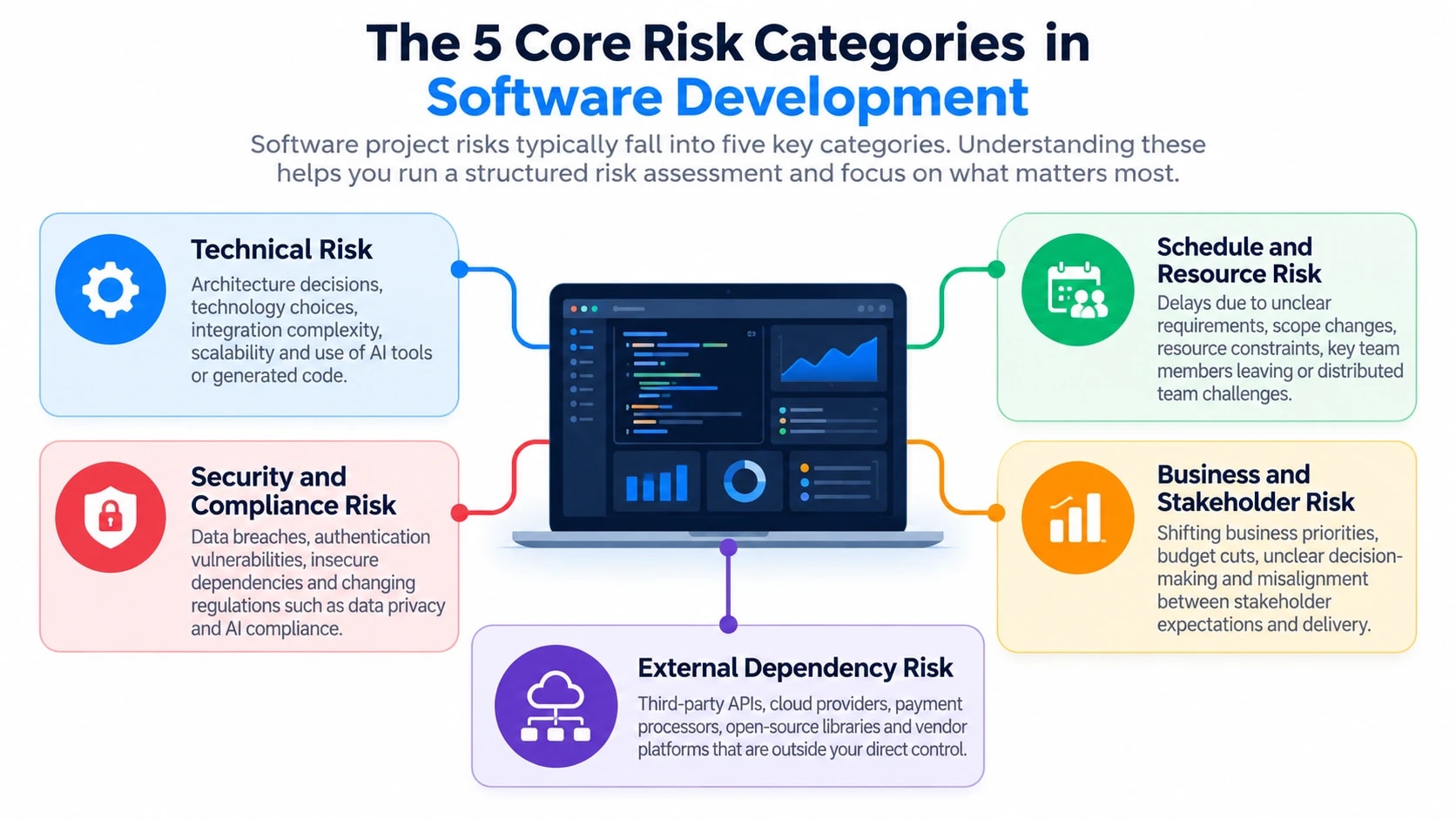
Software risks do not arrive randomly. They cluster into predictable categories, and knowing those categories lets you run a structured assessment rather than a brainstorming free-for-all. Here are the five that consistently cause the most damage across web, SaaS, mobile, and custom software projects.
1. Technical Risk
This covers architecture decisions, technology choices, integration complexity, and scalability assumptions. Picking a framework that lacks long-term community support, underestimating API integration work, or building on a data model that cannot scale without a full rebuild are all technical risks. In 2027, this category also includes risks tied to AI tooling, LLM dependencies, and the use of generated code that has not been properly reviewed.
2. Schedule and Resource Risk
Timelines slip when requirements are unclear, when key team members leave, or when scope grows without a matching adjustment to the delivery date. Resource risk includes single points of failure, meaning a project where only one developer understands a critical component is a project one resignation away from serious trouble. Distributed and contractor-heavy teams in 2027 face additional scheduling risk due to coordination overhead and availability inconsistencies.
3. Security and Compliance Risk
Data breaches, authentication vulnerabilities, insecure third-party dependencies, and regulatory non-compliance all sit here. For SaaS products especially, a single security incident can destroy customer trust overnight. Compliance risk has grown significantly in 2027 as legislation around data handling, AI transparency, and accessibility continues to expand across multiple jurisdictions simultaneously.
4. Business and Stakeholder Risk
This is the category that technical teams underestimate most often. It includes shifting business priorities, budget cuts, unclear decision-making authority, and stakeholders who approve requirements in a meeting and then change their minds three sprints later. Misalignment between what the business wants and what the team builds is one of the top causes of project failure, and it rarely shows up on a technical risk register.
5. External Dependency Risk
Third-party APIs, cloud providers, payment processors, open-source libraries, and vendor platforms all introduce risk that sits outside your direct control. A library that stops receiving security patches, a payment gateway that changes its API without backward compatibility, or a cloud provider outage that takes your product offline for six hours are all external dependency risks. In 2027, with most applications deeply integrated into external services, this category deserves more attention than it typically gets.
How to Conduct a Software Development Risk Assessment
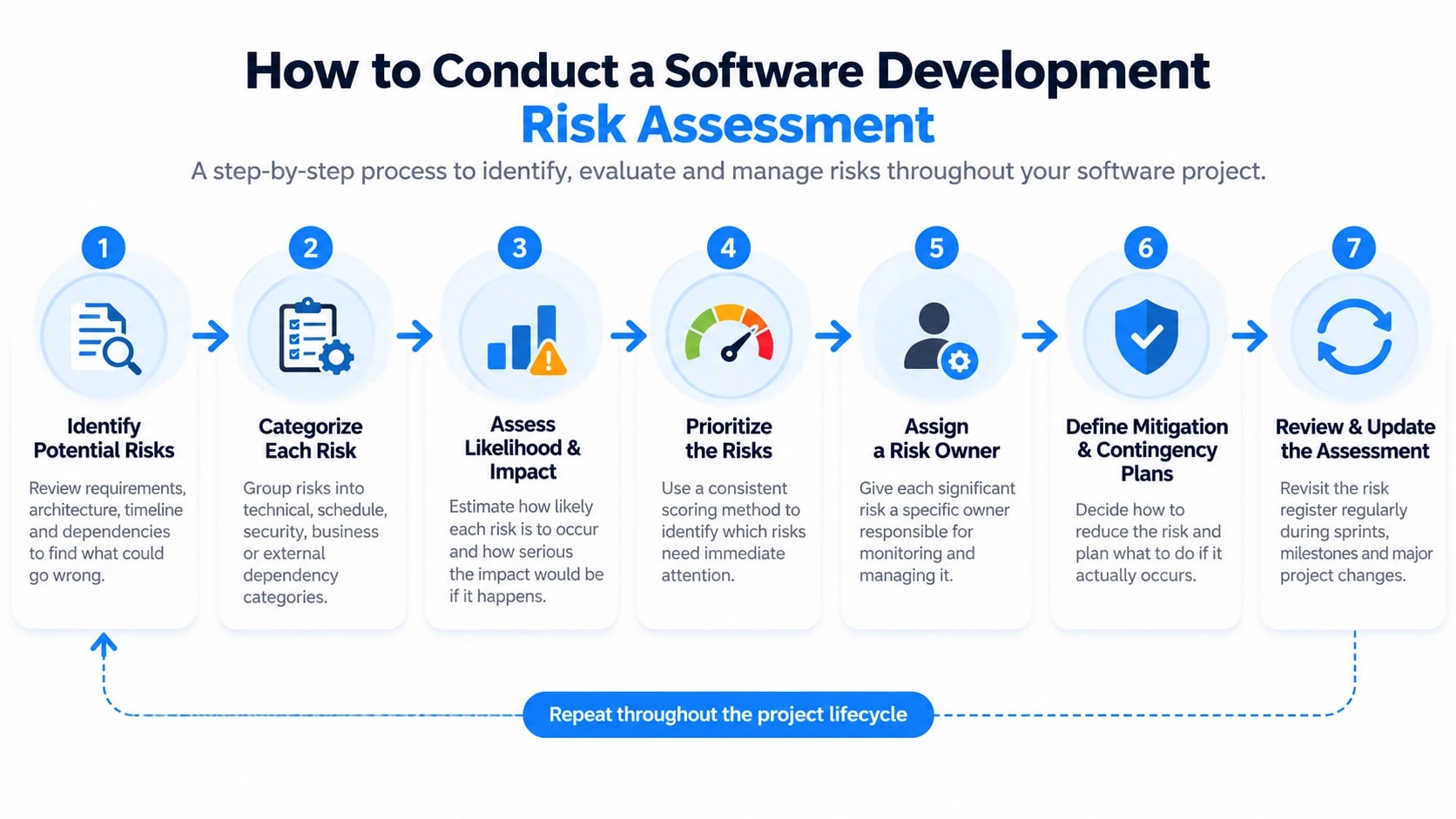 A software development risk assessment works best as a repeatable process rather than a single planning exercise. The goal is to identify potential problems, determine which ones deserve immediate attention, assign responsibility, and establish what the team will do if a risk becomes an actual issue.
1. Identify Potential Risks
Start by reviewing the project’s requirements, architecture, timeline, resources, dependencies, security requirements, and business objectives. Ask what could prevent the team from delivering the expected outcome. Include input from developers, project managers, security teams, product owners, and other stakeholders rather than relying on one person’s perspective.
2. Categorize Each Risk
Place each identified risk into a consistent category such as technical, schedule and resource, security and compliance, business and stakeholder, or external dependency. Categorization makes the risk register easier to review and helps teams identify patterns across projects.
3. Assess Likelihood and Impact
Estimate how likely each risk is to occur and how serious the consequences would be if it did. Using a consistent scoring method prevents teams from prioritizing risks based solely on which problem sounds most urgent during a meeting.
4. Prioritize the Risks
Combine likelihood and impact to determine which risks require immediate mitigation, which should be monitored, and which can be accepted. High-impact risks should receive attention even when their probability is relatively low.
5. Assign a Risk Owner
Give every significant risk a specific owner. That person is responsible for monitoring the risk, updating its status, coordinating mitigation, and escalating it when the situation changes.
6. Define Mitigation and Contingency Plans
Decide what the team can do to reduce the probability or impact of each priority risk. Then document what will happen if the risk actually occurs. Mitigation reduces exposure before an event happens, while a contingency plan defines the response after it happens.
7. Review and Update the Assessment
Risk assessment should continue throughout development. Revisit the register during sprint planning, milestone reviews, major architecture changes, and other decision points. New risks should be added and resolved risks should be closed rather than leaving the original assessment unchanged.
How to Build a Risk Register That Teams Actually Use
A risk register is the central document where you record every identified risk, its likelihood, its potential impact, who owns it, and what the mitigation plan is. The reason most risk registers get ignored is that they are either too complex to maintain or too abstract to act on. Here is a format that stays useful throughout a project lifecycle.
Keep your risk register in a tool the team already uses. If your team lives in Notion, Jira, or Linear, the risk register belongs there, not in a separate spreadsheet nobody checks. Friction kills adoption. A simple table with the right columns is more valuable than a sophisticated template nobody opens.
The columns your register needs are: a unique risk ID, a plain-language description of the risk, the category it falls into, a likelihood score, an impact score, a combined risk score, the current status, the owner responsible for monitoring and acting on it, the mitigation strategy, and a contingency plan if the mitigation fails. That last column, the contingency, is the one most teams skip and the one that matters most when things go wrong.
Assign every risk a single owner. Not a team, not a department, one person. That person is responsible for updating the status, escalating when the risk changes, and executing the mitigation. Shared ownership is another way of saying no ownership.
Review the register at a fixed cadence. For active development sprints, a quick five-minute risk review at the start of each sprint planning session is usually enough. For longer projects, a more thorough monthly review catches risks that have changed in likelihood or impact as the project evolves. The register should shrink as risks are resolved and grow as new ones are discovered. If it never changes, nobody is actually using it.
Risk Scoring Methods Compared: Which Approach Fits Your Project
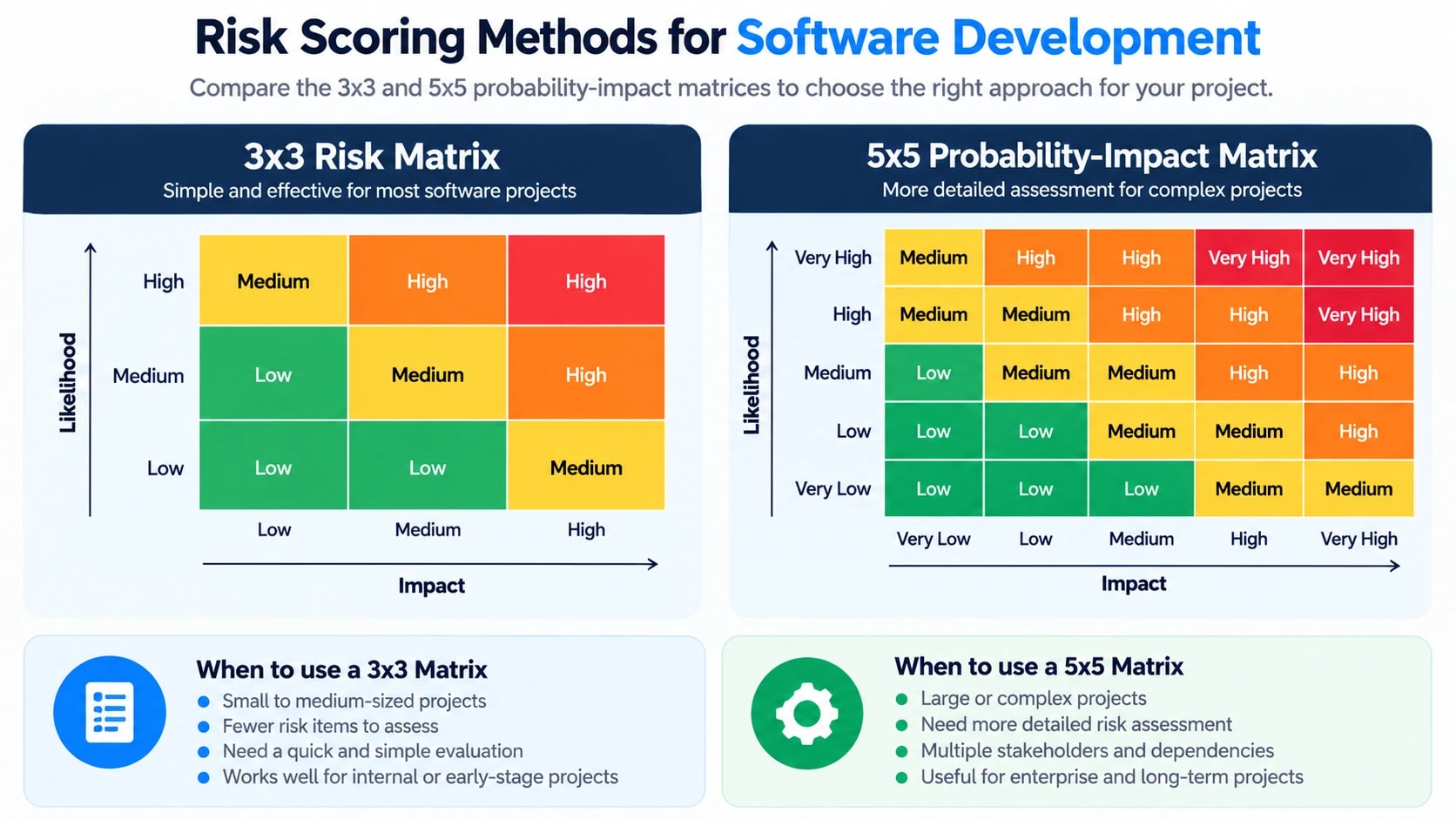
Once you have identified your risks, you need a consistent way to prioritize them. Not every risk deserves equal attention, and your team has limited time. The scoring method you choose should match the complexity of your project and the maturity of your team.
The 3×3 Matrix
This is the simplest option. You score likelihood as Low, Medium, or High, and impact as Low, Medium, or High. The combination gives you a nine-cell grid where the top-right corner, High likelihood plus High impact, represents your priority risks. This works well for smaller projects and teams new to formal risk management. Its weakness is that it lacks precision; two risks can end up in the same cell even when one is significantly more dangerous than the other.
The 5×5 Probability-Impact Matrix
This extends the grid to five levels on each axis, scored 1 through 5. Multiply the two scores together to get a numerical risk rating from 1 to 25. Risks scoring 15 or above typically require active mitigation plans. Risks below 6 can be monitored without immediate action. This method gives you better differentiation and is the most widely used approach across mid-size software projects. It is specific enough to be useful without requiring actuarial precision.
Qualitative Narrative Assessment
Some teams, particularly on early-stage or highly uncertain projects, find numerical scoring misleading because the underlying data does not actually support that level of precision. A qualitative approach describes each risk in plain terms, explains the conditions under which it would materialize, and outlines the business consequence. This is slower to produce but often leads to richer discussions and better-informed decisions than a number in a spreadsheet column.
Monte Carlo Simulation
For large-scale enterprise or infrastructure projects where schedule and budget risk need quantified modeling, Monte Carlo simulation runs thousands of scenario combinations to produce probability distributions for outcomes. It requires dedicated risk modeling software and a team with the expertise to interpret results correctly. This is overkill for most custom software builds but genuinely valuable for complex multi-year platform projects where stakeholders need probabilistic forecasting.
For the majority of web, SaaS, and custom software projects, the 5×5 matrix gives you the right balance of rigor and practicality. Start there, and only move to more sophisticated methods when your project scale genuinely demands it.
Risk Mitigation Strategies for Software Development
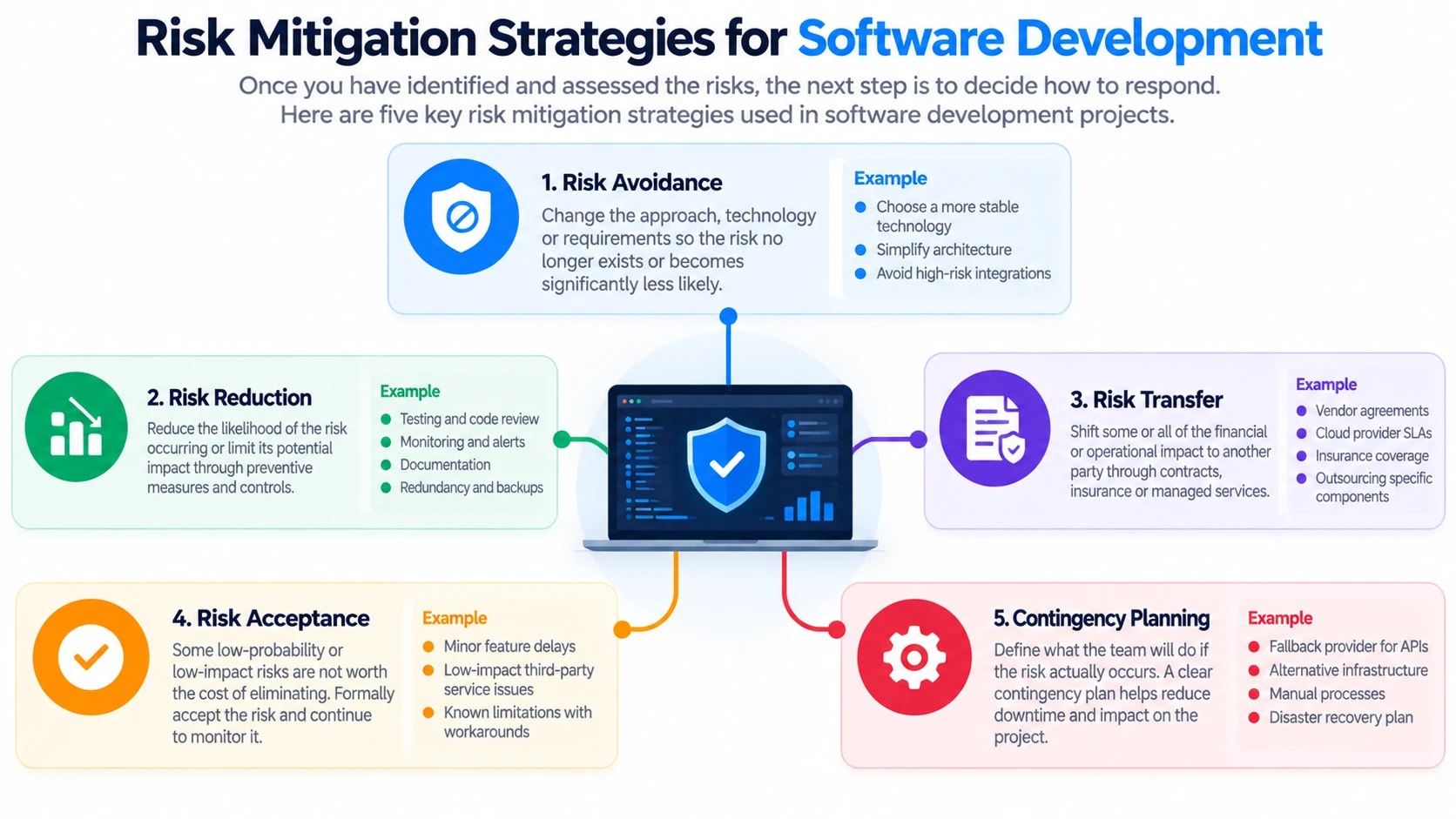 Identifying and scoring risks is only useful if the team takes action on the risks that matter. The appropriate response depends on the likelihood, potential impact, cost of mitigation, and importance of the project objective being protected.
Risk Avoidance
Change the architecture, requirement, technology, or project approach so the risk no longer exists or becomes substantially less likely.
Risk Reduction
Reduce the probability of the risk occurring or limit its potential impact through controls such as testing, documentation, redundancy, monitoring, security reviews, or phased deployment.
Risk Transfer
Shift some of the financial or operational consequences to another party through appropriate contracts, insurance, managed services, or vendor agreements.
Risk Acceptance
Some low-probability or low-impact risks are not worth the cost of eliminating. In these cases, the team can formally accept the risk while continuing to monitor it.
Contingency Planning
A contingency plan defines what the team will do if the risk actually occurs. For example, a project dependent on a third-party API could maintain a fallback provider or alternative integration path.
| Risk | Example Mitigation | Contingency |
|---|---|---|
| Key developer leaves | Documentation and knowledge sharing | Reassign work to another developer |
| Third-party API failure | Monitoring and fallback integration | Switch to backup provider |
| Scope creep | Formal change-control process | Adjust timeline or budget |
| Security vulnerability | Code review and security testing | Patch, isolate, and investigate |
| Cloud cost increase | Budget alerts and usage limits | Reduce workloads or change infrastructure |
New Risk Factors Specific to Software Projects in 2027
Software development in 2027 carries a distinct set of risks that simply did not exist five years ago. AI-generated code, supply chain attacks, regulatory pressure around data sovereignty, and the rapid shift toward agentic software systems have introduced failure points that traditional risk frameworks were never designed to catch. If your risk register still looks like it did in 2022, it is already outdated.
Here are the emerging risk factors every software team should be evaluating this year:
- AI-assisted code quality drift: Teams using AI code generation tools at scale often introduce subtle logic errors, insecure patterns, or license-incompatible code without realizing it. The speed benefit is real, but without review protocols, technical debt accumulates faster than ever.
- Third-party AI model dependency: Products built on top of external AI APIs face a unique risk: the underlying model can be updated, deprecated, or repriced without notice. This creates availability and cost risks that are difficult to hedge.
- Agentic system behavior unpredictability: Software that uses autonomous AI agents to perform multi-step tasks introduces non-deterministic behavior into production environments. Standard QA processes do not adequately cover this.
- Open source supply chain vulnerabilities: Dependency poisoning and malicious package injections have grown significantly. Projects pulling from public registries without software composition analysis tooling are operating with a large blind spot.
- Data residency and sovereignty compliance: New regulations across the EU, Asia-Pacific, and parts of Latin America now impose strict rules on where data can be stored and processed. Ignoring these during architecture decisions creates serious legal exposure.
- LLM prompt injection in user-facing features: Applications that pass user input into language model prompts face a class of security risk that standard penetration testing workflows are not yet equipped to surface reliably.
- Quantum-readiness gaps: Encryption standards that were considered secure are now being reconsidered as quantum computing capabilities advance. Long-lived systems need to account for cryptographic deprecation timelines.
The teams that manage these risks well are not necessarily the ones with the biggest security budgets. They are the ones that have made deliberate decisions to include these categories in their assessment cycles rather than treating them as someone else’s problem.
Common Mistakes Teams Make During Software Risk Assessment
Risk assessment only produces value when it is done honestly and consistently. Unfortunately, most teams fall into the same predictable traps, and those traps tend to become visible only after something goes wrong. Understanding these patterns helps teams build processes that hold up under real project pressure.
Treating risk assessment as a one-time activity
Many teams complete a thorough risk assessment at project kickoff and then file it away. By the time a meaningful risk materializes, the register has not been updated in months. Risk assessment should be embedded in sprint reviews, milestone gates, and change control decisions, not treated as a box to check before development starts.
Underestimating scope and integration risks
Scope creep is consistently underrated as a risk source. Teams often document functional requirements clearly but miss the complexity hidden in third-party integrations, data migration requirements, and cross-system dependencies. These gaps tend to surface late in the project when correction is most expensive.
Assigning risk ownership to no one in particular
A risk without a named owner is a risk that will be ignored. When risk items are listed in a shared document without clear accountability, they tend to sit unaddressed until they escalate. Every risk item should have a specific person responsible for monitoring and response, not a team or a role title.
Conflating likelihood and severity
A risk that is highly likely but low impact requires a different response than one that is unlikely but catastrophic. Teams that average these two dimensions together in a single score often under-prepare for tail risks while over-investing in minor nuisances. Scoring should keep these dimensions separate long enough to inform a differentiated response strategy.
Skipping post-project retrospectives on risk accuracy
Almost no teams review how accurate their initial risk assessments turned out to be. This feedback loop is where institutional knowledge actually gets built. If a team consistently underestimates integration complexity or overestimates infrastructure risks, that pattern will never change without deliberate analysis.
| Common Mistake | Why It Happens | How to Fix It |
|---|---|---|
| One-time assessment | Treated as documentation, not process | Embed review in sprint cycles and milestone gates |
| No clear risk owner | Responsibility distributed to avoid conflict | Assign a named individual to every risk item |
| Conflating likelihood and severity | Easier to produce one number than two | Score dimensions separately before combining |
| Ignoring integration complexity | Focus stays on internal code, not dependencies | Map all third-party touchpoints during scoping |
| No post-project retrospective | Teams move on immediately after delivery | Schedule a formal risk accuracy review after launch |
Conclusion
Software development risk assessment is a practical way to identify uncertainty before it becomes a costly project problem. A strong process combines structured risk identification, likelihood and impact scoring, clear ownership, mitigation planning, and regular review throughout the development lifecycle.
The most effective teams do not try to eliminate every possible risk. They focus their attention on the risks that could materially affect security, cost, schedule, quality, or business outcomes. By keeping the risk register active and connecting it to sprint planning and project decisions, teams can respond earlier and deliver more predictable results.
At Techlad, risk assessment can be incorporated into project scoping, architecture decisions, sprint planning, and milestone reviews so potential problems are addressed before they become expensive to fix.
Frequently Asked Questions
How often should a software team update its risk register?
Risk registers should be reviewed at every sprint review and at each project milestone. For fast-moving projects, a lightweight weekly check-in on the top five risks is a practical approach. The key is treating it as a living document rather than a one-time deliverable that gets filed and forgotten.
What is the difference between a risk and an issue in software development?
A risk is a potential problem that has not yet occurred, meaning you still have time to prevent or reduce its impact. An issue is a problem that is already happening and requires immediate action. Good risk management reduces how often risks convert into issues by catching warning signs early in the process.
Do small software teams really need a formal risk assessment process?
Yes, though the format can be simpler. Small teams actually have less capacity to absorb unexpected problems, which makes early risk identification more important, not less. Even a shared spreadsheet with five to ten identified risks, clear owners, and a monthly review cadence provides meaningful protection for small teams.
What tools are commonly used for software development risk assessment in 2027?
Teams typically use project management platforms with built-in risk tracking, dedicated GRC tools for compliance-heavy projects, and lightweight spreadsheet templates for smaller engagements. The tool matters less than the consistency of the process. A simple spreadsheet used weekly outperforms sophisticated software that nobody updates.
How do you assess risk when project requirements are still unclear?
Unclear requirements are themselves a high-priority risk and should be logged as such. Use assumption-based risk entries to document what you are taking for granted, then plan validation checkpoints to confirm or correct those assumptions early. Discovery sprints and structured scoping sessions are effective ways to reduce this uncertainty before full development begins.