

 Post by
 Skipping the discovery phase is one of the most expensive mistakes a business can make when building software. It is the stage where vague ideas get turned into a concrete, buildable plan, and without it, even the best development team will be building on unstable ground. This guide walks you through exactly what the discovery phase involves, the steps that make it effective, what you should walk away with, and what it typically costs.
What the Discovery Phase Actually Is in Software Development

The software development discovery phase is the initial stage of a project in which a business idea or problem is translated into a defined product scope, technical approach, and development plan. Also known as project discovery or scoping, it helps stakeholders clarify requirements, evaluate feasibility, identify risks, and estimate costs before development begins. The goal is to reduce uncertainty and give the team a shared understanding of what needs to be built.
Think of it this way: if you were building a house, you would not hand a construction crew a rough sketch and say “figure it out.” You would hire an architect, agree on a floor plan, get the structural drawings approved, and only then break ground. The discovery phase is the architectural stage of software development.
During discovery, the team typically includes business analysts, UX designers, solution architects, and sometimes a technical lead. Together, they work with stakeholders to answer four fundamental questions:
- What problem are we solving? Not just the surface-level request, but the underlying business need driving it.
- Who are we solving it for? Understanding the actual users and their behaviors, not assumptions about them.
- How will the solution work? Mapping out the functionality, user flows, and technical approach at a high level.
- What will it take to build it? Producing a realistic scope, timeline, and cost estimate based on actual requirements.
Discovery is not about building a prototype or writing a proposal. It is about producing a shared understanding between the client and the development team so that both parties are aligned before any major investment is committed. Projects that skip this stage routinely run over budget, miss deadlines, or deliver products that do not solve the right problem.
Discovery Phase vs. Development Phase: What’s the Difference?
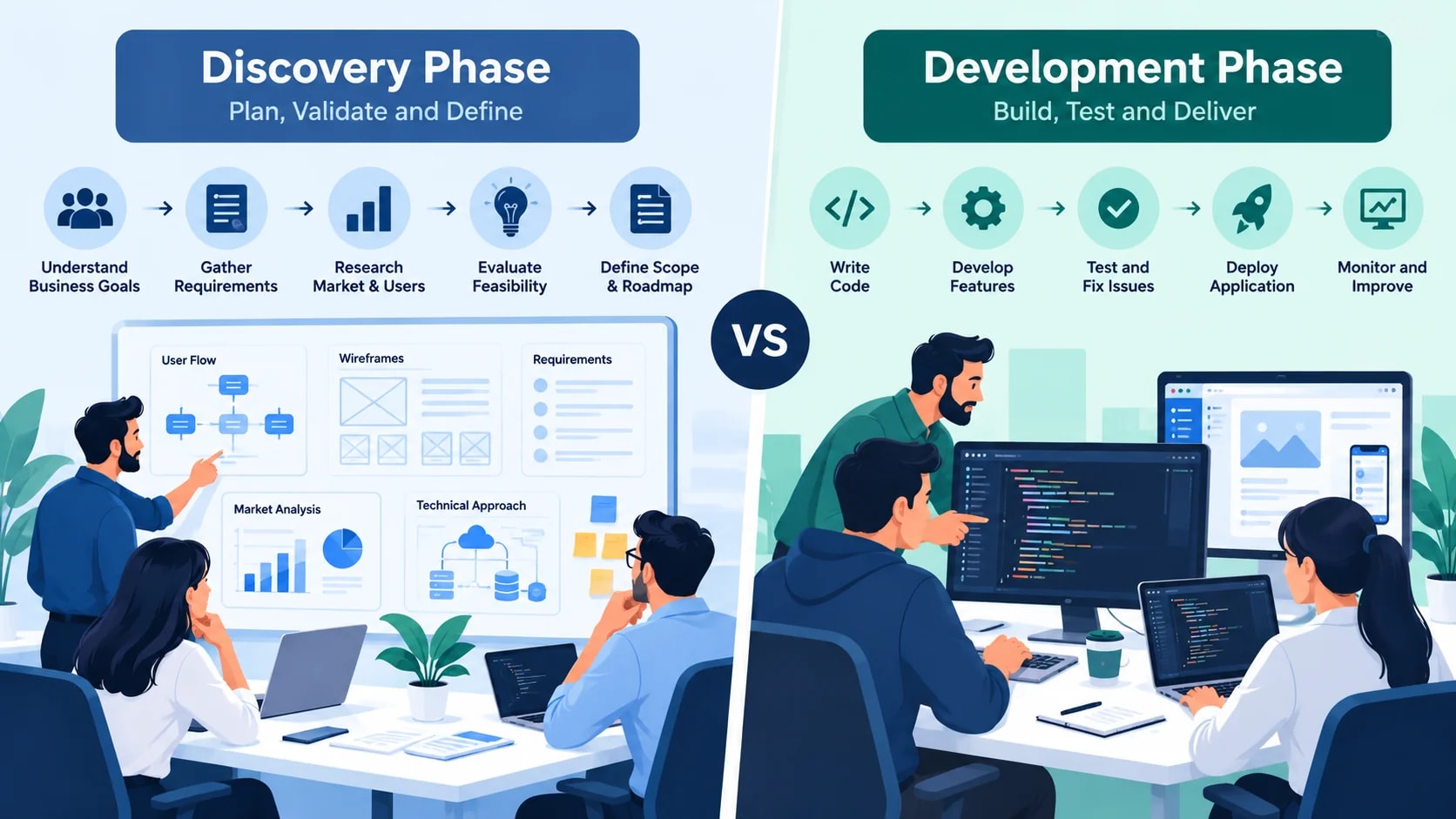
The software development discovery phase focuses on deciding what to build, why it is needed, and how the project should be approached. The development phase turns those decisions into a working product through coding, testing, and implementation.
During discovery, the team gathers requirements, researches users, evaluates technical feasibility, maps user journeys, and estimates the scope, timeline, and budget. During development, developers build the agreed features, engineers integrate systems, and testers check that the product meets its requirements.
Discovery helps reduce uncertainty before significant development costs begin. Development delivers the software itself. The two phases are connected, but they serve different purposes. A well-documented discovery phase gives the development team a clearer plan, although requirements may still change as the project progresses.
The 6 Core Steps of the Software Development Discovery Phase
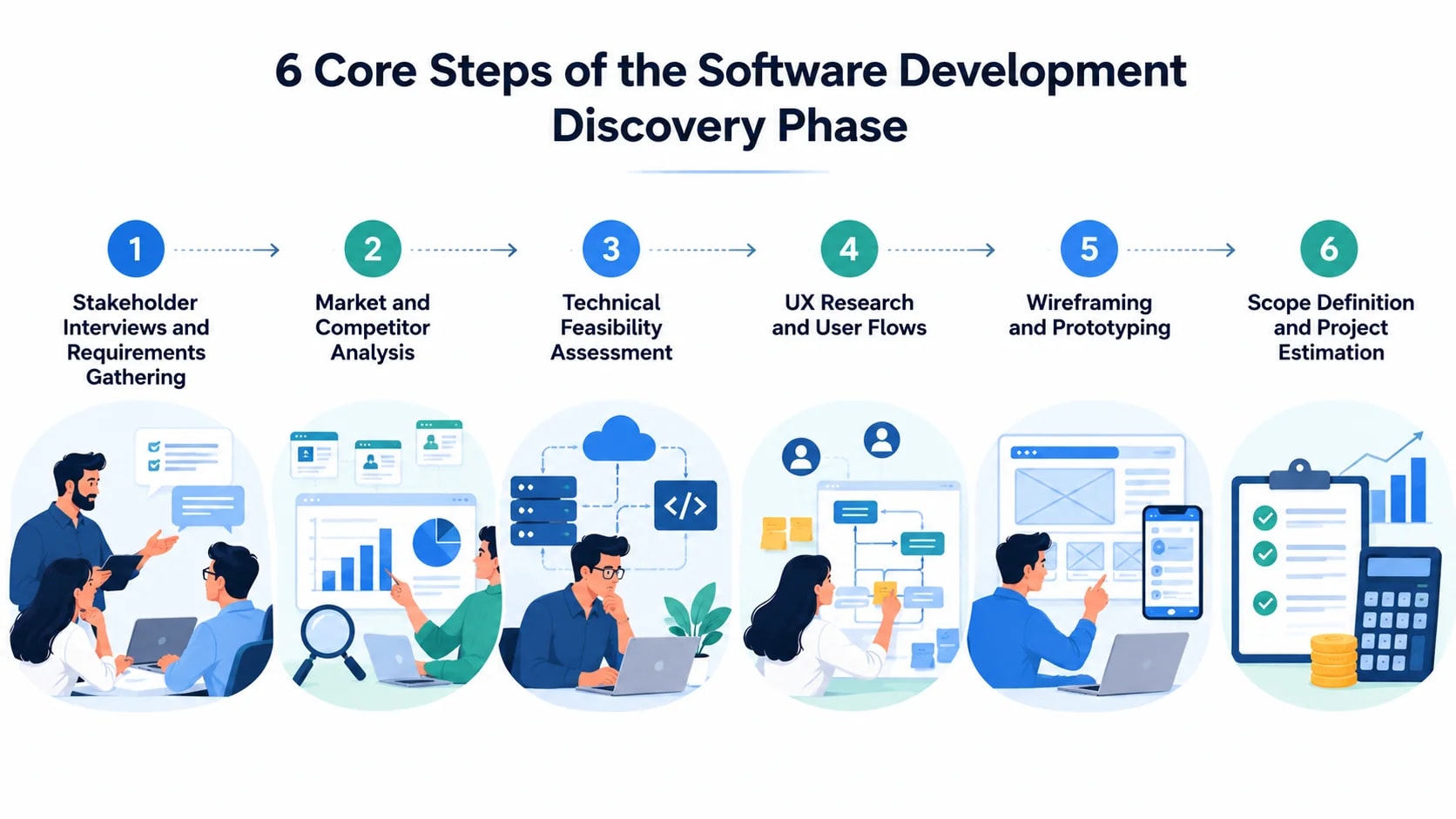
Discovery is not a single meeting or a quick call. It is a structured series of activities, each one building on the last. Here is how a well-run discovery phase typically progresses.
1. Stakeholder Interviews and Requirements Gathering
Everything starts with conversations. The development team conducts structured interviews with the key stakeholders, founders, product owners, department heads, or whoever holds the vision for the product. The goal is to surface the business goals, the pain points being addressed, the expected outcomes, and any constraints like budget, timeline, or existing technology.
This step also involves identifying all the different user groups who will interact with the product. A SaaS platform, for example, might have admins, end users, and external clients, each with very different needs. Capturing all of these perspectives early prevents major design oversights later.
2. Market and Competitor Analysis
Understanding the environment the product will enter is a practical necessity, not a bonus. The team reviews existing solutions in the market to identify gaps the product can fill, features users already expect as standard, and technical approaches worth learning from or avoiding. This step directly informs feature prioritization and helps avoid building something the market already has in a better form.
3. Technical Feasibility Assessment
Once the requirements are clearer, a technical lead or solution architect evaluates what it will actually take to build the product. This includes assessing the technology stack options, any integrations with third-party systems or APIs, data architecture considerations, security requirements, and potential technical risks that could affect the timeline or cost.
If a client wants a feature that sounds simple but is technically complex, this is the stage where that reality gets surfaced, before the project is priced and contracted.
4. User Experience (UX) Research and Flow Mapping
Good software is built around how people actually think and behave, not how the internal team assumes they will. UX research during discovery includes creating user personas, mapping out the primary user journeys, and identifying where friction points are most likely to occur. This feeds directly into the wireframing and prototyping work that follows.
Flow mapping is particularly valuable for complex applications. It forces clarity on how different parts of the system connect, what triggers each action, and where decisions branch into different outcomes.
5. Wireframing and Prototyping
Wireframes are low-fidelity visual representations of the product’s key screens and interactions. They are not final designs, but they give stakeholders something concrete to react to. This is where abstract requirements become tangible, and it is far easier, and far cheaper, to change a wireframe than to redesign a built feature.
For larger or more complex products, a clickable prototype may be created. This allows user testing to happen before development begins, validating core assumptions while the cost of change is still low.
6. Scope Definition and Project Estimation
The final step of discovery brings everything together into a documented scope. This includes a prioritized feature list (often using a MoSCoW framework: Must have, Should have, Could have, Won’t have), a proposed technology stack, a project timeline broken into phases or sprints, and a detailed cost estimate.
This document becomes the foundation of the development contract. It gives the client confidence that the budget is grounded in real analysis, and it gives the development team a clear mandate to build against.
How Long Does the Software Development Discovery Phase Take?
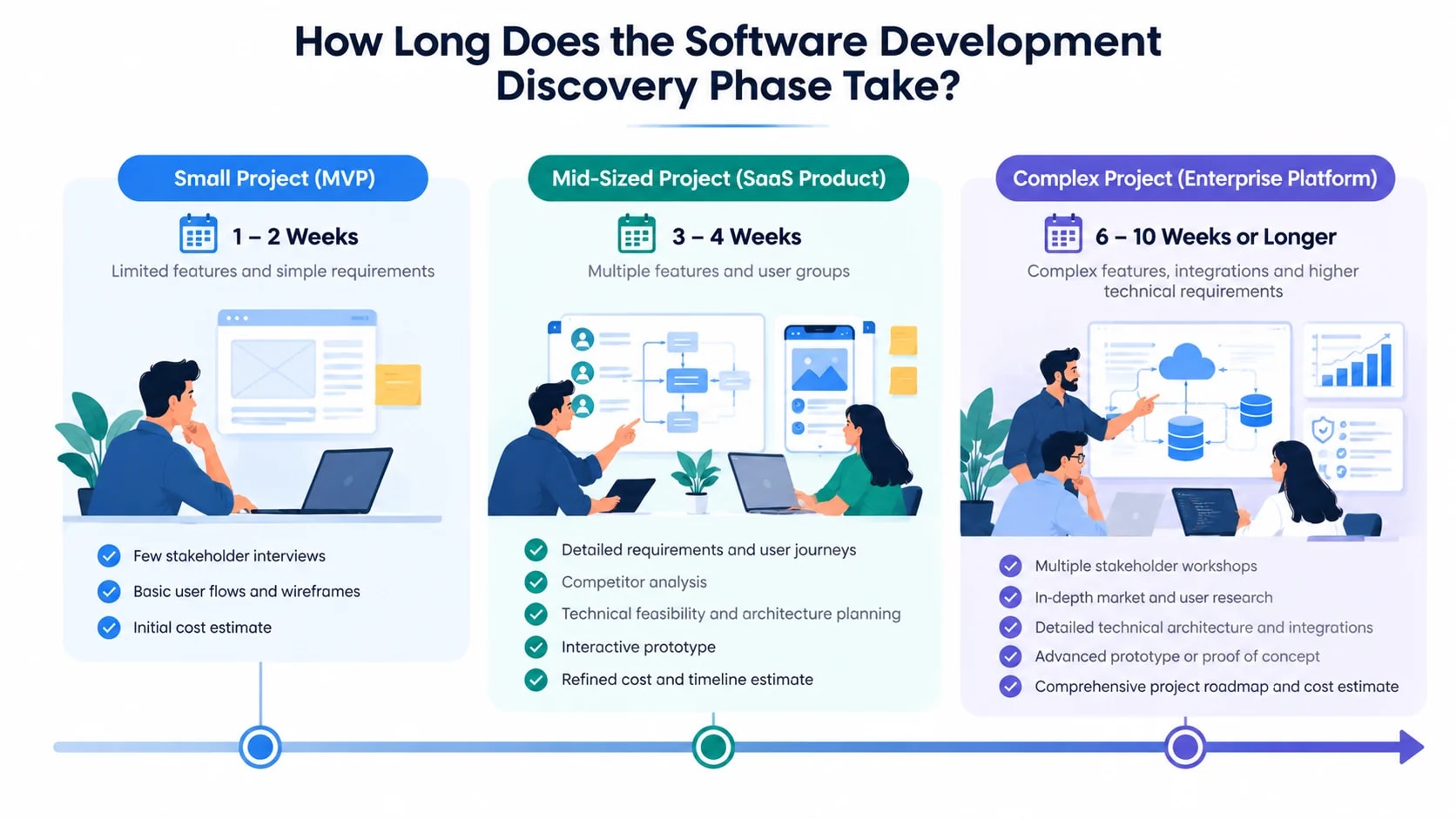
The software development discovery phase can take anywhere from one to two weeks for a small project to six to ten weeks or longer for a complex enterprise platform. The timeline depends on the number of stakeholders, the clarity of existing requirements, the amount of user research needed, and the complexity of the proposed technology.
A small MVP with a limited feature set may need only a few stakeholder interviews, a feasibility assessment, basic wireframes, and an initial cost estimate. A larger SaaS or enterprise project may require multiple workshops, competitor research, detailed user journeys, architecture planning, integration assessments, and an interactive prototype.
Discovery can also take longer when stakeholders disagree on priorities or important requirements remain unresolved. To keep the process on track, agree on the scope, required deliverables, decision-makers, and review dates before work begins. The goal is not to finish discovery as quickly as possible, but to resolve enough uncertainty to make informed development decisions.
Key Deliverables You Should Receive After Discovery
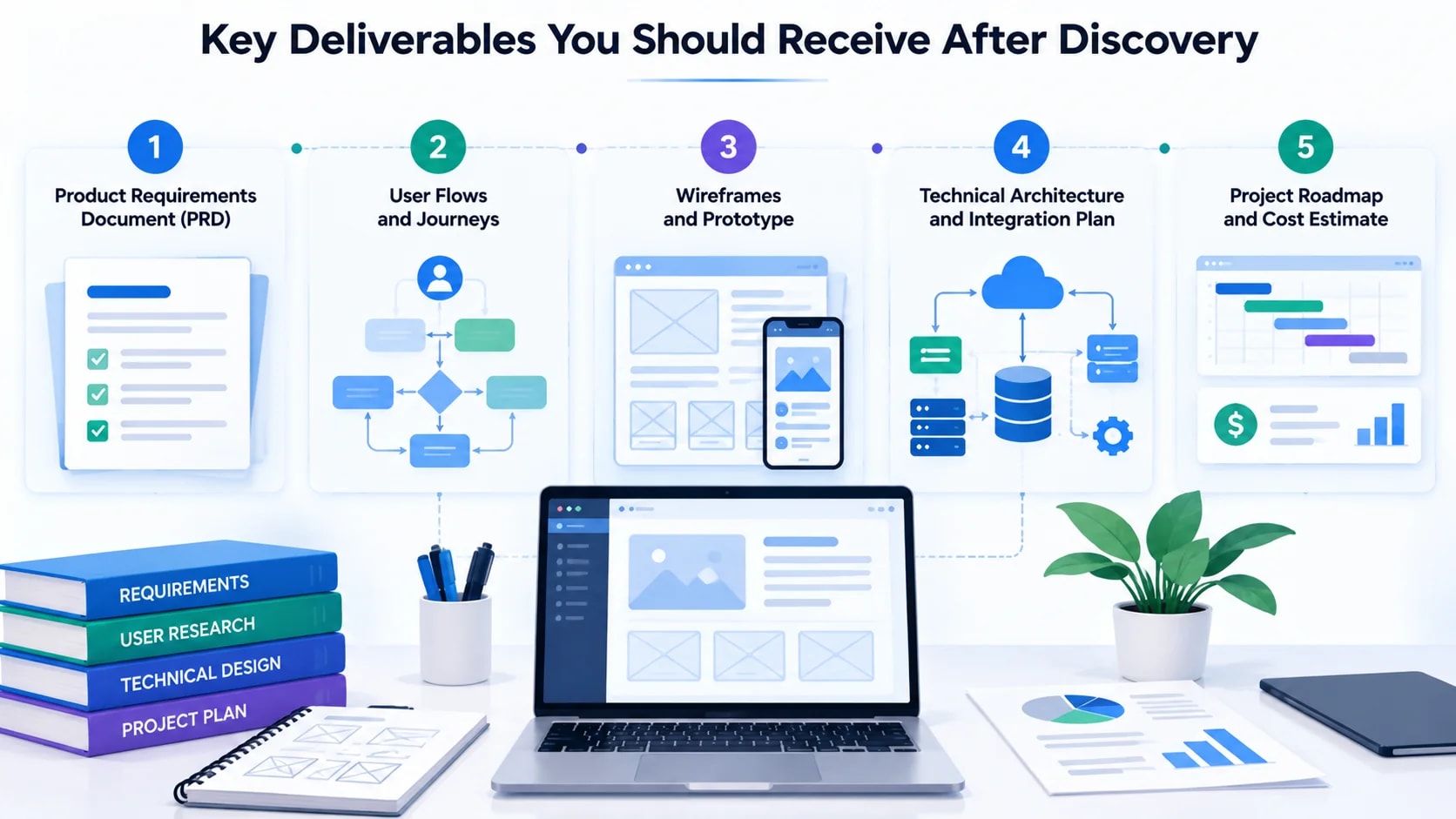
A discovery phase is only as valuable as what it produces. At the end of the process, you should have a set of concrete documents and artifacts that make the path forward clear. If a team runs a discovery phase and hands you back a rough summary email, that is a red flag.
Here are the deliverables you should expect:
Product Requirements Document (PRD)
This document captures the full picture of what the product needs to do. It covers the business context, the user personas, the functional requirements for each feature, and the non-functional requirements like performance, security, and scalability. A well-written PRD becomes the single source of truth throughout the entire build, reducing miscommunication between designers, developers, and stakeholders.
User Flow Diagrams
These are visual maps of how users will move through the product, from entry point to goal completion. They confirm that the team has thought through every step of the user experience and identify any gaps or dead ends in the product logic before design and development begin.
Wireframes or Interactive Prototype
Depending on the scope and complexity of the product, you should receive either static wireframes of the core screens or a clickable prototype that simulates the main user journeys. These serve as the visual blueprint for the UI design phase and give you something to test with real users or show to investors.
Technical Architecture Document
This outlines the recommended technology stack, the system architecture (including how the front end, back end, database, and any third-party services connect), and the key technical decisions made during discovery along with the reasoning behind them. It gives your development team a clear starting point and reduces the risk of costly architectural decisions being made on the fly during the build.
Project Roadmap and Cost Estimate
The roadmap breaks the project into phases or milestones with estimated timelines. The cost estimate details how the budget is allocated across different workstreams, such as design, front-end development, back-end development, and QA. Together, these give you a realistic picture of what you are committing to before development contracts are signed.
Taken together, these deliverables dramatically reduce the risk of the project that follows. They give every party involved, client, designer, developer, and project manager, a shared reference point that keeps the work aligned as it scales.
How Much Does the Discovery Phase Cost in 2026
The cost of a software development discovery phase depends on project complexity, team composition, location, and the depth of research and documentation required. A small internal tool may need only a short discovery engagement, while a complex SaaS platform or enterprise application may require stakeholder workshops, technical assessments, UX research, and interactive prototypes. The estimates below are illustrative planning ranges rather than fixed market rates. Request an itemized proposal to understand exactly what each engagement includes.
| Project Type | Team Location | Typical Duration | Estimated Cost |
|---|---|---|---|
| Small MVP or Internal Tool | Eastern Europe / Asia | 1 to 2 weeks | $2,000 to $6,000 |
| Mid-Sized SaaS Product | Eastern Europe / Asia | 3 to 4 weeks | $6,000 to $18,000 |
| Mid-Sized SaaS Product | US / Western Europe | 3 to 4 weeks | $15,000 to $35,000 |
| Complex Enterprise Platform | US / Western Europe | 6 to 10 weeks | $30,000 to $80,000+ |
A few factors push the cost up or down in practice:
- Number of stakeholders involved: More workshops and interviews mean more billable hours for the product and UX team.
- Fidelity of prototypes: Interactive, high-fidelity wireframes cost significantly more than basic static screens.
- Third-party integrations: If your product connects to payment gateways, CRMs, or external APIs, each one needs its own scoping and risk assessment.
- Compliance requirements: Products in healthcare, finance, or legal sectors require additional research into HIPAA, GDPR, PCI-DSS, and similar standards.
One important point: discovery cost is not a sunk cost. Most vendors apply part of the discovery investment toward the development contract, or the deliverables are specific enough to take to any team you choose to work with. Either way, the clarity you gain far outweighs what you spend upfront.
Common Mistakes That Derail the Discovery Phase
Even when teams commit to doing a proper discovery phase, certain patterns consistently cause problems. Recognizing these early can save weeks of confusion and thousands of dollars in rework.
- Treating discovery as a formality: Some clients go through the motions of discovery while already having a fixed idea of what to build. If stakeholders are not genuinely open to questioning their assumptions, the output will simply validate what was already decided, and that defeats the entire purpose.
- Excluding the right people: Discovery workshops without actual end users or key technical leads produce incomplete insights. Business owners often describe what they think users want, not what users actually struggle with. Both perspectives need to be in the room.
- Skipping technical architecture planning: Some teams rush through discovery with a focus on design and skip the engineering side entirely. Without a clear architecture decision, the first sprint of development often turns into a second discovery phase, but much more expensive.
- Scope creep within discovery itself: Discovery has a tendency to expand when there is no clear boundary on what it includes. Without a defined scope and time box, discovery can run for months and still produce vague documentation.
- Not validating with real users: Building wireframes or prototypes that only internal stakeholders review is a missed opportunity. Even brief usability testing with five to eight real users surfaces problems that would otherwise be discovered after launch.
- Choosing a vendor based on price alone: A cheap discovery phase that produces generic deliverables is not a bargain. If the documentation is too vague to estimate development accurately, you will pay for the ambiguity many times over during the build.
The antidote to most of these mistakes is straightforward: define clear outcomes for discovery before it begins, include the right people throughout, and treat every deliverable as something that will be directly used during development, not filed away after sign-off.
How to Choose a Software Development Partner for Discovery
Choose a software development partner that can demonstrate a structured discovery process, not just promise to deliver a product quickly. Ask how the team gathers requirements, validates assumptions, assesses technical feasibility, identifies risks, and estimates the project scope.
Before signing an agreement, confirm the deliverables you will receive. These may include a product requirements document, user flows, wireframes, a technical architecture plan, and a project roadmap with estimated costs. Clarify who owns the documentation, designs, and other project assets, and whether you can use them with another development team if necessary.
Compare proposals based on the work included, the experience of the people assigned to the project, and the clarity of the final deliverables. The cheapest proposal may leave out important research or technical assessment. A clearly defined discovery engagement makes it easier to evaluate the plan before committing to full development.
Our guide on how to hire a software development contractor explains what to look for when selecting the right professional for your project.
Conclusion
The discovery phase is where good software products separate themselves from expensive failures. It is the stage where your team aligns on what is actually being built, who it is being built for, and what it will realistically take to get there. The six steps outlined in this guide, from stakeholder workshops through technical scoping and risk planning, are not bureaucratic overhead. They are the foundation that every successful development engagement is built on. Skipping them does not save time. It borrows time from the future and pays it back with interest in the form of misaligned features, surprise costs, and missed deadlines.
If you are preparing to build a web application, SaaS product, or custom software solution, investing in a structured discovery phase is the single highest-return decision you can make before writing a line of code. At Techlad, we run discovery engagements for startups and scaling businesses that want to go into development with confidence, not guesswork. The deliverables you receive, from technical architecture documents to validated prototypes, become the blueprint your entire build follows. Start with clarity, and the rest of the process becomes significantly more predictable.
Frequently Asked Questions
Is the discovery phase necessary for every software project?
Not for every project, but for most. Simple tools with well-defined requirements and no third-party integrations may not need a full discovery engagement. However, any product involving multiple user roles, external APIs, custom logic, or significant budget should go through structured discovery to avoid costly mid-development surprises.
How long does the discovery phase typically take?
Duration depends on project complexity. A small MVP discovery can wrap up in one to two weeks. A mid-sized SaaS product typically requires three to four weeks. Enterprise-level platforms with multiple integrations and compliance requirements can take six to ten weeks to scope and document properly.
Can we start development before discovery is fully complete?
In most cases, starting development before discovery is finished creates more problems than it solves. Developers may build features that get deprioritized or redesigned once the full scope is clear. It is better to complete discovery fully, then move into development with a finalized architecture and validated wireframes already in hand.
What is the difference between a discovery phase and a requirements document?
A requirements document is one output of discovery, but discovery is far broader. It also includes user research, technical architecture planning, risk identification, prototyping, and project estimation. A requirements document alone describes what to build, while discovery answers why, how, and at what realistic cost and timeline.
Should we pay for discovery if we already have detailed specs?
Detailed specs reduce discovery time but rarely eliminate the need for it entirely. Even thorough specs benefit from technical review, architecture planning, and prototype validation. A shorter discovery engagement, sometimes called a technical audit or scoping session, ensures your specs are accurate, buildable, and correctly estimated before development begins.