

 Post by
 When businesses plan a software project, the technology decisions get most of the attention, but the financial structure behind how you fund and account for that software can be just as consequential. The choice between Capital Expenditure and Operational Expenditure is not just an accounting technicality; it shapes your cash flow, tax position, balance sheet, and even how agile your technology decisions can be over time. Getting this right from the start can save your business significant money and strategic headaches down the road.
Read our guide on Best Software Development Productivity Tools in 2027
What CapEx and OpEx Actually Mean in Software Development
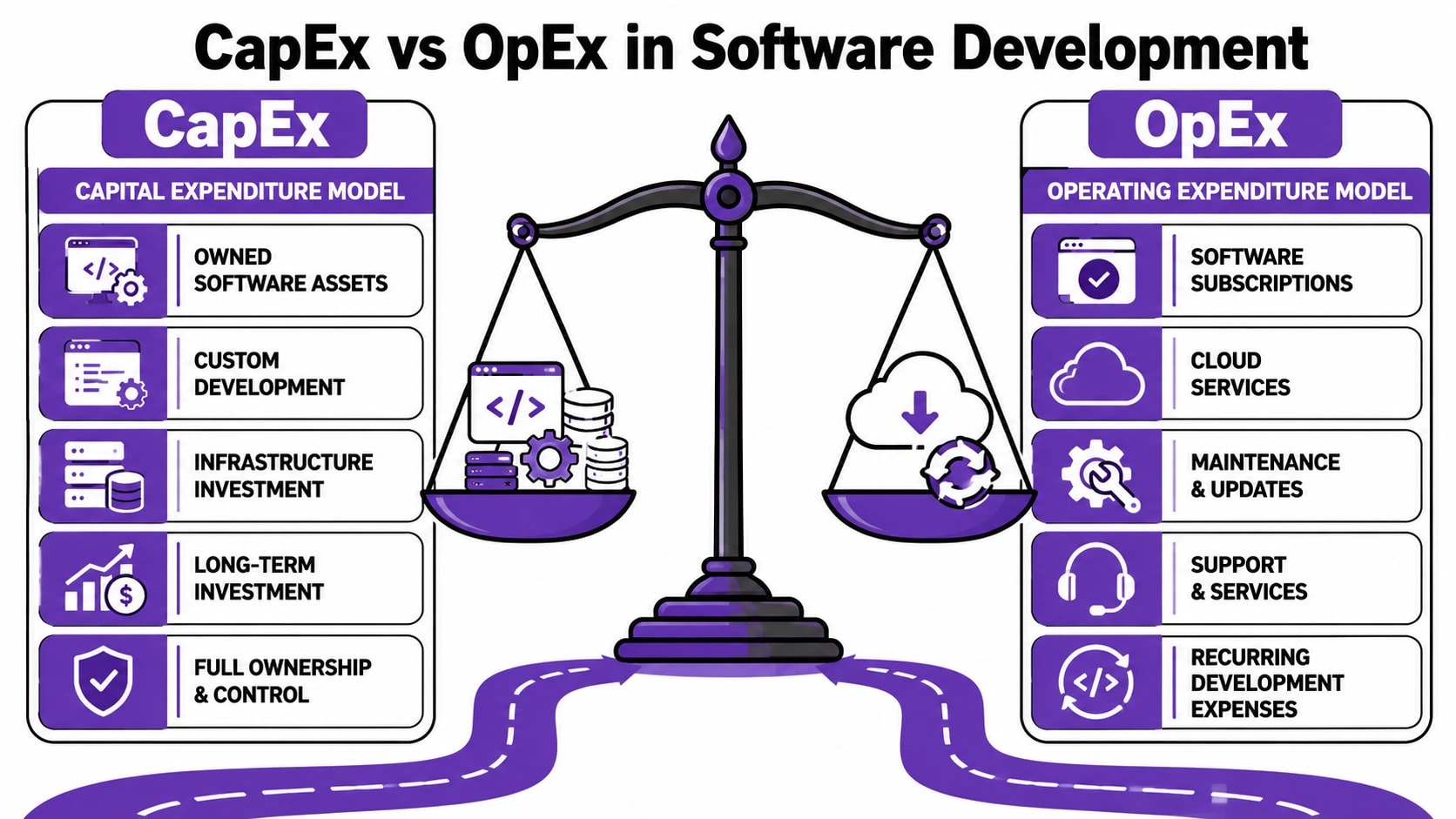
At their core, CapEx and OpEx describe two different ways a business spends money, and each carries distinct financial and operational implications when applied to software.
Capital Expenditure (CapEx) refers to money spent on acquiring or building assets that will provide value over multiple years. In software development, CapEx typically covers the cost of building custom software, developing a proprietary platform, or purchasing perpetual software licenses. Because these investments create long-term assets, they are capitalized on the balance sheet and depreciated or amortized over their useful life, often three to ten years depending on the asset type and accounting standards in your jurisdiction.
Operational Expenditure (OpEx) refers to ongoing costs incurred in the day-to-day running of the business. In software terms, this includes SaaS subscription fees, cloud hosting costs, software maintenance contracts, and increasingly, managed development services where you pay regularly rather than commissioning a one-time build. These costs are expensed immediately in the period they occur, which means they reduce your taxable income right away rather than being spread across years.
The distinction matters because it changes how both your accountants and your investors read your financials. A large CapEx project shows up as an asset, whereas an equivalent OpEx spend flows straight through your income statement as an expense. Neither is inherently better; the right choice depends on your business model, growth stage, cash position, and the type of software you are building.
It is also worth noting that in practice, many software projects contain elements of both. A custom web application might be a CapEx investment, while the cloud infrastructure it runs on is an OpEx cost. A SaaS product you subscribe to is OpEx, but custom integrations built on top of it may qualify as CapEx depending on how your accountants classify the work.
To understand CapEx vs OpEx Software Development: Key Differences, it helps to compare what you see in the data and what action you need to take next.
Check out our latest blog on Greenfield Software Development vs Brownfield Explained
How Each Model Affects Your Financial Statements and Tax Position
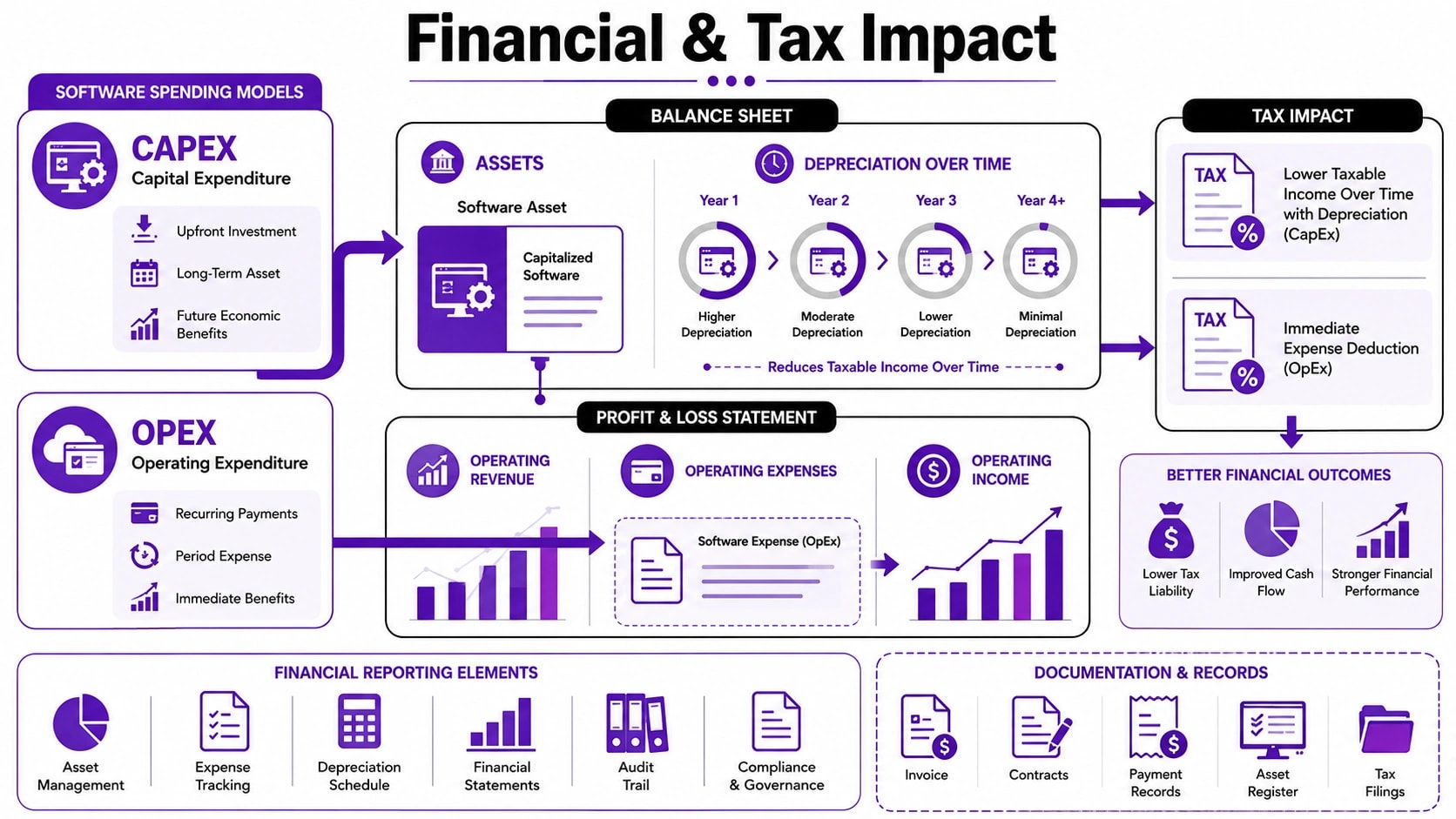
Understanding the accounting treatment of each model is essential before you commit to a software development strategy, particularly if your business is preparing for fundraising, managing tight margins, or optimizing for tax efficiency.
With CapEx software development, the upfront cost does not hit your income statement all at once. Instead, it is recorded as an intangible asset on your balance sheet and amortized over its expected useful life. For example, if your business spends $300,000 building a custom SaaS platform, you might amortize that cost at $60,000 per year over five years. Each year, only that $60,000 portion reduces your operating profit, which can make your short-term profitability look stronger. However, the full cash outlay happens upfront, which puts real pressure on your working capital.
From a tax perspective, CapEx treatment means your deductions are spread over multiple years rather than taken immediately. In high-growth phases where you want to minimize taxable income quickly, this can actually be a disadvantage compared to OpEx.
With OpEx software development, costs are expensed in the period they are incurred. This means a $25,000 monthly spend on a managed development team or a SaaS platform reduces your taxable income by that amount immediately. For businesses in profitable periods, this immediate deduction can produce meaningful tax savings. It also keeps large liabilities off the balance sheet, which can appeal to certain types of investors or lenders who prefer asset-light business models.
The trade-off is that recurring OpEx spending can make your profit and loss statement look more volatile, particularly if your development costs fluctuate month to month. Investors analyzing your unit economics will also scrutinize high OpEx ratios, especially in early-stage businesses where the path to profitability is under the microscope.
One practical consideration is how your software spending interacts with accounting standards such as ASC 350-40 in the United States or IAS 38 under international reporting standards. Both frameworks have specific rules about which phases of software development can be capitalized and which must be expensed, so working with an accountant familiar with software project accounting is strongly advisable before you finalize your approach.
Real-World Scenarios: When to Choose CapEx vs OpEx for Software Projects
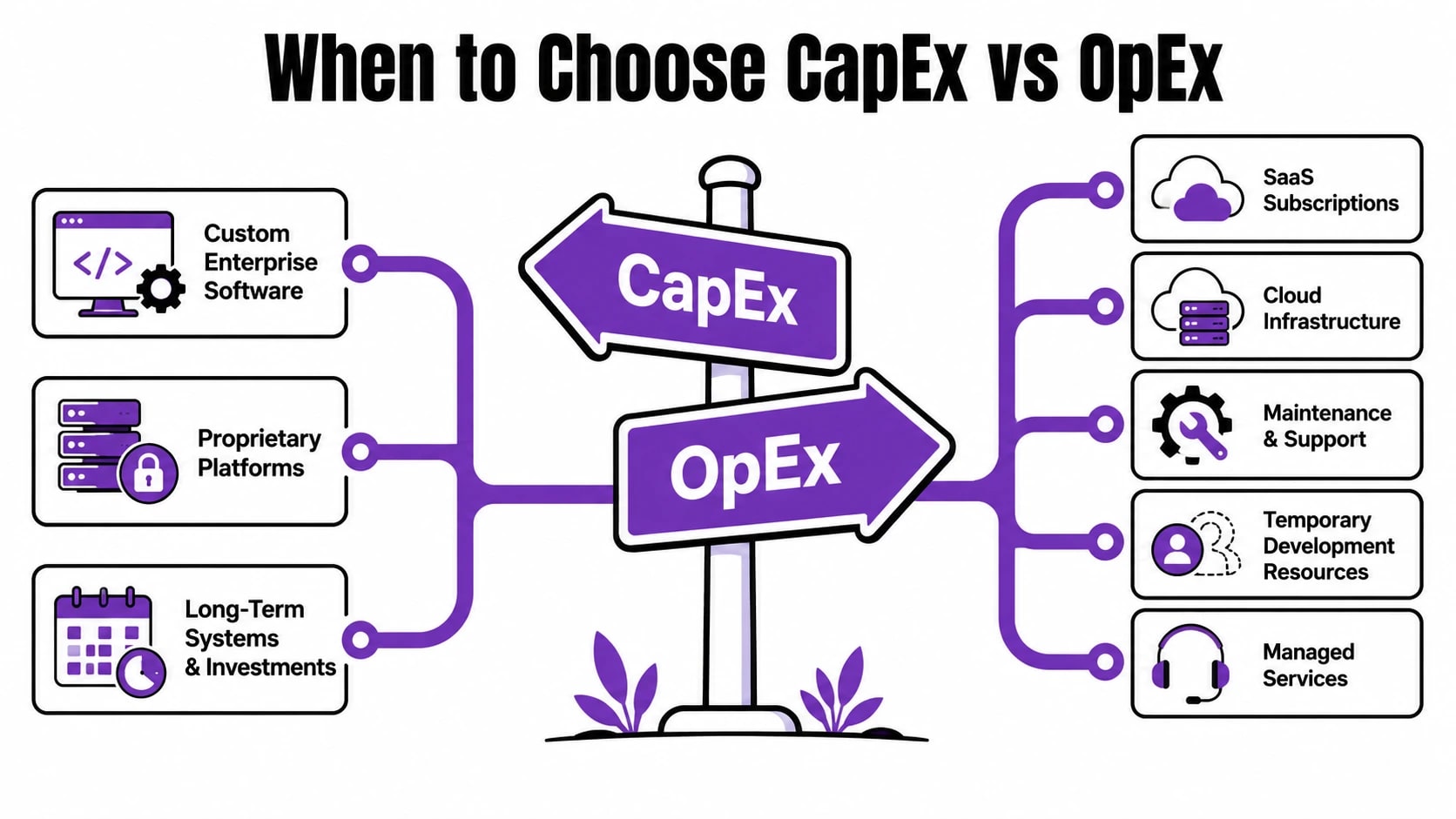
The right classification model depends heavily on your company’s financial goals, funding stage, and the nature of the software being built. A profitable enterprise with strong cash reserves might prefer CapEx treatment to spread costs over time and reduce taxable income through depreciation. Meanwhile, a venture-backed startup burning through runway typically benefits from OpEx treatment, since it keeps reported assets lean and aligns spending with the periods in which value is actually being consumed. Neither approach is universally superior, and the decision should be driven by your specific situation rather than a general preference.
Consider a retail company commissioning a custom inventory management platform that will be used internally for the next five or more years. The development cost here is a strong candidate for capitalization. The asset has a defined useful life, it produces measurable future value, and once deployed, it replaces a recurring operational cost. Contrast that with a startup paying a monthly fee for a cloud-based project management tool or outsourcing ongoing feature development to a software partner under a rolling contract. Those costs lack a fixed asset, offer no long-term ownership, and are consumed month by month, making them natural operating expenses.
The following table outlines common software project types and their typical classification:
| Project Type | Typical Classification | Key Reason |
|---|---|---|
| Custom internal software built from scratch | CapEx | Creates a long-lived intangible asset |
| SaaS subscription (third-party tools) | OpEx | No ownership, consumed monthly |
| Ongoing feature development and enhancements | OpEx or mixed | Maintains rather than materially extends the asset |
| Major version rebuild or platform migration | CapEx | Substantially extends useful life or adds new capability |
| Bug fixes and routine maintenance | OpEx | Preserves existing functionality, no new value created |
| Research and feasibility studies | OpEx | Pre-development phase, future benefit not yet probable |
Common Mistakes Companies Make When Classifying Software Development Costs
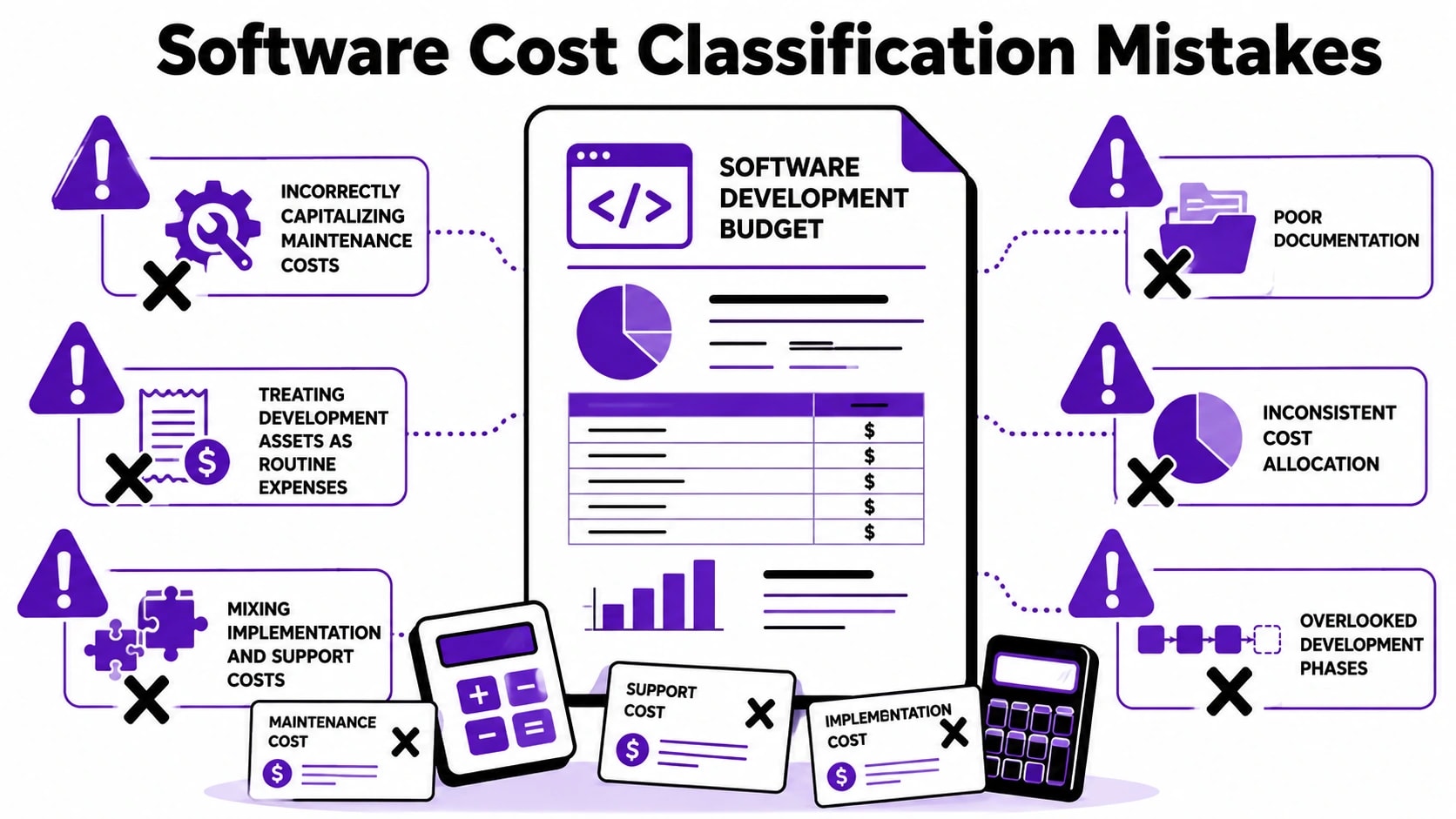
One of the most frequent errors is treating all software spending as either entirely CapEx or entirely OpEx without breaking down the project into its distinct phases. Under accounting standards like ASC 350-40, only the application development phase qualifies for capitalization. Costs incurred during the preliminary project stage, such as evaluating vendors, defining requirements, or conducting feasibility analysis, must be expensed immediately. Similarly, post-implementation costs like user training, minor bug fixes, and ongoing support fall squarely into operating expenses. Lumping everything together creates inaccurate financial statements and exposes companies to audit risk.
Another widespread mistake involves misclassifying cloud and subscription-based software costs. Companies sometimes attempt to capitalize SaaS fees because the software feels integral to operations, but under current guidance, fees paid to access software hosted on a vendor’s infrastructure generally cannot be capitalized as an intangible asset. The distinction matters because you never own the underlying code. Only implementation costs tied to configuring or customizing the SaaS application may qualify for capitalization in certain cases, and even then, the rules are nuanced. Getting this wrong inflates your asset base and understates expenses.
Here are the most common classification mistakes to watch for:
- Capitalizing preliminary-stage costs such as market research, vendor evaluation, and initial planning meetings
- Expensing large-scale development projects that clearly generate long-lived internal assets
- Failing to separate labor costs by project phase, making it impossible to defend capitalization decisions during an audit
- Treating SaaS subscription fees as capital expenditures simply because the tool is business-critical
- Capitalizing post-go-live maintenance and support without evidence that those costs extend the asset’s useful life
- Ignoring the amortization schedule after capitalization, which leads to overstated assets on the balance sheet over time
How Techlad Helps Clients Structure Software Projects for Clean Financial Classification
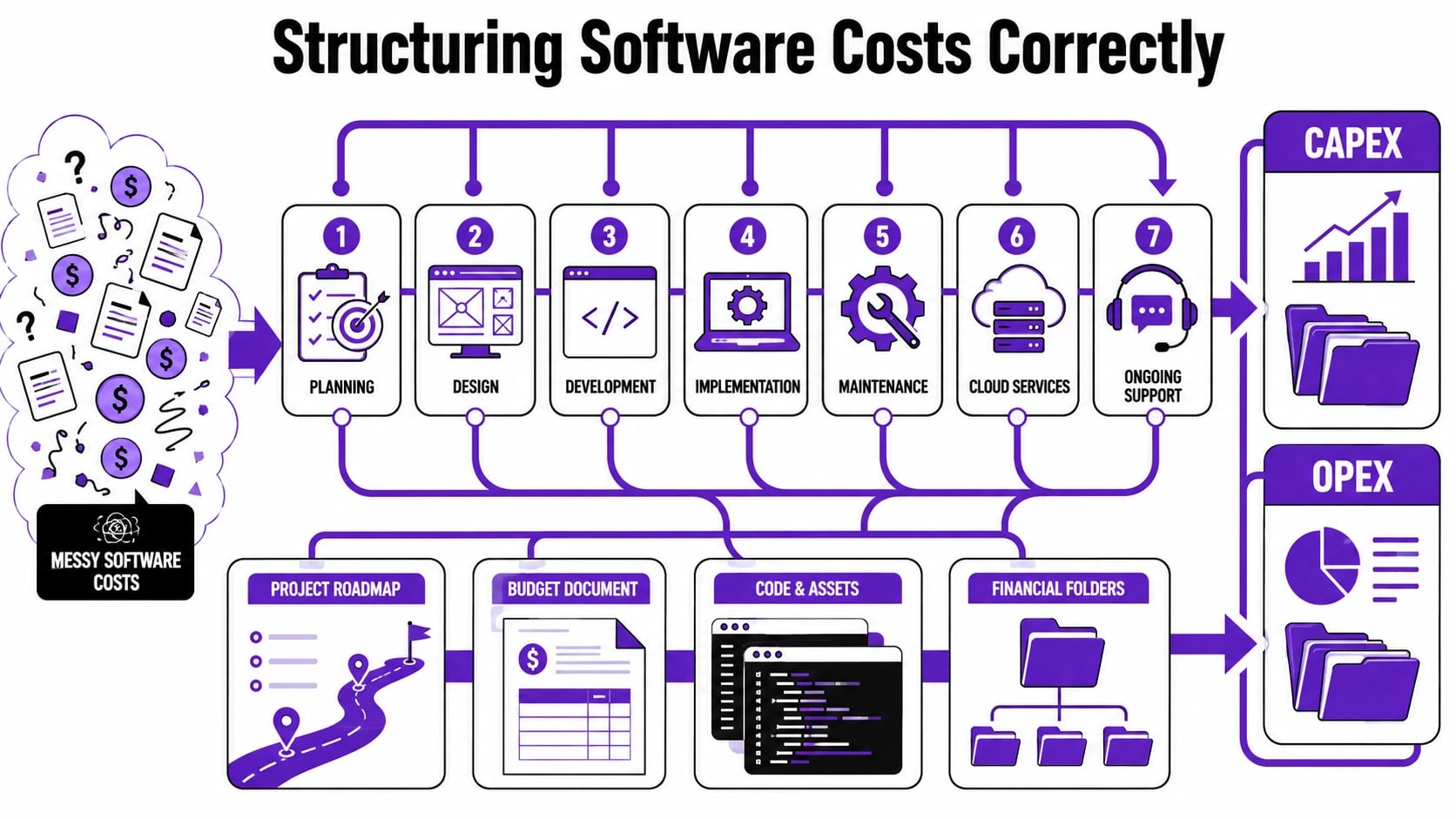
When businesses engage Techlad for custom software development, one practical advantage is the way projects are structured and documented from the start. Rather than delivering a single undifferentiated invoice for a year’s worth of development work, project scopes are broken into clearly defined phases: preliminary discovery, active application development, and post-launch support, each tracked and invoiced separately. This granularity gives finance teams and auditors a clear paper trail that maps directly to accounting standards, making the capitalization decision straightforward rather than a retroactive guessing game.
For clients building SaaS products or internal platforms where CapEx treatment is the goal, Techlad’s development teams document time allocation by phase and feature, distinguishing between work that creates new functionality and work that simply maintains existing capability. This level of detail directly supports the kind of cost segregation that accountants need to defend capitalized balances. For clients who prefer OpEx simplicity, such as those operating under tight cash flow constraints or seeking predictable monthly spend, Techlad also offers flexible engagement models, including retainer-based development partnerships where costs are recognized as they occur.
Beyond the development work itself, Techlad can assist with structuring contracts and project milestones to align with a client’s preferred financial treatment. Consider what clean classification enables:
- Accurate reporting of intangible assets on the balance sheet, strengthening investor confidence
- Defensible amortization schedules tied to realistic useful-life estimates for each software module
- Predictable operating expense recognition for subscription and retainer arrangements
- Cleaner due diligence preparation for fundraising rounds or acquisition conversations
- Reduced risk of restatement when auditors scrutinize software capitalization practices
Key Decision Factors: How to Choose Between CapEx and OpEx for Your Next Software Project
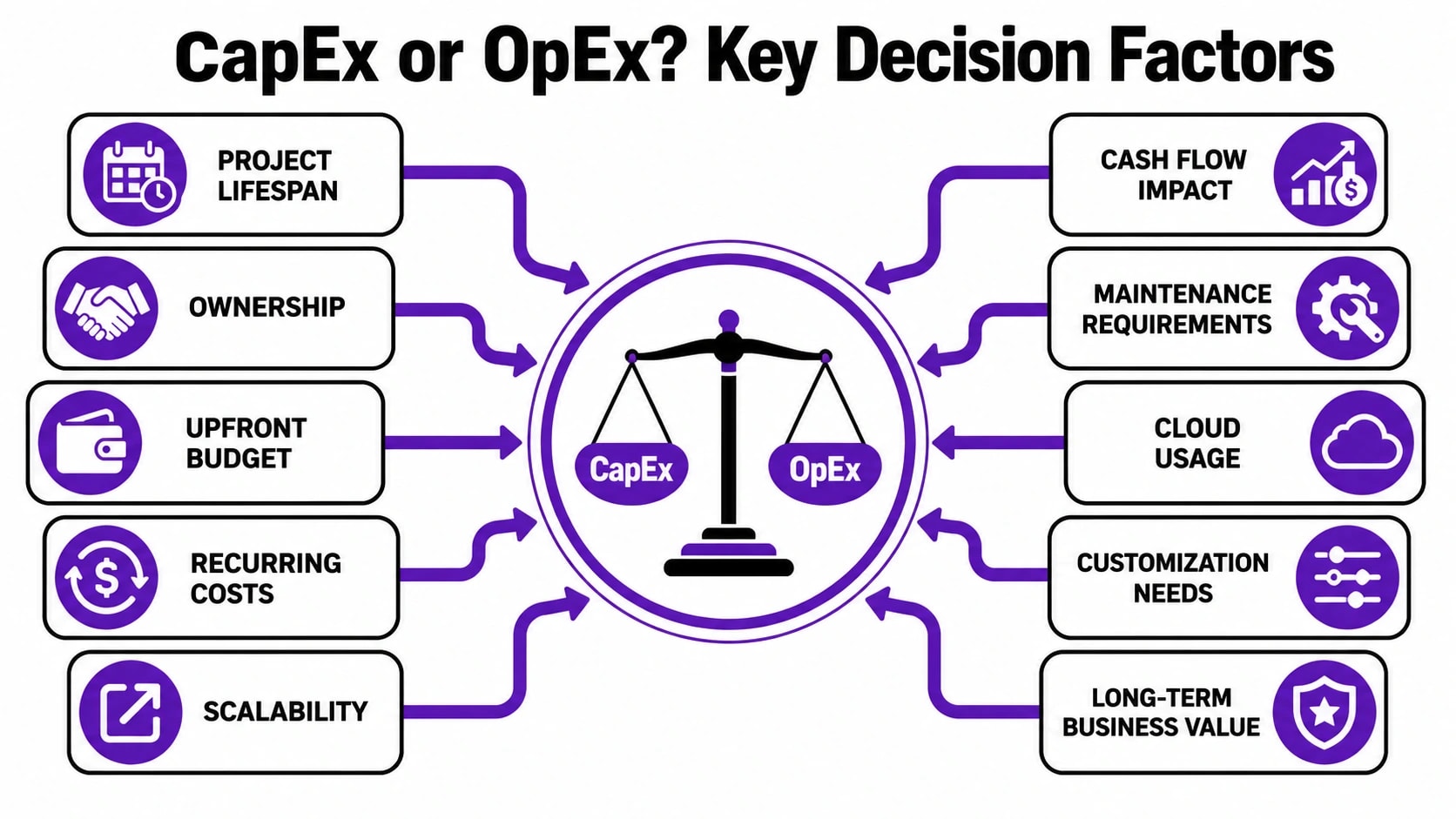
Choosing the right classification model is not a one-size-fits-all decision. It depends on your company’s financial goals, tax position, cash flow situation, and the nature of the software being built. Working through a clear set of decision factors before a project starts will save you from costly reclassifications and accounting headaches later.
Start with Your Cash Flow Reality
If preserving cash in the short term is a priority, an OpEx model is almost always the better fit. Subscription-based services, managed development teams billed monthly, and cloud hosting costs spread the financial burden evenly. CapEx, by contrast, requires absorbing high upfront costs before any benefit appears on your income statement.
- Early-stage startups with limited runway typically benefit from OpEx structures.
- Profitable companies with strong cash reserves may prefer CapEx to reduce taxable income through depreciation.
- Businesses in growth phases often mix both, capitalising core platform development while expensing ongoing iterations.
Consider the Software’s Expected Lifespan and Ownership
CapEx makes the most sense when you are building something with a long, defined useful life and clear ownership. If the software will serve your business for five or more years and is entirely proprietary, capitalising its development costs reflects its true economic value. If the software is experimental, likely to change significantly within a year, or depends on third-party platforms you do not control, expensing it as OpEx is the safer and more accurate approach.
Factor In Your Industry and Reporting Requirements
Public companies, investor-backed startups, and businesses operating under strict accounting standards such as IFRS or US GAAP must follow specific rules about when capitalisation is even permitted. Getting this wrong does not just affect your books; it can trigger audit findings or misrepresent your financial position to stakeholders.
| Decision Factor | Lean Toward CapEx | Lean Toward OpEx |
|---|---|---|
| Cash flow position | Strong reserves, profitable | Limited runway, early stage |
| Software lifespan | 5+ years, clearly defined | Short-term, experimental |
| Ownership model | Fully proprietary asset | SaaS subscriptions, licensed tools |
| Tax strategy | Spread deductions over time | Maximise immediate deductions |
| Development phase clarity | Clear build phase with milestones | Ongoing maintenance, support |
| Reporting obligations | IFRS/GAAP capitalisation criteria met | Strict expense-only requirements |
When multiple factors point in opposite directions, splitting costs across both models is often the most defensible approach. Many businesses capitalise the application development phase of a project while expensing preliminary research and post-launch maintenance, which aligns with standard accounting guidance and produces cleaner financial statements.
Conclusion
The choice between CapEx and OpEx in software development is rarely just an accounting formality. It shapes how your business reports profitability, manages cash flow, handles taxes, and presents itself to investors or lenders. Understanding the difference between building a long-term asset and paying for an ongoing service gives you the clarity to make financial decisions that actually match how your software projects work in practice. Neither model is universally better, but the wrong classification applied consistently can distort your financial picture and create real problems during audits or funding rounds.
The smartest approach is to make this decision before a project begins, not after the invoices arrive. Work with your finance team and development partners early to define project phases clearly, document your cost allocation rationale, and align your contracts with the classification you intend to use. If you are building a custom platform, SaaS product, or scalable web application and want your development structured in a way that supports clean financial reporting, the team at Techlad can help you plan projects with that clarity built in from day one.
Frequently Asked Questions
Can a single software project include both CapEx and OpEx costs?
Yes, and this is actually very common. The preliminary research phase and post-launch maintenance are typically expensed as OpEx, while the core application development phase can be capitalised as CapEx. Clear documentation of each phase makes this split defensible and audit-ready.
Does using a SaaS tool automatically make it an OpEx cost?
In most cases, yes. Subscription-based SaaS products do not transfer ownership to your business, so they are treated as operating expenses. You are paying for access to a service, not acquiring an asset, which means the cost flows directly through your income statement each period.
How does cloud hosting fit into CapEx vs OpEx classification? regularlyregularly
Cloud hosting is almost always classified as OpEx because you are paying for computing resources on a recurring basis without owning the underlying infrastructure. Unlike purchasing physical servers, cloud services are consumption-based operating costs that are expensed as incurred each billing period.
What happens if software development costs are misclassified?
Misclassification can overstate or understate your assets, distort profitability metrics, and create problems during audits or investor due diligence. It may also affect your tax position, either by deferring deductions you could have taken or by claiming deductions that are not yet permitted under accounting rules.
Is agile software development harder to classify as CapEx?
Agile development can make capitalisation more complex because work is iterative rather than phase-based. However, many companies successfully apply CapEx to agile projects by tracking developer time against defined features or user stories, clearly separating build work from research and maintenance activities throughout the process.