

 Post by
 The benefits of inhouse software development include greater project control, faster communication, stronger collaboration, improved software quality, better security, faster product iteration, long-term knowledge retention, and closer alignment between technology teams and business goals. Internal development teams are particularly valuable for businesses building strategic, long-term software products.
Software has evolved from a business support function into a competitive advantage. Whether you’re building a customer-facing application, an internal workflow system, or an enterprise platform, the quality and speed of software development can directly influence growth, customer satisfaction, and long-term profitability.
As businesses become more dependent on digital products, many are rethinking how software is developed. While outsourcing remains a popular option, an increasing number of organizations are investing in internal engineering teams to gain greater control over their technology, protect intellectual property, and accelerate innovation.
The benefits of inhouse software development extend beyond simply having developers on payroll. An internal team develops a deeper understanding of your products, customers, and business objectives. They collaborate closely with stakeholders, respond faster to changing requirements, and continuously improve software based on real user feedback.
That doesn’t mean in-house development is always the right solution. Building an internal team requires significant investment in hiring, training, infrastructure, and leadership. The best approach depends on your business goals, budget, and long-term technology strategy.
Read More On Software Developer Salary Without Degree: Pay & Skills
What Is Inhouse Software Development?
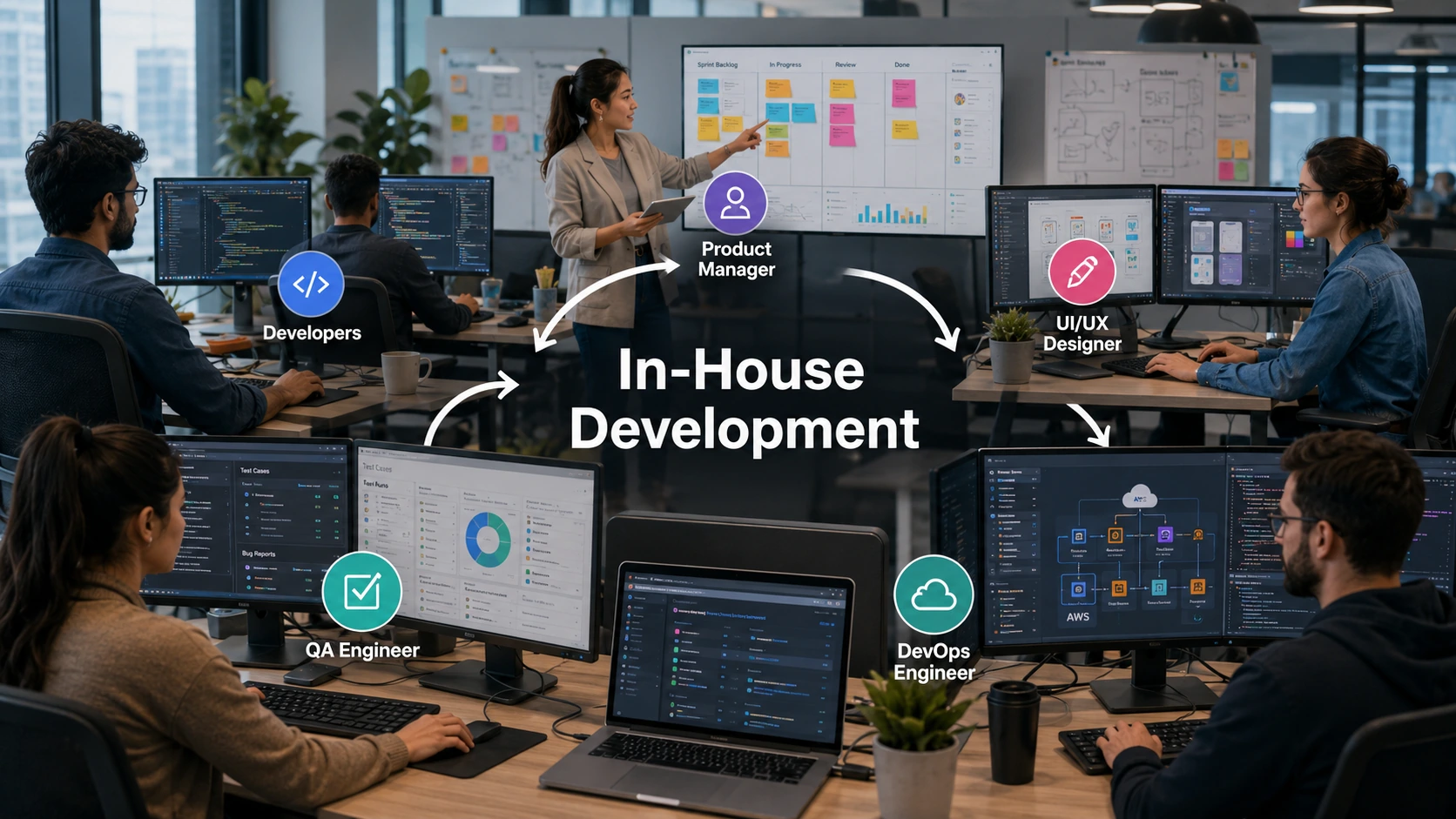
In-house software development refers to building and maintaining software using a company’s own employees rather than relying on external vendors, freelancers, or outsourcing firms.
These developers work directly for your organization and collaborate closely with product managers, designers, QA engineers, security specialists, and business stakeholders throughout the software development lifecycle.
Unlike outsourced teams, in-house developers become deeply familiar with your company’s goals, customers, internal processes, and technical environment.
Because they are part of the organization, they often contribute beyond writing code. They participate in strategic planning, product discussions, architecture decisions, technical debt management, and long-term innovation.
Read More On Best Colleges for Software Development in 2026
Typical In-House Development Team Structure
A mature software engineering team typically includes several specialized roles working together.
- Product Manager
- Engineering Manager
- Software Architects
- Front-End Developers
- Back-End Developers
- Full-Stack Developers
- Mobile Developers
- UI/UX Designers
- QA Engineers
- DevOps Engineers
- Security Engineers
- Database Administrators
- Business Analysts
- Scrum Master
Smaller companies may combine multiple responsibilities into fewer roles, while larger enterprises often have dedicated specialists for each area.
How an In-House Development Workflow Typically Works
Although every organization has its own process, a typical workflow follows these stages:
- Business teams define requirements.
- Product managers prioritize features.
- Designers create wireframes and prototypes.
- Developers build new functionality.
- QA engineers test the software.
- DevOps teams automate deployment.
- Customers provide feedback.
- Developers improve the product based on user insights.
Because everyone works within the same organization, communication is generally faster and more consistent.
In-House Development vs Outsourcing vs Freelancers
Understanding the differences between these models helps businesses choose the right approach.
| Feature | In-House | Outsourcing | Freelancers |
|---|---|---|---|
| Team Ownership | Full | External | Individual |
| Communication | Excellent | Good | Varies |
| Product Knowledge | High | Medium | Low |
| Long-Term Support | Excellent | Good | Limited |
| Security Control | High | Medium | Low |
| Scalability | Medium | High | Low |
| Initial Cost | High | Medium | Low |
| Knowledge Retention | Excellent | Limited | Very Limited |
Each model has its place. The right choice depends on your business priorities, available budget, project complexity, and long-term roadmap.
Why Businesses Build Internal Development Teams
Companies rarely invest in internal engineering teams simply because they want software developers in the office. They do so because software has become a strategic business asset.
When technology directly influences customer experience, operational efficiency, and competitive advantage, many organizations prefer to keep development close to the business.
Here are the main reasons businesses choose in-house software development.
Greater Control
Internal teams give organizations complete visibility into every stage of development, from planning and design to deployment and maintenance.
Decision-makers can quickly adjust priorities without renegotiating contracts or waiting for external vendors.
Better Collaboration
Developers work alongside product managers, designers, marketers, customer support teams, and executives.
This close collaboration reduces misunderstandings and ensures software aligns with business objectives.
Faster Innovation
Internal teams can experiment, prototype, and release new features much faster because communication happens directly within the organization.
There are fewer delays caused by time zones, third-party approvals, or contractual limitations.
Improved Product Knowledge
Over time, in-house developers gain deep expertise in:
- Customer behavior
- Business processes
- Technical architecture
- Historical decisions
- Product roadmap
This knowledge improves software quality and accelerates future development.
Better Security
Organizations handling sensitive information often prefer internal development because they maintain direct control over:
- Source code
- Infrastructure
- Customer data
- Security policies
- Compliance requirements
This is especially important in industries such as healthcare, banking, insurance, and government.
Long-Term Cost Efficiency
Building an internal team requires higher upfront investment, but it can become more economical over several years, especially for businesses with continuous development needs.
Instead of paying repeatedly for external services, organizations invest in a team that continuously improves the product.
Stronger Company Culture
Developers who are fully integrated into the business often feel a stronger sense of ownership.
They understand how their work contributes to company success and collaborate more effectively with colleagues across departments.
20 Benefits of Inhouse Software Development

The advantages of in-house software development extend far beyond writing code. An internal engineering team becomes a long-term strategic asset that supports innovation, operational efficiency, and business growth.
Below are the 20 most significant benefits and why they matter.
1. Complete Control Over Projects
One of the biggest benefits of inhouse software development is full ownership of the development process.
Your team controls:
- Priorities
- Timelines
- Feature releases
- Technical architecture
- Quality standards
If market conditions change, you can immediately adjust priorities without renegotiating contracts or waiting for external approvals.
Business Example
An e-commerce company notices customers abandoning checkout due to a payment issue. Its internal developers can begin fixing the problem the same day instead of submitting a request to an external vendor and waiting in a development queue.
This flexibility helps businesses respond faster to customer needs and market opportunities.
2. Better Communication
Communication is one of the biggest challenges in software development.
Internal teams work closely with stakeholders every day, making it easier to:
- Clarify requirements
- Resolve issues quickly
- Share updates
- Gather feedback
- Align technical and business goals
Whether through daily stand-ups, sprint planning, or informal conversations, direct communication reduces misunderstandings and keeps projects moving forward.
3. Faster Decision Making
Businesses often need to pivot quickly.
With an in-house team, decisions involving new features, bug fixes, or product changes can happen immediately because the people responsible are already part of the organization.
There is no need to wait for vendor meetings or contract amendments.
This agility becomes a significant competitive advantage in fast-moving industries.
4. Stronger Collaboration
Successful software is rarely built by developers alone.
Product managers, UX designers, QA engineers, security specialists, marketers, and customer support teams all contribute valuable insights.
An internal team collaborates naturally across departments, resulting in software that better meets user needs and business objectives.
5. Higher Software Quality
An internal development team has a deeper understanding of your product, coding standards, business requirements, and long-term objectives. This familiarity leads to better design decisions and more consistent code quality.
Unlike external teams that may work on multiple client projects simultaneously, in-house developers remain focused on improving your software over time. They understand previous technical decisions, existing architecture, and user expectations, reducing the likelihood of introducing unnecessary complexity.
Business Example
A SaaS company developing a project management platform assigns the same engineering team to the product for several years. As they gain experience with the codebase, they identify recurring issues, improve system architecture, and reduce software defects with every release.
Why It Matters
- Better code consistency
- Fewer production bugs
- Improved maintainability
- Higher customer satisfaction
6. Better Knowledge Retention
One of the biggest challenges with outsourced development is knowledge loss.
When an external contract ends, valuable information about system architecture, business logic, and technical decisions often leaves with the vendor.
An internal team retains this knowledge within the company.
Developers build expertise over time by working on multiple releases, documenting technical decisions, mentoring new employees, and continuously improving the software.
This institutional knowledge makes future development faster and less risky.
Best Suited For
- Enterprise software
- SaaS platforms
- Long-term digital products
- Mission-critical applications
7. Greater Flexibility
Business priorities rarely remain static.
Customer feedback, market trends, regulations, and competitor activity often require rapid changes.
An in-house team can quickly:
- Change sprint priorities
- Release urgent fixes
- Add requested features
- Respond to customer feedback
- Adjust product roadmaps
This flexibility helps businesses remain competitive in rapidly changing markets.
Business Example
A retail company launches a seasonal promotion earlier than planned. Its internal developers quickly modify the mobile app and website to support the campaign without waiting for an external vendor’s availability.
8. Improved Security
Security has become one of the strongest arguments for building internal software teams.
Internal developers operate within the company’s security framework and follow established policies for:
- Access management
- Source code protection
- Secure development practices
- Identity management
- Data encryption
- Compliance requirements
Organizations maintain direct control over sensitive assets rather than sharing them with multiple third parties.
This is especially valuable for businesses handling:
- Financial records
- Healthcare information
- Government data
- Intellectual property
- Customer payment information
9. Easier Compliance
Many industries must comply with strict regulations.
Examples include:
- GDPR
- HIPAA
- PCI DSS
- ISO 27001
- SOC 2
Internal development teams work closely with legal, compliance, and cybersecurity departments throughout the software development lifecycle.
This collaboration helps ensure compliance requirements are built into the product instead of being added later.
Business Example
A healthcare provider developing an electronic medical records platform involves security engineers and compliance specialists from the beginning, reducing costly redesigns before launch.
10. Faster Bug Resolution
Every software product experiences bugs.
The difference lies in how quickly they are resolved.
Because in-house developers understand the application architecture and deployment process, they can often identify the root cause much faster than an external team that first needs to understand the environment.
This results in:
- Faster incident response
- Shorter downtime
- Better customer experience
- Higher system reliability
For customer-facing applications, quick bug fixes directly impact user satisfaction.
11. Better Product Understanding
Software developers who interact regularly with product managers, sales teams, customer support representatives, and end users develop a much deeper understanding of the product.
This context helps them make smarter technical decisions.
Rather than simply implementing requested features, they begin suggesting improvements that enhance usability, performance, and scalability.
Over time, developers become product experts rather than just programmers.
12. Stronger Innovation
Innovation happens when technical expertise meets business knowledge.
Internal teams continuously identify opportunities to:
- Automate workflows
- Improve performance
- Introduce AI capabilities
- Reduce operational costs
- Enhance customer experiences
Because developers understand both technology and business goals, they often contribute ideas beyond software implementation.
Business Example
An internal engineering team notices repeated customer support requests and develops a self-service AI chatbot, reducing support costs while improving customer satisfaction.
13. Higher Employee Engagement
Developers generally feel more motivated when they understand the impact of their work.
Instead of completing isolated tasks for different clients, internal engineers contribute directly to a product they use, improve, and maintain over time.
This sense of ownership often leads to:
- Better collaboration
- Increased accountability
- Higher productivity
- Greater innovation
Engaged employees are also more likely to stay with the company, reducing recruitment costs.
14. Long-Term Cost Savings
Building an internal development team requires significant upfront investment.
Costs include:
- Recruitment
- Salaries
- Office equipment
- Development tools
- Training
- Infrastructure
However, organizations with continuous software development needs often achieve better long-term value compared to repeatedly outsourcing projects.
Internal teams eliminate recurring vendor fees while continuously improving the same software.
Important Note
The return on investment is usually highest for businesses developing products over multiple years rather than short-term projects.
15. Better Customer Experience
Internal developers have direct access to customer feedback from support teams, product managers, analytics platforms, and user research.
This continuous feedback loop helps teams:
- Improve usability
- Remove friction
- Fix recurring issues
- Deliver requested features
- Increase customer satisfaction
Customer-centric development often leads to higher retention and stronger brand loyalty.
16. Easier Agile Development
Agile methodologies rely on constant communication and collaboration.
Internal teams naturally support Agile practices such as:
- Daily stand-ups
- Sprint planning
- Sprint reviews
- Retrospectives
- Continuous feedback
Quick communication allows teams to adjust priorities without delays caused by external contracts or multiple approval layers.
17. Faster Product Iteration
Modern software products evolve continuously.
Internal teams can release improvements more frequently because they control the entire development process.
Benefits include:
- Faster feature releases
- Continuous improvements
- Rapid experimentation
- Shorter release cycles
- Better responsiveness to customer needs
Companies that iterate quickly often outperform slower competitors.
18. Better Integration With Existing Systems
Most businesses rely on multiple systems working together.
Examples include:
- CRM platforms
- ERP systems
- HR software
- Payment gateways
- Analytics platforms
- Customer support tools
Internal developers understand your technology ecosystem and can build integrations that are secure, scalable, and easier to maintain.
19. Greater Competitive Advantage
Technology increasingly differentiates businesses within almost every industry.
An internal development team enables organizations to:
- Launch features faster
- Build proprietary technology
- Improve operational efficiency
- Deliver unique customer experiences
Rather than relying on off-the-shelf solutions used by competitors, businesses create capabilities that are difficult to replicate.
This strengthens long-term market positioning.
20. Stronger Company Culture
Software development is no longer isolated from the rest of the business.
Developers contribute to strategy discussions, customer experience improvements, and operational efficiency.
When engineering teams are integrated into the company culture, they:
- Share business goals
- Collaborate across departments
- Take ownership of outcomes
- Support continuous improvement
This alignment creates stronger teamwork and more successful software projects.
Key Takeaways
The benefits of inhouse software development extend far beyond technical implementation. Internal engineering teams create long-term business value by improving collaboration, accelerating innovation, strengthening security, and enabling faster decision-making.
Organizations that view software as a strategic asset often find that investing in an internal team provides advantages that go well beyond the initial development costs.
Benefits Summary Table
| Benefit | Primary Business Value |
|---|---|
| Complete Project Control | Better governance |
| Better Communication | Faster collaboration |
| Faster Decisions | Greater agility |
| Stronger Collaboration | Better alignment |
| Higher Software Quality | Reliable applications |
| Knowledge Retention | Long-term efficiency |
| Greater Flexibility | Rapid adaptation |
| Improved Security | Better risk management |
| Easier Compliance | Regulatory confidence |
| Faster Bug Resolution | Higher uptime |
| Better Product Understanding | Smarter features |
| Stronger Innovation | Business growth |
| Higher Employee Engagement | Improved productivity |
| Long-Term Cost Savings | Better ROI |
| Better Customer Experience | Higher retention |
| Easier Agile Development | Faster delivery |
| Faster Product Iteration | Competitive advantage |
| Better System Integration | Operational efficiency |
| Greater Competitive Advantage | Market differentiation |
| Stronger Company Culture | Sustainable success |
In-House vs Outsourced Software Development
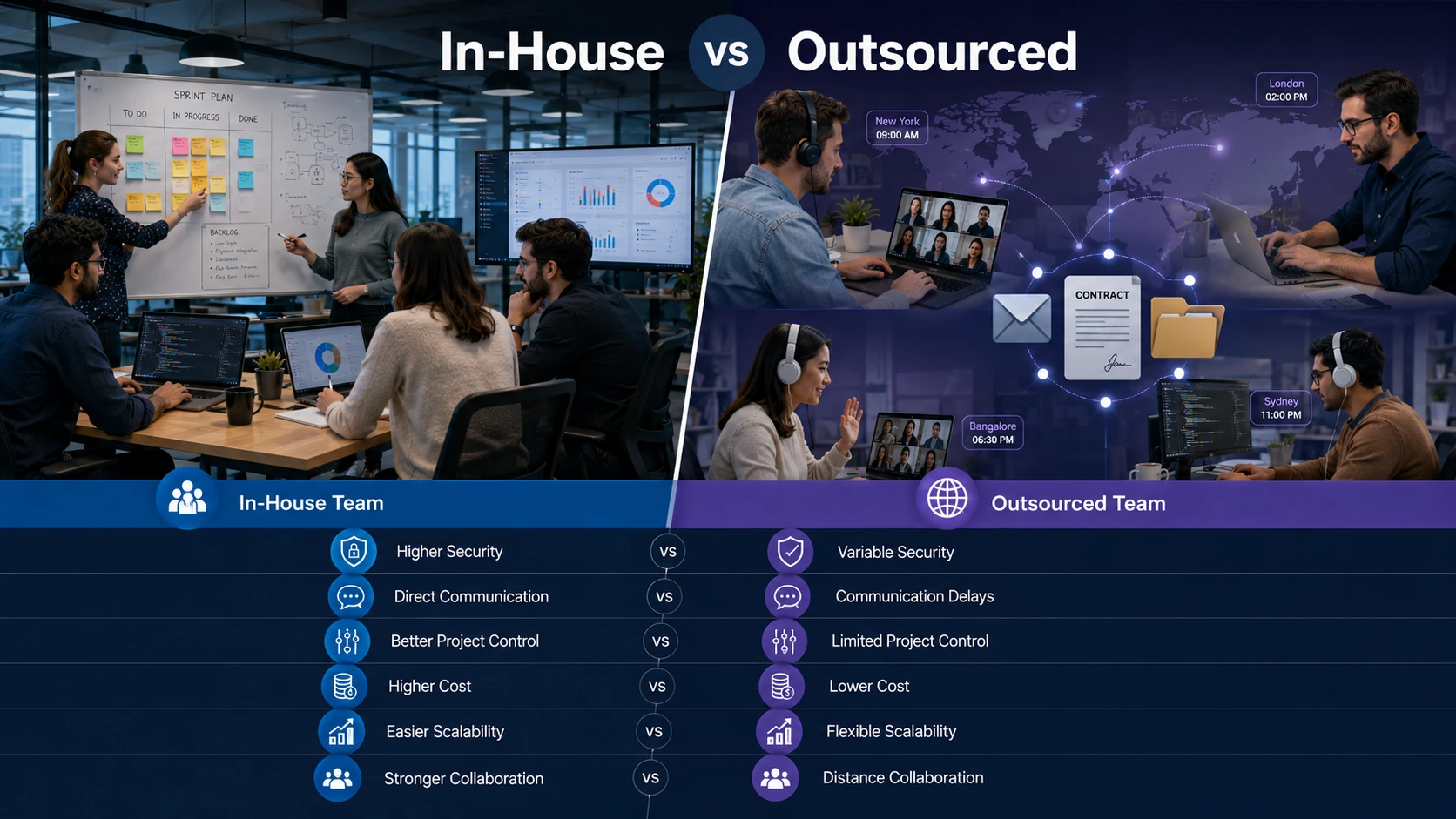
Choosing between an in-house development team and outsourcing is one of the most important technology decisions a business can make. There isn’t a universal answer because the right approach depends on your budget, project complexity, internal expertise, security requirements, and long-term business goals.
Companies developing software as a core business asset often benefit from building internal engineering capabilities. On the other hand, organizations with limited technical resources or short-term projects may achieve better results through outsourcing.
Understanding the strengths and limitations of each model helps you make a more informed decision.
Comparison Table
| Factor | In-House Development | Outsourced Development |
|---|---|---|
| Initial Cost | Higher | Lower |
| Long-Term Cost | Often lower for ongoing products | Can increase over multiple projects |
| Communication | Direct and immediate | Depends on vendor and time zones |
| Product Knowledge | Deep understanding | Limited to project scope |
| Project Control | Complete ownership | Shared with vendor |
| Development Speed | Fast after team is established | Fast for immediate project start |
| Scalability | Slower hiring process | Easier to scale quickly |
| Security | High internal control | Depends on vendor practices |
| Compliance | Easier internal governance | Requires additional oversight |
| Innovation | Strong alignment with business goals | Varies by vendor |
| Intellectual Property | Fully retained internally | Requires contractual protection |
| Maintenance | Continuous long-term support | Often billed separately |
| Team Collaboration | Excellent | More structured communication |
| Flexibility | High | Depends on contract terms |
| Best For | Long-term software products | Short-term or specialized projects |
When In-House Development Is the Better Choice
An internal development team is often the right investment when:
- Software is central to your business.
- You need continuous feature development.
- Customer experience depends on technology.
- Security and compliance are critical.
- You want complete ownership of your codebase.
- Long-term innovation is a priority.
- You expect the product to evolve for years.
Example
A SaaS company delivering project management software releases new features every two weeks. Because product innovation drives revenue, maintaining an internal engineering team ensures rapid iteration and deep product knowledge.
When Outsourcing Makes More Sense
Outsourcing can be a practical option when:
- You need to launch quickly.
- Your internal technical resources are limited.
- The project has a clearly defined scope.
- You require specialized expertise.
- Hiring full-time developers isn’t financially viable.
- The software isn’t a core competitive advantage.
Example
A manufacturing company needs a simple employee scheduling application. Rather than hiring a permanent engineering team, outsourcing the project to an experienced software development firm may be more cost-effective.
Can Businesses Combine Both Models?
Yes.
Many successful organizations adopt a hybrid development model.
For example:
- Core platform development remains in-house.
- Specialized AI projects are outsourced.
- UI design is handled by an external agency.
- Security testing is performed by third-party experts.
- Internal engineers manage architecture and product strategy.
This approach balances flexibility with long-term ownership.
Challenges of Inhouse Software Development

Although the benefits are significant, building an internal engineering team also comes with challenges.
Understanding these obstacles allows businesses to prepare realistic strategies before investing.
1. Hiring Skilled Developers
Finding experienced software engineers is increasingly competitive.
Companies often compete with:
- Global technology firms
- Fast-growing startups
- Remote employers
- International recruiters
How to Overcome It
- Build a strong employer brand.
- Offer career development opportunities.
- Provide competitive compensation.
- Invest in internships and graduate programs.
- Support flexible work arrangements.
2. Higher Initial Costs
Internal development requires investment in:
- Salaries
- Recruitment
- Office equipment
- Software licenses
- Cloud infrastructure
- Training
Although these costs are high, they often become more economical over the lifespan of long-term software products.
3. Talent Retention
Replacing experienced developers is expensive.
Losing key engineers can delay projects and reduce productivity.
Best Practices
- Encourage continuous learning.
- Provide technical career paths.
- Recognize employee achievements.
- Foster a collaborative engineering culture.
4. Infrastructure Management
Internal teams require reliable development environments.
This includes:
- Cloud platforms
- Development servers
- CI/CD pipelines
- Testing environments
- Security monitoring
- Source code repositories
Proper infrastructure improves productivity and software quality.
5. Continuous Learning
Technology changes rapidly.
Developers need regular training in:
- New programming languages
- Cloud technologies
- Cybersecurity
- AI development
- DevOps
- Framework updates
Organizations that invest in learning remain more competitive.
6. Scaling Teams
Expanding an engineering team isn’t as simple as hiring more developers.
Growth requires:
- Team leads
- Engineering managers
- Onboarding processes
- Documentation
- Architecture planning
Poor scaling can reduce productivity instead of improving it.
7. Management Overhead
Internal development teams require effective leadership.
Engineering managers must balance:
- Product priorities
- Technical quality
- Employee development
- Delivery timelines
- Budget constraints
Strong leadership is essential for long-term success.
8. Technology Evolution
Programming languages, frameworks, cloud platforms, and security standards evolve constantly.
Businesses must regularly modernize their technology stack to avoid accumulating technical debt.
How to Build a Successful In-House Development Team
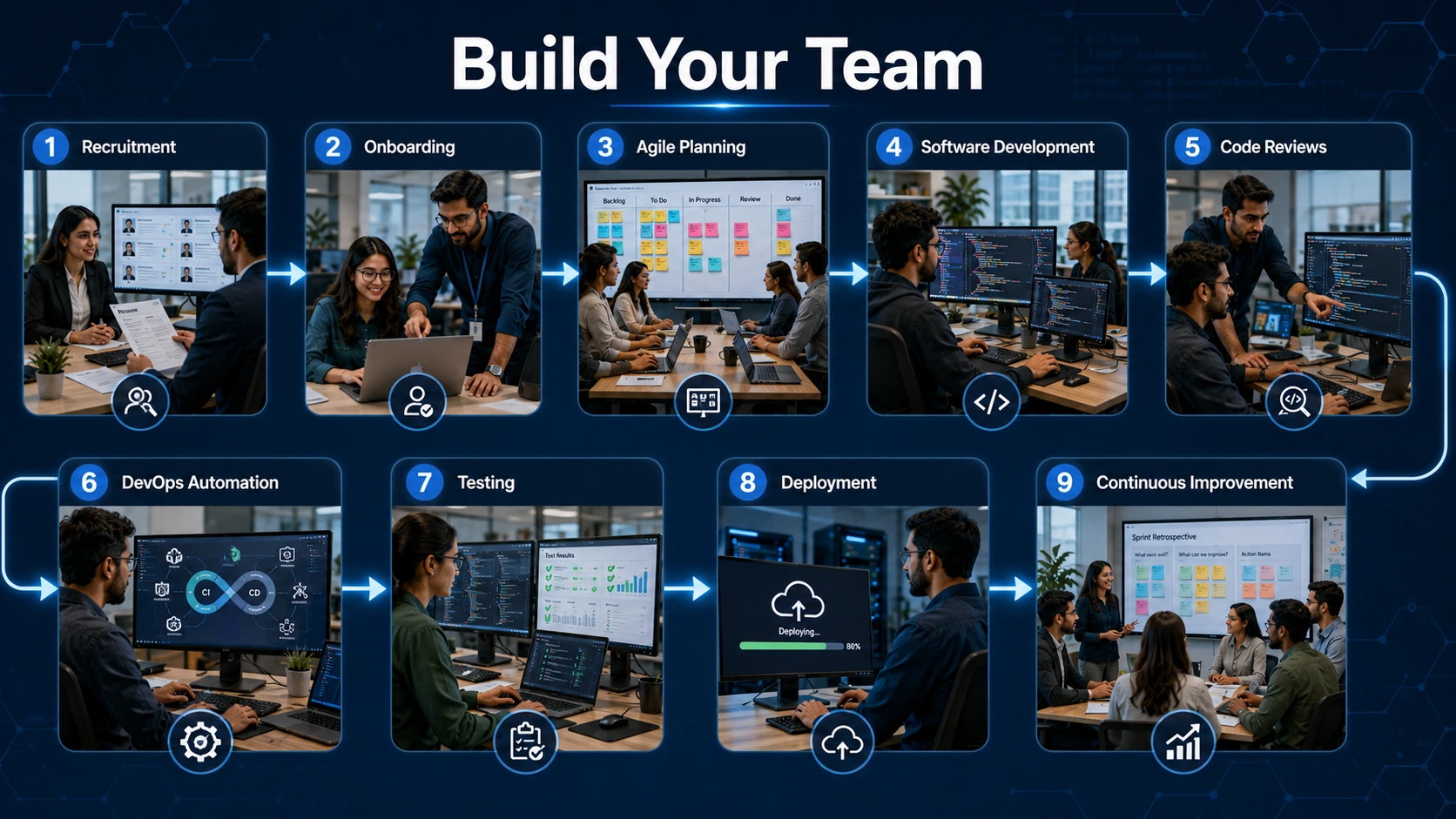
Building an engineering team involves much more than hiring developers.
Successful organizations focus on people, processes, and technology together.
Hire the Right Mix of Skills
A balanced engineering team typically includes:
- Product Manager
- Technical Lead
- Front-End Developers
- Back-End Developers
- QA Engineers
- DevOps Engineers
- UX Designer
- Security Engineer
Every role contributes to delivering reliable software.
Hire for Long-Term Potential
Technical ability matters, but so do:
- Communication
- Problem-solving
- Curiosity
- Collaboration
- Adaptability
Technology changes faster than technical interviews.
Developers who learn quickly often become your strongest long-term contributors.
Adopt Agile Development
Agile enables teams to deliver value continuously.
Core Agile practices include:
- Sprint planning
- Daily stand-ups
- Sprint reviews
- Retrospectives
- Product backlog refinement
These practices encourage continuous improvement.
Invest in DevOps
Modern software development depends on automation.
Implement:
- Continuous Integration (CI)
- Continuous Deployment (CD)
- Automated testing
- Infrastructure as Code
- Monitoring
- Logging
Automation reduces manual effort while improving reliability.
Encourage Documentation
Documentation should explain:
- Architecture decisions
- APIs
- Deployment processes
- Coding standards
- Business logic
Good documentation protects institutional knowledge.
Promote Knowledge Sharing
Encourage developers to:
- Present technical talks.
- Pair program.
- Conduct code reviews.
- Write internal guides.
- Mentor junior engineers.
Knowledge sharing improves team resilience and reduces dependency on individual contributors.
Best Practices for In-House Software Development
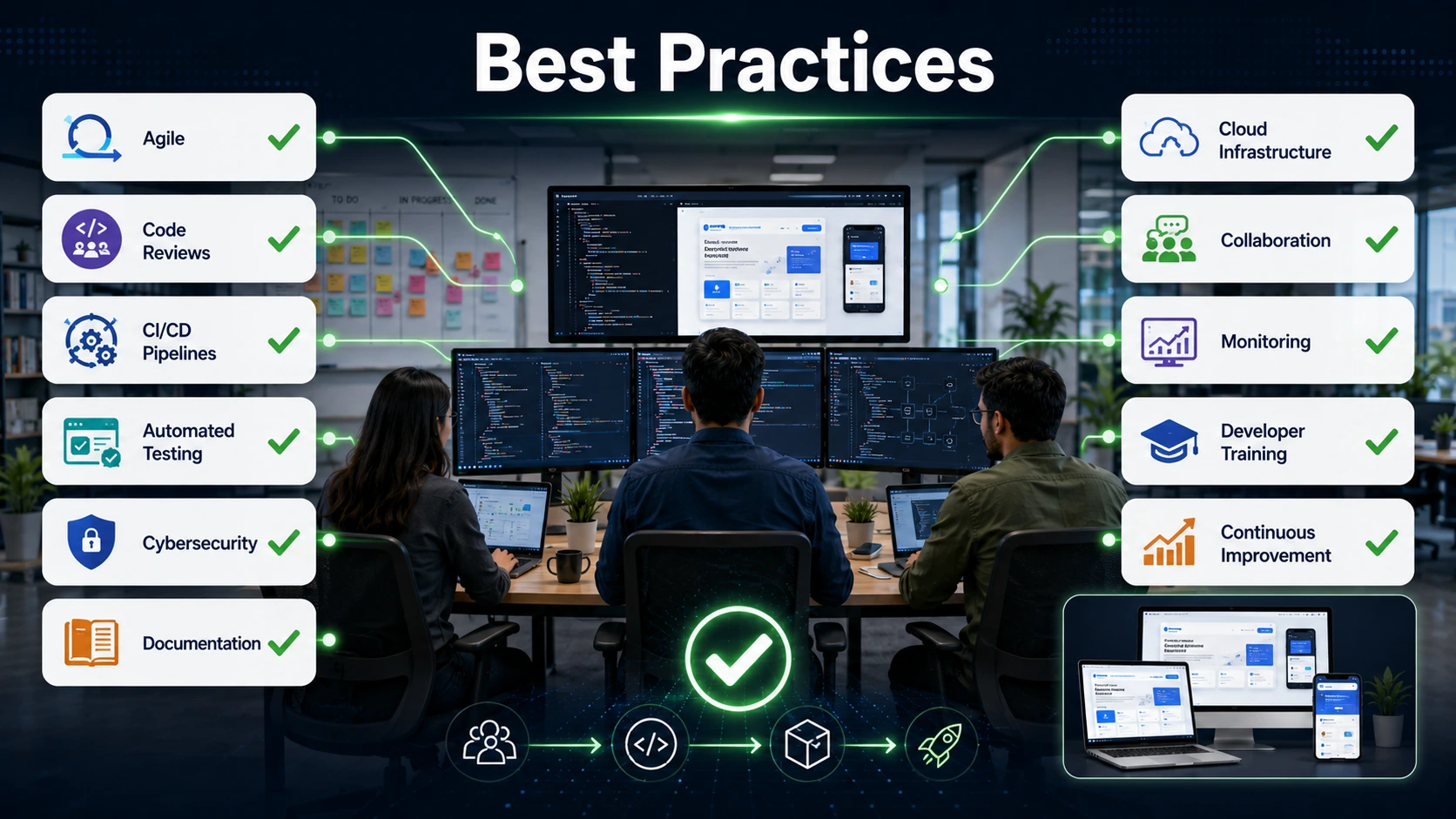
Building a successful internal development team requires consistent engineering practices.
Consider these recommendations:
Hire for Both Technical and Soft Skills
Strong collaboration often matters as much as technical expertise.
Standardize Coding Practices
Define:
- Coding guidelines
- Naming conventions
- Documentation standards
- Review processes
Consistency improves maintainability.
Automate Testing
Automated tests help identify issues before deployment.
Focus on:
- Unit testing
- Integration testing
- End-to-end testing
- Security testing
Prioritize Cybersecurity
Integrate security throughout the development lifecycle.
Examples include:
- Secure coding
- Dependency scanning
- Vulnerability assessments
- Identity management
- Least privilege access
Perform Regular Code Reviews
Peer reviews improve:
- Code quality
- Knowledge sharing
- Security
- Maintainability
They also help junior developers learn from experienced engineers.
Track Engineering Metrics
Monitor key indicators such as:
- Deployment frequency
- Lead time
- Bug resolution time
- Code coverage
- Sprint velocity
Engineering metrics help identify opportunities for improvement.
Invest in Developer Experience
Provide developers with:
- Fast development environments
- Reliable tooling
- Modern hardware
- Automated workflows
Removing friction increases productivity.
Key Takeaways
Choosing between in-house and outsourced software development isn’t about determining which model is universally better. It’s about selecting the approach that best aligns with your business strategy, product goals, and available resources.
For organizations building software as a long-term competitive advantage, investing in an internal engineering team often delivers greater control, stronger collaboration, and sustainable innovation. For short-term projects or specialized expertise, outsourcing can provide flexibility and faster initial delivery.
Many modern businesses achieve the best results by combining both approaches, keeping strategic product development in-house while using external partners for niche skills or temporary capacity.
Industries That Benefit Most from Inhouse Software Development

While almost every business relies on software, some industries gain significantly more value from maintaining internal development teams. These organizations often manage sensitive data, require continuous innovation, or depend on software as a core part of their business model.
Healthcare
Healthcare providers must balance innovation with strict privacy and compliance requirements.
An internal development team can build and maintain:
- Electronic Health Record (EHR) systems
- Patient portals
- Telemedicine platforms
- Appointment scheduling systems
- Healthcare analytics dashboards
Because these applications process sensitive patient information, keeping development in-house often simplifies security management and regulatory compliance.
Banking and Financial Services
Banks and financial institutions require software that is secure, reliable, and continuously available.
Internal engineering teams commonly develop:
- Mobile banking applications
- Payment platforms
- Fraud detection systems
- Digital wallets
- Investment platforms
- Risk management tools
Keeping critical systems under direct organizational control reduces operational and security risks.
Insurance
Insurance companies increasingly compete through digital customer experiences.
Internal teams can rapidly improve:
- Claims processing
- Customer self-service portals
- Underwriting systems
- Policy management platforms
- AI-powered risk assessment
Continuous product improvement helps insurers respond to changing customer expectations.
Retail and E-Commerce
Modern retailers depend on technology for every stage of the customer journey.
Examples include:
- Online stores
- Inventory management
- Recommendation engines
- Customer loyalty platforms
- Mobile shopping apps
- Order management systems
An internal engineering team enables rapid feature releases during seasonal campaigns and promotional events.
Manufacturing
Manufacturers increasingly adopt Industry 4.0 technologies.
Internal developers help build:
- Production monitoring systems
- Predictive maintenance platforms
- Warehouse automation
- IoT dashboards
- Supply chain analytics
Custom software improves operational efficiency while supporting digital transformation initiatives.
Logistics and Transportation
Delivery companies process massive amounts of operational data every day.
Internal software teams develop:
- Fleet management systems
- Route optimization tools
- Shipment tracking
- Warehouse management
- Driver mobile applications
Fast iteration helps logistics businesses improve delivery efficiency and customer satisfaction.
Government
Government agencies manage critical public services requiring high levels of security and long-term maintenance.
Internal teams often build:
- Citizen service portals
- Tax systems
- Identity management platforms
- Digital document services
- Public safety applications
Maintaining internal expertise supports data sovereignty and long-term sustainability.
SaaS Companies
For Software-as-a-Service businesses, software is the product.
Internal engineering teams continuously improve:
- User experience
- Platform performance
- Feature releases
- Security
- Scalability
Fast product iteration directly influences customer retention and revenue growth.
Telecommunications
Telecommunications providers operate complex systems that require constant monitoring and optimization.
Internal development teams build:
- Network management platforms
- Customer portals
- Billing systems
- Service provisioning tools
- Analytics dashboards
These systems often integrate with specialized infrastructure that benefits from deep organizational knowledge.
Education
Educational institutions increasingly rely on digital platforms for teaching and administration.
Internal developers create:
- Learning management systems
- Student portals
- Online examination platforms
- Attendance systems
- Campus mobile apps
Close collaboration with educators ensures software evolves with changing academic needs.
Real-World Examples
Understanding how different organizations use in-house development makes the benefits easier to visualize.
Example 1: Startup Building Its MVP
A startup developing a project management platform hires a small internal team consisting of:
- Product Manager
- UX Designer
- Two Full-Stack Developers
Because the team works directly with early customers, they release updates every two weeks and quickly adapt the product based on user feedback.
The result is faster product-market fit and stronger customer engagement.
Example 2: Enterprise Modernizing Legacy Systems
A large manufacturing company replaces outdated desktop applications with cloud-based software.
Its internal engineering team works alongside operations managers to migrate data, redesign workflows, and integrate new applications without disrupting production.
Because developers understand the company’s existing systems, modernization happens gradually with lower operational risk.
Example 3: SaaS Company Accelerating Innovation
A software company competing in a crowded market wants to release new features every month.
Its in-house developers continuously monitor user behavior, prioritize customer requests, and improve performance through Agile development.
Frequent releases help the company stay ahead of competitors.
Example 4: Bank Improving Security
A financial institution develops a new mobile banking application using its internal engineering and cybersecurity teams.
Because developers collaborate closely with security specialists throughout the project, secure coding practices and compliance requirements are integrated from the beginning rather than added later.
This approach reduces security risks while improving customer trust.
Common Mistakes to Avoid
Building an internal software development team is a significant investment. Avoiding common mistakes improves both productivity and long-term success.
1. Hiring Too Quickly
Rushing recruitment often results in poor cultural fit and inconsistent technical skills.
2. Ignoring Documentation
Undocumented systems become increasingly difficult to maintain as teams grow.
3. Weak Onboarding
New developers need structured onboarding to become productive quickly.
4. No Coding Standards
Inconsistent coding practices reduce maintainability and increase technical debt.
5. Ignoring Technical Debt
Postponing architectural improvements eventually slows future development.
6. Poor Communication
Engineering teams should regularly communicate with product, design, support, and business stakeholders.
7. Lack of Automated Testing
Manual testing alone rarely scales for growing software products.
8. Weak Security Practices
Security should be integrated throughout development rather than treated as a final checklist.
9. Micromanaging Developers
Highly skilled engineers perform best when trusted to solve problems independently.
10. Measuring Only Output
Productivity isn’t determined by lines of code or hours worked.
Focus on business outcomes instead.
11. Delaying Infrastructure Improvements
Reliable development environments improve productivity and software quality.
12. Underestimating Team Culture
Healthy collaboration is often a stronger predictor of success than technical ability alone.
13. Ignoring Customer Feedback
Software should evolve based on user needs rather than assumptions.
14. Failing to Invest in Learning
Technology evolves rapidly.
Continuous education keeps engineering teams competitive.
15. Treating Development as an IT Function Only
Modern engineering teams contribute to business strategy, innovation, and customer experience—not just software delivery.
Future of In-House Software Development
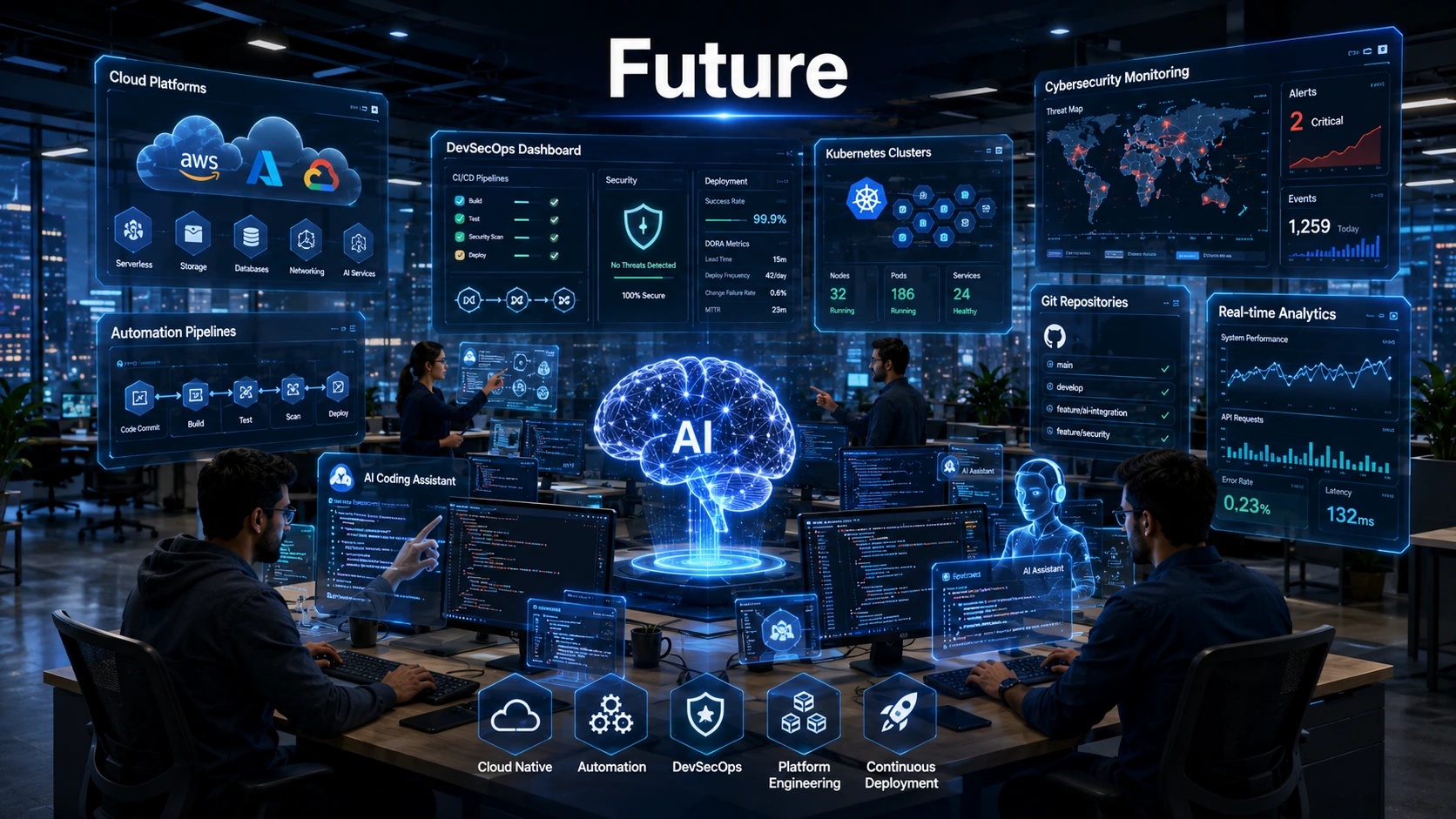
Software engineering continues to evolve as organizations adopt new technologies and development practices.
Several trends are shaping the future of internal development teams.
AI-Assisted Development
Developers increasingly use AI tools for:
- Code generation
- Documentation
- Testing
- Refactoring
- Debugging
These tools improve productivity but don’t replace engineering expertise.
DevSecOps
Security is becoming an integral part of the development lifecycle.
Organizations increasingly automate:
- Vulnerability scanning
- Dependency analysis
- Compliance checks
- Infrastructure security
Cloud-Native Development
Businesses continue moving toward:
- Containers
- Kubernetes
- Serverless computing
- Microservices
- Managed cloud services
These architectures improve scalability and resilience.
Platform Engineering
Internal developer platforms simplify software delivery by providing standardized tools, workflows, and infrastructure.
This improves consistency across engineering teams.
Remote and Distributed Teams
Many organizations now build global engineering teams while maintaining strong collaboration through cloud-based development environments.
Automation Everywhere
Automation continues expanding across:
- Testing
- Deployment
- Monitoring
- Infrastructure management
- Security
This allows developers to focus on solving business problems instead of repetitive tasks.
How to Measure Success
Building an internal development team is an investment.
Measuring success helps determine whether that investment delivers business value.
Important Engineering KPIs
| KPI | Why It Matters |
|---|---|
| Deployment Frequency | Measures delivery speed |
| Lead Time | Tracks development efficiency |
| Change Failure Rate | Indicates software quality |
| Mean Time to Recovery (MTTR) | Measures incident response |
| Sprint Velocity | Tracks Agile productivity |
| Customer Satisfaction | Reflects product quality |
| Defect Rate | Measures software reliability |
| Employee Retention | Indicates team health |
| System Availability | Measures operational reliability |
| ROI | Connects engineering investment to business outcomes |
Rather than relying on a single metric, evaluate performance across delivery, quality, customer outcomes, and team effectiveness.
In-House Software Development Checklist
Use this checklist when planning or expanding an internal engineering team.
Strategy
- Define business objectives.
- Identify long-term product goals.
- Secure executive support.
Hiring
- Recruit experienced engineers.
- Hire for technical and interpersonal skills.
- Develop structured onboarding.
Development
- Adopt Agile practices.
- Implement CI/CD.
- Standardize coding guidelines.
- Automate testing.
Security
- Integrate DevSecOps.
- Protect source code.
- Enforce access controls.
- Conduct regular security reviews.
Collaboration
- Encourage documentation.
- Perform code reviews.
- Share technical knowledge.
- Hold regular retrospectives.
Measurement
Track:
- Delivery speed
- Product quality
- Customer satisfaction
- System reliability
Final Thoughts
The benefits of inhouse software development go beyond building software. An internal team gives your business greater control, stronger collaboration, faster innovation, and long-term ownership of your technology.
While in-house development requires a larger upfront investment, it can deliver significant value for businesses that rely on software as a core part of their growth. Evaluate your goals, budget, and product strategy to determine whether an internal team, outsourcing, or a hybrid approach is the best fit.
When supported by the right people, processes, and tools, an in-house development team can become a lasting competitive advantage.
Frequently Asked Questions
The main benefits include greater project control, stronger collaboration, improved security, faster communication, better product knowledge, long-term cost efficiency, and closer alignment with business goals.
Neither approach is universally better. In-house development is often ideal for long-term strategic software, while outsourcing may suit short-term projects or specialized expertise.
Initial costs are generally higher because of recruitment, salaries, tools, and infrastructure. However, businesses with ongoing software needs often achieve stronger long-term returns.
Organizations that rely on software for competitive advantage, continuous innovation, or sensitive data management typically benefit the most.
Team size depends on project complexity. Many startups begin with three to five engineers, while larger enterprises may employ hundreds across multiple product teams.