

 Post by
 Businesses today are under constant pressure to build software faster while controlling costs and keeping pace with changing technology. Hiring and maintaining an in-house development team can be expensive, especially for startups and growing companies. This has made outsourcing software development one of the most popular business strategies across industries.
Companies outsource everything from mobile applications and enterprise software to cloud migration, artificial intelligence projects, quality assurance, cybersecurity, and ongoing maintenance. According to industry reports, the global IT outsourcing market continues to grow as organizations seek specialized expertise and flexible development resources.
Still, outsourcing is not the right solution for every project. While it can reduce costs and accelerate development, it may also introduce communication challenges, security concerns, and quality risks if managed poorly.
This guide explores the pros and cons of outsourcing software development, explains different outsourcing models, compares outsourcing with in-house development, and helps you decide whether outsourcing is the right choice for your business.
What Is Software Development Outsourcing?

Software development outsourcing is the practice of hiring an external company or an independent development team to design, build, test, deploy, or maintain software rather than relying entirely on internal employees.
Rather than recruiting developers, designers, testers, DevOps engineers, and project managers individually, organizations partner with specialized software development companies that already have experienced teams.
Outsourcing can cover an entire software project or only specific tasks, including:
- Mobile application development
- Web application development
- Enterprise software
- SaaS platforms
- API development
- Cloud migration
- Legacy software modernization
- Quality assurance and testing
- DevOps implementation
- UI/UX design
- Cybersecurity integration
- Ongoing software maintenance
Companies of every size use outsourcing. Startups often outsource because they lack engineering resources, while large enterprises outsource to scale faster or access specialized technical expertise.
Types of Software Development Outsourcing

Understanding outsourcing models helps businesses choose the right partnership based on budget, communication requirements, and project complexity.
1. Onshore Outsourcing
Onshore outsourcing means hiring a software development company within the same country.
Advantages
- Shared language
- Similar business culture
- Easier communication
- Fewer time zone challenges
- Simpler legal compliance
Disadvantages
- Higher development costs
- Smaller talent pool
- Greater competition for experienced developers
This model is suitable for organizations handling regulated industries or projects requiring frequent face-to-face collaboration.
2. Nearshore Outsourcing
Nearshore outsourcing involves working with development teams located in neighboring countries or regions with similar time zones.
For example:
- United States → Mexico
- Germany → Poland
- UAE → Egypt
Benefits
- Lower costs than local hiring
- Better collaboration
- Minimal time differences
- Easier travel if needed
Nearshore outsourcing provides a balance between affordability and effective communication.
3. Offshore Outsourcing
Offshore outsourcing involves partnering with companies located in distant countries.
Popular outsourcing destinations include:
- India
- Vietnam
- Philippines
- Ukraine
- Poland
- Romania
- Brazil
Many businesses choose offshore outsourcing because these countries offer experienced developers at significantly lower hourly rates.
Offshore development is particularly attractive for long-term software projects requiring larger engineering teams.
Pros of Outsourcing Software Development

Outsourcing has become a preferred strategy because it provides several business advantages beyond simple cost savings.
1. Lower Development Costs
One of the biggest reasons companies outsource software development is reduced cost.
Building an internal development team involves expenses such as:
- Recruitment
- Salaries
- Employee benefits
- Office space
- Hardware
- Software licenses
- Training
- Insurance
- Equipment upgrades
These expenses continue regardless of whether developers are actively working on a project.
Outsourcing converts many fixed expenses into predictable project costs.
Businesses only pay for:
- Required expertise
- Project duration
- Actual development work
This makes budgeting much easier.
2. Access to Global Talent
Finding experienced software engineers can be difficult in competitive hiring markets.
Outsourcing removes geographical limitations.
Instead of hiring locally, businesses gain access to professionals specializing in:
- Artificial Intelligence
- Machine Learning
- Cloud Computing
- Blockchain
- Mobile Development
- Data Engineering
- DevOps
- Cybersecurity
- IoT
- Big Data
This allows companies to build stronger products without waiting months for recruitment.
3. Faster Development Time
Experienced outsourcing companies already have complete software teams.
Instead of hiring developers individually, projects often begin within days.
A typical outsourcing team includes:
- Project Manager
- Software Architect
- Backend Developers
- Frontend Developers
- Mobile Developers
- QA Engineers
- DevOps Engineers
- UI/UX Designers
Having an established workflow significantly shortens development timelines.
Many companies reduce product launch times by several months.
4. Focus on Core Business Activities
Technology companies often spend too much time managing software development instead of growing the business.
Outsourcing allows internal teams to focus on:
- Sales
- Marketing
- Customer success
- Product strategy
- Business expansion
- Investor relations
Meanwhile, technical implementation remains the responsibility of the development partner.
5. Easy Team Scaling
Software projects rarely require the same number of developers throughout their lifecycle.
During product launches, companies may need:
- 10 developers
- 4 QA engineers
- 2 DevOps engineers
After launch, only a small maintenance team may be necessary.
Outsourcing allows businesses to increase or reduce development resources without layoffs or new hiring cycles.
This flexibility lowers operational costs while improving resource utilization.
6. Access to Modern Technologies
Leading software outsourcing companies continually train developers on emerging technologies.
Their teams often have experience with:
- Kubernetes
- Docker
- AWS
- Azure
- Google Cloud
- React
- Angular
- Node.js
- Python
- Rust
- Flutter
- Kubernetes
- Terraform
Instead of investing heavily in training internal employees, companies immediately benefit from specialized technical expertise.
7. Reduced Recruitment Challenges
Hiring experienced software engineers can take several months.
Recruitment usually involves:
- Job advertisements
- Resume screening
- Technical interviews
- HR interviews
- Salary negotiations
- Notice periods
- Employee onboarding
Outsourcing eliminates most of these delays.
Businesses receive an experienced team without managing the hiring process themselves.
8. Round-the-Clock Development
Global outsourcing teams often work across multiple time zones.
This creates a near 24-hour development cycle.
For example:
- US business hours end.
- Offshore developers continue development overnight.
- Completed work is ready by the next business morning.
This approach accelerates product delivery, bug fixes, and feature implementation.
9. Better Risk Sharing
Experienced outsourcing companies follow established development methodologies.
These include:
- Agile
- Scrum
- DevSecOps
- Continuous Integration
- Automated Testing
- Code Reviews
- Version Control
Many outsourcing contracts also include service-level agreements (SLAs), defined deliverables, and quality guarantees that help distribute project risk between both parties.
10. Improved Technology Support
Outsourcing partners usually provide ongoing services after deployment, including:
- Bug fixes
- Security patches
- Performance optimization
- Feature enhancements
- Infrastructure monitoring
- Disaster recovery planning
This ensures software remains secure, stable, and up to date without requiring a large in-house support team.
Why Businesses Continue to Outsource Software Development
Outsourcing has evolved beyond cost reduction.
Today, companies outsource to gain strategic advantages such as:
- Faster innovation
- Access to specialized expertise
- Flexible team scaling
- Reduced operational overhead
- Improved product quality
- Shorter development cycles
- Better access to emerging technologies
- Increased competitiveness
For many organizations, outsourcing has become an extension of their engineering department rather than simply hiring external developers.
Cons of Outsourcing Software Development

While outsourcing offers significant advantages, it also comes with challenges that businesses should carefully evaluate. Most outsourcing failures happen because of poor planning, unclear requirements, or choosing the wrong development partner rather than outsourcing itself. Understanding these potential drawbacks helps you minimize risks and build a successful partnership.
1. Communication Challenges
Communication is one of the most common issues in outsourced software projects. Teams working in different countries may have different native languages, business practices, or communication styles. Even small misunderstandings can lead to delays, rework, or features that don’t meet expectations.
Communication becomes more difficult when:
- Requirements are unclear.
- Documentation is incomplete.
- Project goals change frequently.
- Meetings are infrequent.
- Feedback is delayed.
How to Reduce This Risk
- Hold regular sprint meetings.
- Use collaboration tools like Jira, Slack, or Microsoft Teams.
- Maintain detailed technical documentation.
- Assign a dedicated project manager.
- Define acceptance criteria before development begins.
Strong communication processes often determine whether an outsourcing project succeeds or fails.
2. Time Zone Differences
Offshore development teams often operate several hours ahead or behind your local time. While this can accelerate development through round-the-clock work, it can also slow decision-making when urgent questions arise.
For example, if your team is based in New York and your developers are in India, there may only be a few overlapping working hours each day. A simple clarification request could delay progress until the next business day.
How to Reduce This Risk
- Schedule daily overlap hours.
- Document decisions instead of relying on verbal discussions.
- Record meetings for team members in different time zones.
- Assign technical leads who can make quick decisions.
With proper planning, many organizations successfully manage globally distributed development teams.
3. Security and Data Privacy Risks
Software projects often involve sensitive business information, customer data, intellectual property, or confidential source code. Sharing these assets with an external company naturally increases security concerns.
Potential risks include:
- Unauthorized access to proprietary information.
- Data breaches.
- Weak security practices.
- Source code leaks.
- Intellectual property disputes.
Industries such as healthcare, banking, government, and cybersecurity must be especially cautious when outsourcing software development.
How to Reduce This Risk
- Sign comprehensive Non-Disclosure Agreements (NDAs).
- Use secure version control systems.
- Restrict repository access based on roles.
- Perform security audits.
- Require compliance with standards such as ISO 27001 or SOC 2.
- Include intellectual property ownership clauses in contracts.
Choosing an outsourcing partner with a strong security culture is essential.
4. Less Direct Control
Managing an internal software team allows leaders to monitor daily progress, prioritize work immediately, and make rapid changes. Outsourced teams usually operate independently according to agreed milestones and sprint plans.
This reduced visibility can make some businesses uncomfortable, particularly during complex or fast-changing projects.
How to Reduce This Risk
- Use Agile development methodologies.
- Schedule weekly demonstrations.
- Review sprint deliverables regularly.
- Request transparent reporting dashboards.
- Define measurable project milestones.
A reliable outsourcing partner should provide complete visibility into project progress.
5. Quality Can Vary
Not every outsourcing company delivers the same level of expertise. Some providers prioritize low costs over software quality, resulting in poorly written code, inadequate testing, or technical debt.
Common quality issues include:
- Poor software architecture.
- Limited documentation.
- Security vulnerabilities.
- Performance problems.
- Inconsistent coding standards.
Choosing the cheapest provider often leads to higher long-term costs.
How to Reduce This Risk
Before signing a contract:
- Review previous projects.
- Check client testimonials.
- Request technical interviews with developers.
- Evaluate GitHub portfolios if available.
- Conduct a paid pilot project.
- Review code quality standards.
Selecting the right partner is often more important than selecting the lowest price.
6. Hidden Costs
Although outsourcing is usually less expensive than hiring an in-house team, unexpected expenses can appear during development.
Examples include:
- Scope changes.
- Additional feature requests.
- Extended testing.
- Infrastructure costs.
- Third-party software licenses.
- Project management overhead.
- Extra security assessments.
Without a clearly defined scope, project costs can increase significantly.
How to Reduce This Risk
- Define detailed project requirements.
- Use milestone-based contracts.
- Estimate change request pricing in advance.
- Track project budgets regularly.
Transparent contracts help prevent unexpected financial surprises.
7. Dependency on the Vendor
Over time, businesses may become heavily dependent on their outsourcing partner. If the vendor suddenly increases prices, changes priorities, or stops providing support, transitioning the project to another team can be difficult.
Vendor dependency becomes more problematic when documentation is incomplete or proprietary development processes are used.
How to Reduce This Risk
- Maintain ownership of source code.
- Store repositories under your company’s accounts.
- Require complete documentation.
- Avoid proprietary development frameworks unless necessary.
- Include knowledge transfer requirements in contracts.
A well-documented project reduces long-term business risk.
8. Cultural Differences
Different countries often have different workplace expectations regarding communication, deadlines, reporting structures, and decision-making.
While cultural diversity can strengthen innovation, misunderstandings may affect collaboration if expectations are not clearly defined.
Organizations should encourage open communication and establish shared project standards from the beginning.
Pros and Cons of Outsourcing Software Development at a Glance
| Pros | Cons |
|---|---|
| Lower development costs | Communication challenges |
| Access to global talent | Time zone differences |
| Faster project delivery | Security concerns |
| Flexible team scaling | Less direct management |
| Specialized expertise | Vendor dependency |
| Faster hiring | Variable quality between providers |
| Latest technologies | Hidden project costs |
| Reduced operational overhead | Cultural differences |
Outsourcing vs In-House Software Development
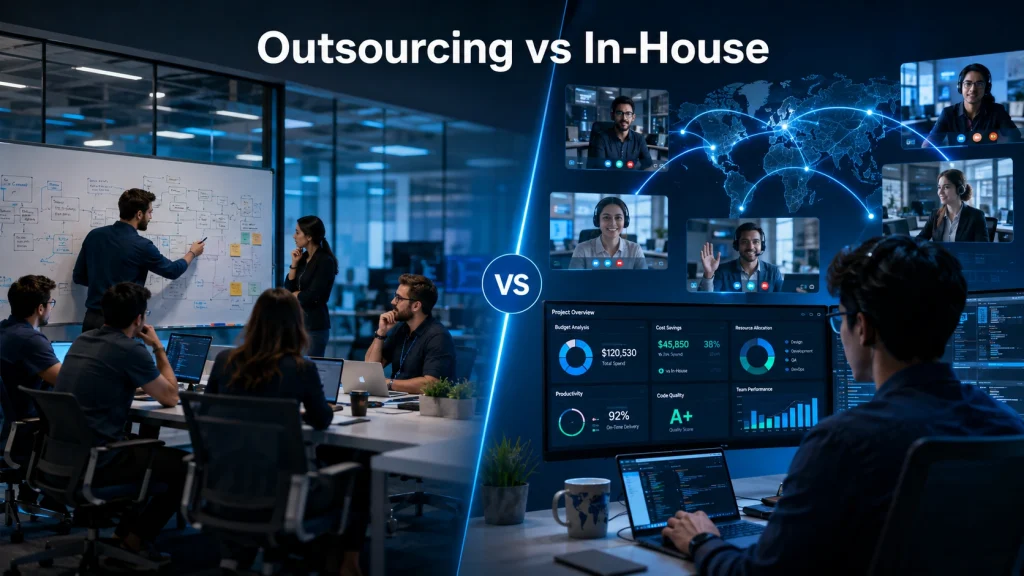
Choosing between outsourcing and building an internal development team depends on your business goals, budget, timeline, and technical requirements.
| Factor | Outsourcing | In-House Development |
|---|---|---|
| Initial Cost | Lower | Higher |
| Recruitment | Immediate | Months |
| Talent Availability | Global | Local |
| Scalability | High | Limited |
| Project Control | Moderate | High |
| Communication | Depends on partner | Easier |
| Long-Term Knowledge | External | Internal |
| Flexibility | Excellent | Moderate |
| Security Control | Shared | Complete |
| Maintenance | Often included | Internal responsibility |
Neither model is universally better. Many successful organizations combine both approaches through a hybrid development strategy.
When Should You Outsource Software Development?

Outsourcing works best when speed, flexibility, and specialized expertise are more important than maintaining a large internal engineering department.
Consider outsourcing if:
- You are launching a startup with limited resources.
- You need to build an MVP quickly.
- Your project requires specialized technologies such as AI, blockchain, or cloud engineering.
- Your internal developers are already committed to other priorities.
- You need temporary development capacity.
- You want to reduce operational expenses.
- Your software requires ongoing maintenance without hiring full-time staff.
For many growing companies, outsourcing accelerates product development while allowing leadership to focus on business growth.
When Should You Keep Development In-House?

Building an internal software team may be the better option if your application is central to your competitive advantage or requires constant collaboration with business stakeholders.
An in-house team is often preferable when:
- Software contains highly sensitive intellectual property.
- Strict regulatory compliance is required.
- Continuous product innovation depends on close collaboration.
- Frequent requirement changes demand rapid decision-making.
- Long-term technical knowledge must remain inside the company.
- You have sufficient budget to recruit and retain experienced developers.
Organizations developing proprietary platforms or highly confidential systems often benefit from keeping core engineering functions in-house.
Hybrid Outsourcing: The Best of Both Worlds

Many enterprises combine internal and external development teams to balance cost, flexibility, and control.
A hybrid model typically works like this:
- Internal teams define product strategy, architecture, and business priorities.
- Outsourced teams handle feature development, testing, maintenance, or specialized technical work.
- Both groups collaborate using shared Agile processes, documentation, and communication tools.
This approach allows businesses to scale quickly without losing ownership of critical decisions or intellectual property.
How to Choose the Right Software Development Outsourcing Partner

Choosing the right outsourcing company is often more important than deciding whether to outsource. A skilled development partner can deliver high-quality software on time and within budget, while the wrong choice can result in delays, security issues, and increased costs. Before signing a contract, evaluate each vendor carefully based on technical expertise, communication practices, project management processes, and long-term support capabilities.
1. Define Your Project Requirements First
Before approaching software development companies, clearly document what you want to build.
Your project documentation should include:
- Business objectives
- Target audience
- Core features
- Technical requirements
- Preferred technology stack
- Budget
- Timeline
- Security requirements
- Compliance needs
- Expected deliverables
Well-defined requirements help outsourcing companies provide more accurate estimates and reduce misunderstandings during development.
2. Evaluate Technical Expertise
Every software development company has different strengths. Some specialize in enterprise software, while others focus on mobile applications, AI, cloud computing, or SaaS platforms.
Review the company’s experience with technologies relevant to your project, such as:
- Java
- Python
- .NET
- Node.js
- React
- Angular
- Flutter
- AWS
- Microsoft Azure
- Google Cloud
- Kubernetes
- Docker
Ask for similar projects they have completed successfully.
3. Review Previous Work
A reputable outsourcing company should have a portfolio demonstrating successful projects across different industries.
Look for:
- Case studies
- Client testimonials
- Product screenshots
- Live applications
- Industry experience
- Technical complexity
If possible, speak directly with previous clients to understand their experience working with the company.
4. Assess Communication Processes
Strong communication is essential for successful outsourcing.
Ask questions such as:
- How often are sprint meetings held?
- Which collaboration tools are used?
- Who is the primary point of contact?
- How are project updates shared?
- What happens when requirements change?
Clear communication reduces delays and improves overall project quality.
5. Understand Their Development Methodology
Modern software companies generally follow Agile development practices.
Ask whether they use:
- Agile
- Scrum
- Kanban
- DevSecOps
- Continuous Integration (CI)
- Continuous Deployment (CD)
Frequent sprint reviews allow businesses to provide feedback throughout development instead of waiting until the project is complete.
6. Verify Security Standards
Security should never be an afterthought.
Ask potential partners about:
- Source code protection
- Access controls
- Data encryption
- Secure development lifecycle
- Vulnerability management
- Penetration testing
- Compliance certifications
If your application handles sensitive customer information, ensure the vendor follows recognized security frameworks.
7. Clarify Intellectual Property Ownership
Your company should retain complete ownership of:
- Source code
- Documentation
- Designs
- APIs
- Databases
- Deployment scripts
The contract should clearly state that all intellectual property belongs to your organization after payment.
Factors That Affect Outsourcing Costs
There is no single price for outsourced software development. Costs vary depending on project complexity, team size, technology stack, and geographic location.
The main pricing factors include:
Project Complexity
Simple websites cost significantly less than enterprise platforms with advanced integrations, AI features, or cloud-native architectures.
Team Size
Larger projects require more professionals, including:
- Developers
- QA engineers
- UI/UX designers
- DevOps engineers
- Project managers
- Business analysts
Technology Stack
Specialized technologies such as artificial intelligence, blockchain, cybersecurity, or machine learning often command higher hourly rates because of the limited talent pool.
Development Timeline
Accelerated delivery schedules may require larger teams or extended working hours, increasing overall costs.
Ongoing Maintenance
Most software projects continue after launch with:
- Bug fixes
- Security updates
- Performance optimization
- Feature enhancements
- Infrastructure monitoring
Maintenance costs should be included in long-term budgeting.
Common Mistakes to Avoid When Outsourcing Software Development
Many outsourcing failures stem from avoidable mistakes rather than outsourcing itself. Being aware of these pitfalls can help ensure a smoother project.
Choosing the Cheapest Vendor
Price should not be the only deciding factor. Extremely low-cost providers may compromise on code quality, documentation, testing, or security, leading to higher expenses later.
Poor Requirement Documentation
Vague requirements often result in incorrect features, frequent revisions, and project delays. Invest time in creating detailed specifications before development begins.
Ignoring Security
Failing to establish security expectations early can expose your business to data breaches or compliance issues. Discuss security requirements before signing any agreement.
Lack of Regular Communication
Waiting until the end of the project to review progress increases the risk of costly rework. Frequent sprint reviews and milestone demonstrations help keep development aligned with business goals.
Unrealistic Timelines
Software development requires planning, testing, and quality assurance. Unrealistic deadlines often reduce software quality and increase technical debt.
Not Planning for Maintenance
Launching software is only the beginning. Every application requires updates, bug fixes, and security patches throughout its lifecycle.
Final Thoughts
The pros and cons of outsourcing software development depend largely on your business goals, project complexity, and the partner you choose. Outsourcing can significantly reduce costs, provide access to global talent, speed up product delivery, and give businesses the flexibility to scale development teams as needed. At the same time, challenges such as communication barriers, security concerns, and vendor dependency require careful planning and proactive management.
Rather than viewing outsourcing as a replacement for an in-house team, many successful organizations treat it as a strategic extension of their engineering capabilities. A hybrid approach combining internal leadership with external technical expertise often delivers the best balance of control, innovation, and efficiency.
Before making a decision, define your project requirements, evaluate potential partners thoroughly, establish clear communication channels, and prioritize security and documentation. With the right strategy, outsourcing can become a powerful way to accelerate digital transformation while maintaining software quality and long-term business value.
Frequently Asked Questions
Yes. Outsourcing is a practical option for many businesses looking to reduce costs, access specialized talent, and accelerate software delivery. Success depends on selecting a reliable development partner and maintaining clear communication.
Popular outsourcing destinations include India, Poland, Vietnam, Romania, the Philippines, and Ukraine. These countries offer experienced software engineers across a wide range of technologies.
Common risks include communication gaps, security concerns, inconsistent quality, hidden costs, vendor dependency, and time zone differences. These risks can be minimized through careful vendor selection, detailed contracts, and regular project oversight.
Absolutely. Many startups outsource development to launch products faster, reduce hiring costs, and access experienced engineers without building a full internal team.
In many cases, yes. Outsourcing eliminates recruitment expenses, employee benefits, office infrastructure, and long-term staffing costs. However, overall costs depend on project scope, technology requirements, and vendor pricing.