

 Post by
 Check out our latest blog on CapEx vs OpEx Software Development: Key Differences
How Insurance Fraud Actually Happens and Why Generic Tools Miss It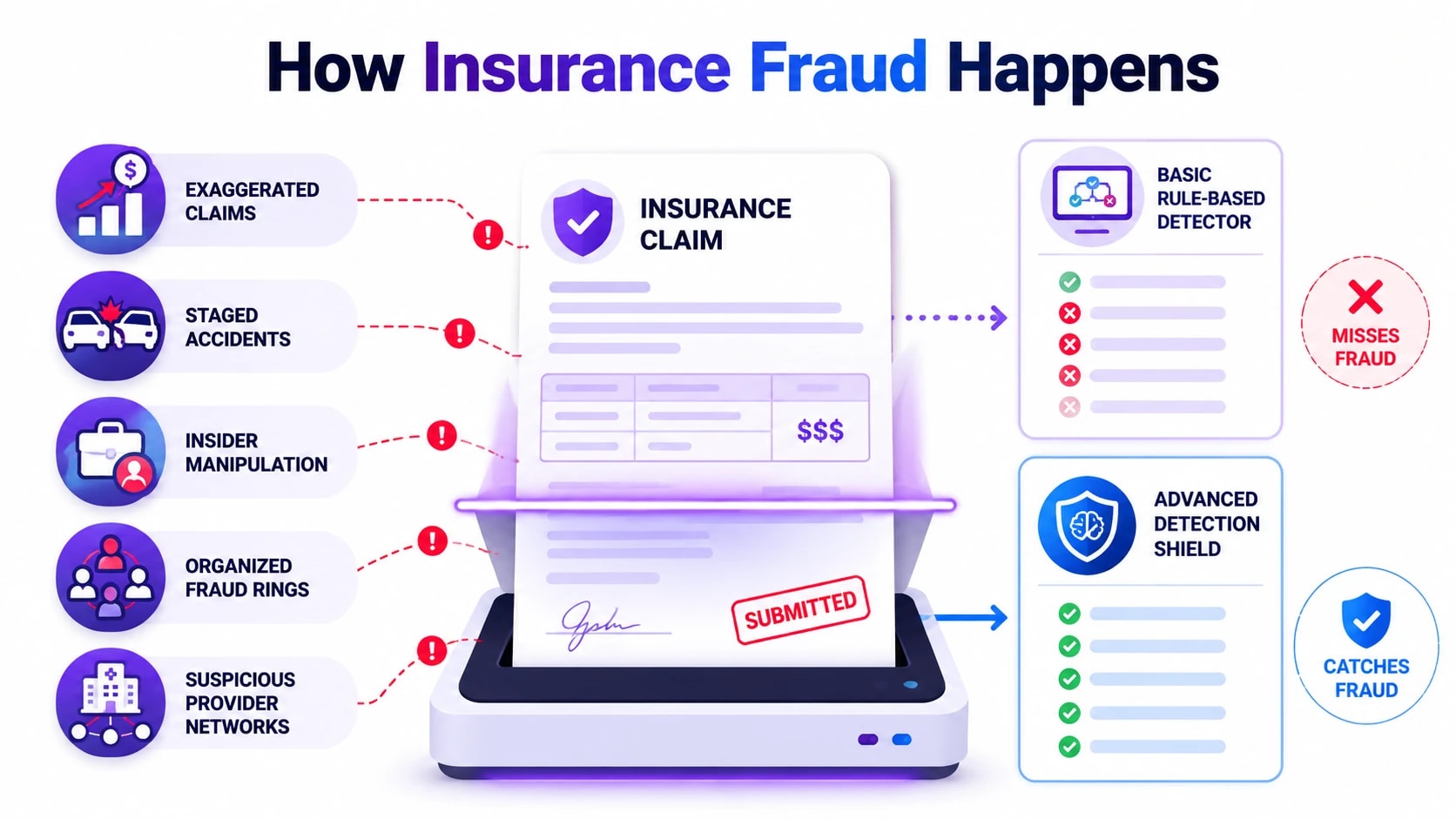
Before writing a single line of code, it helps to understand what you are actually trying to catch. Insurance fraud is not a single behavior. It shows up in dozens of forms across health, auto, property, life, and liability insurance, and each type requires a different detection approach.
The Main Categories of Insurance Fraud
- Soft fraud: Policyholders exaggerate legitimate claims. A minor fender-bender becomes a claim for whiplash, lost wages, and a rental car. This is the most common type and the hardest to prove.
- Hard fraud: Staged accidents, arson, fake deaths, or deliberately destroyed property. Higher dollar amounts, more coordination, more sophisticated actors.
- Insider fraud: Agents or adjusters manipulating claims, issuing fake policies, or routing payouts to connected parties.
- Organized fraud rings: Networks of participants, including doctors, lawyers, repair shops, and claimants, all working together to file coordinated fraudulent claims.
Why Off-the-Shelf Tools Fall Short
Most commercial fraud detection products are built on static rule sets. If a claim meets three or more predefined red flags, it gets flagged. The problem is that experienced fraudsters know these rules and build their schemes around them. They keep claim amounts just below thresholds. They spread activity across time to avoid pattern detection. They use clean policyholder histories as cover.
Generic tools also struggle with context. A claim filed two days after policy inception looks suspicious in one context and completely normal in another. A single-vendor healthcare provider billing every Monday morning could be a fraud ring or just a small clinic with a consistent schedule. Without the ability to weigh context dynamically, rule-based systems produce enormous volumes of false positives, which burns out investigation teams and causes real fraud to slip through in the noise.
Custom-built software solves this by combining rule logic with machine learning models trained on your specific book of business, your claim types, your customer profiles, and your historical fraud cases. That specificity is where the real detection accuracy comes from.
Check out our latest blog on Greenfield Software Development vs Brownfield Explained
Core Architecture of Insurance Fraud Detection Software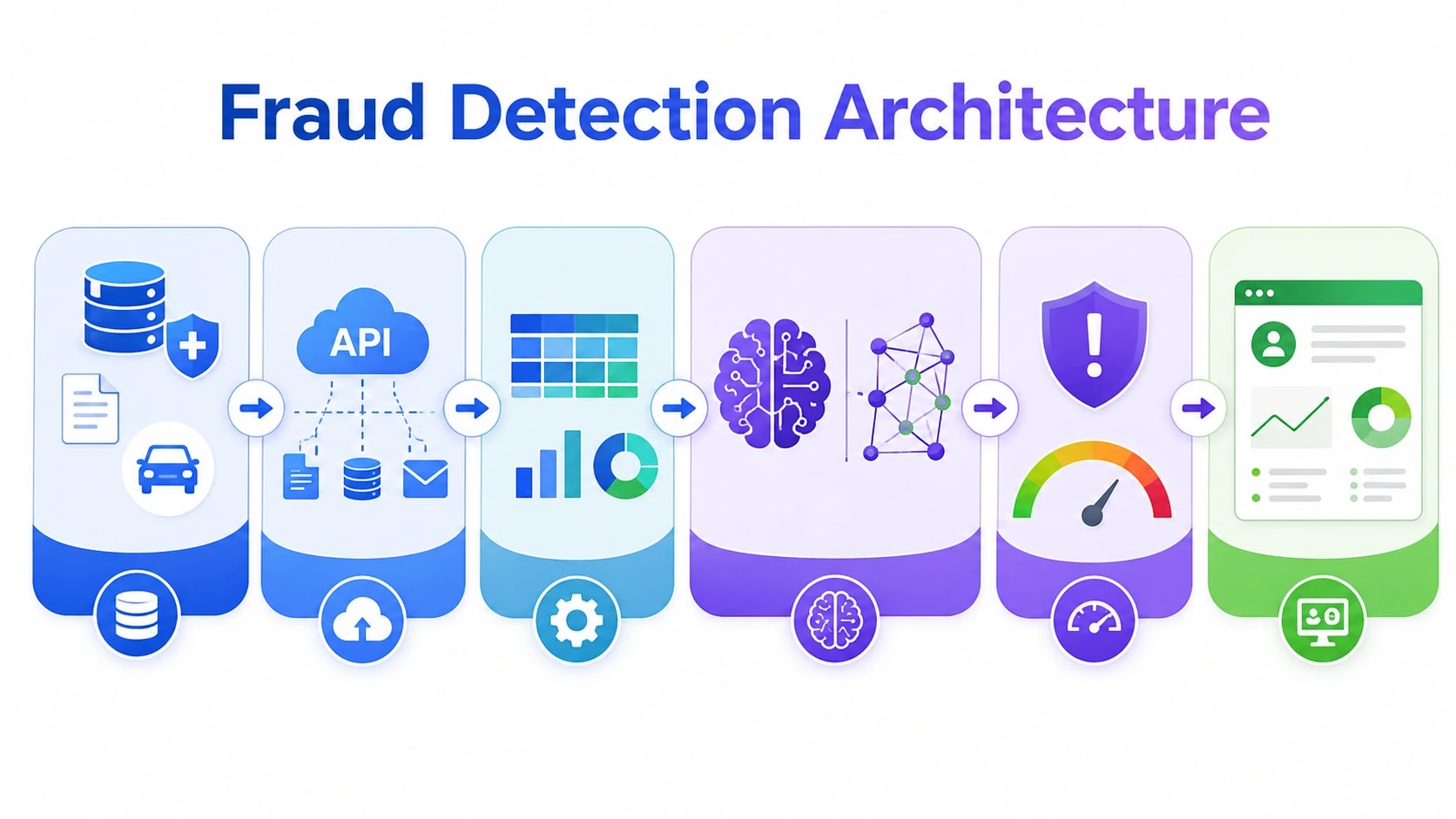
A well-engineered fraud detection system is not a single tool. It is a pipeline of interconnected components that ingest data, process it in real time, score it for risk, and surface actionable intelligence for investigators. Here is how the architecture typically breaks down.
1. Data Ingestion and Integration Layer
Fraud detection is only as good as the data feeding it. The ingestion layer connects to all relevant data sources, which typically include core policy management systems, claims management platforms, third-party databases such as ISO ClaimSearch or LexisNexis, telematics and IoT feeds for auto and property insurance, medical billing records for health insurance, and social media or public records where permitted by regulation.
This layer needs to handle both batch processing for historical analysis and real-time streaming for live claim scoring. Technologies like Apache Kafka or AWS Kinesis handle the streaming side, while ETL pipelines manage batch ingestion from legacy systems that often use outdated data formats.
2. Feature Engineering and Data Normalization
Raw data is rarely usable directly. The feature engineering layer transforms it into structured signals that models can interpret. This includes calculating derived features like claim frequency per policyholder, average time between policy start and first claim, geographic clustering of related claims, network connections between claimants, providers, and attorneys, and behavioral patterns such as the time of day claims are typically submitted.
Normalization matters here because fraud detection models trained on skewed or inconsistently formatted data produce unreliable scores. Getting this layer right is often where most of the development time goes, and it is where experienced software engineers make the biggest difference.
3. Detection Engine: Rules, Models, and Graphs
The detection engine is the analytical core of the system. It typically runs three types of analysis in parallel.
- Rules engine: Fast, interpretable, and easy to update. Handles obvious red flags and regulatory compliance checks.
- Machine learning models: Supervised models trained on labeled fraud cases handle classification. Unsupervised models like isolation forests or autoencoders catch anomalies that do not match any known fraud pattern.
- Graph analytics: This is where fraud rings get exposed. Graph databases like Neo4j map relationships between entities, flagging suspicious networks of claimants, providers, and legal representatives who appear together across multiple claims.
Running all three in parallel and combining their outputs into a single composite risk score gives investigators a prioritized, explainable alert rather than a raw model output that no one knows how to act on.
4. Case Management and Investigator Interface
Detection without action is worthless. The case management interface surfaces flagged claims with supporting evidence, risk scores, timeline visualizations, and network graphs. Investigators can document findings, escalate cases, and feed outcomes back into the system as training data. That feedback loop is what allows the model to improve over time rather than degrading as fraud patterns shift.
AI and Machine Learning Techniques Used in Fraud Detection Software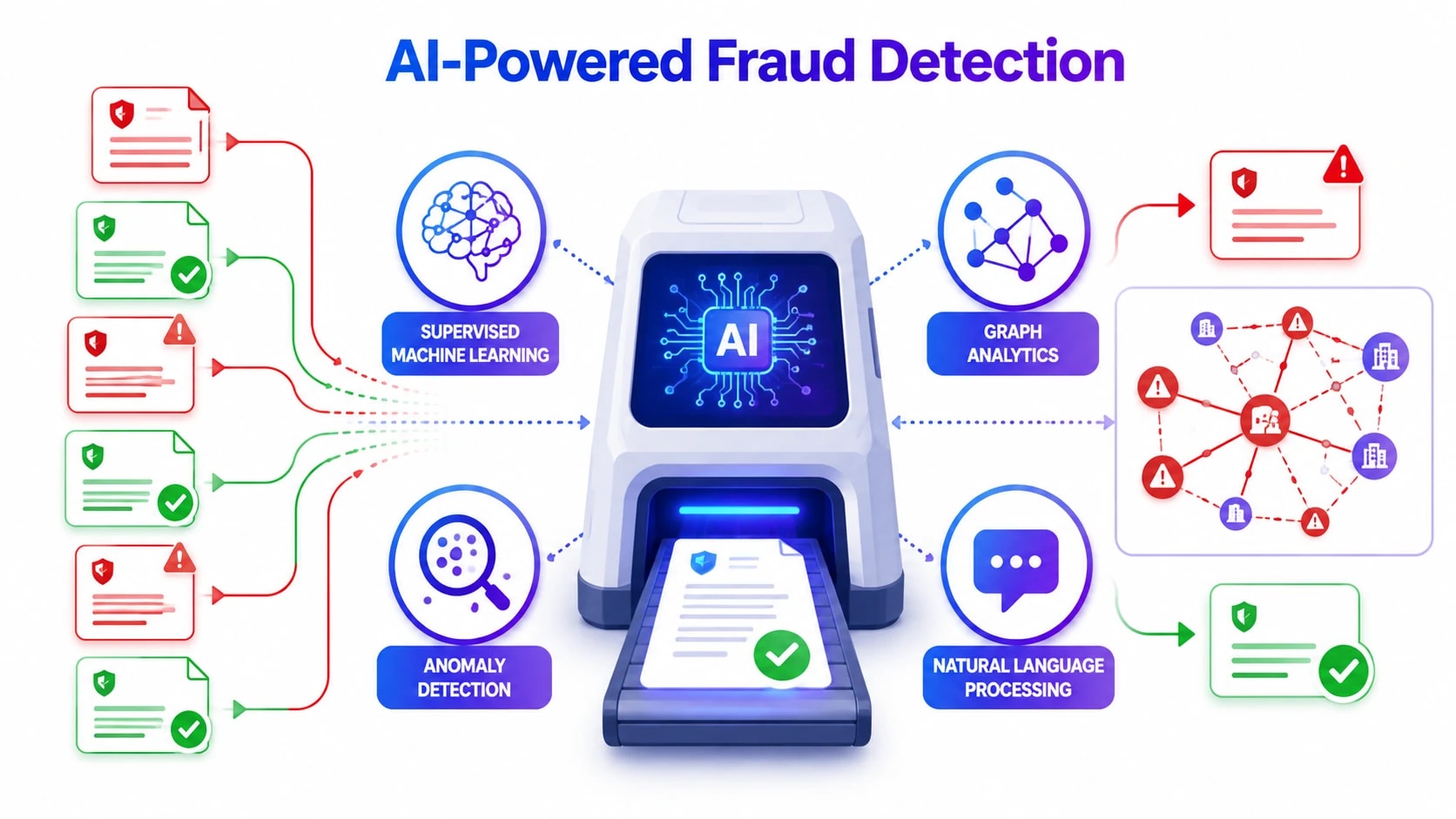
Modern insurance fraud detection does not rely on a single algorithm. The most effective systems layer multiple machine learning techniques to catch different fraud patterns, from scripted claim manipulation to subtle behavioral anomalies that no human adjuster would notice. The choice of technique depends heavily on the type of insurance, the volume of claims, and the quality of historical data available. Getting this combination right during development is what separates a system that flags 60% of fraud from one that catches 92% of it.
Supervised learning models, trained on labeled datasets of confirmed fraud and legitimate claims, form the backbone of most detection engines. Random forests, gradient boosting models like XGBoost, and neural networks excel at scoring incoming claims against known fraud patterns. However, supervised models only catch what they have already seen. This is where unsupervised techniques become critical. Clustering algorithms group claims by behavioral similarity and surface outliers that deviate significantly from peer groups, even when those deviations have no prior fraud label attached. Graph analytics adds another layer, mapping relationships between claimants, providers, attorneys, and witnesses to detect organized fraud rings that would appear innocent if each claim were reviewed in isolation.
Natural language processing plays a growing role in fraud detection, particularly for analyzing adjuster notes, medical reports, and claimant statements. NLP models can identify inconsistencies in reported timelines, flag claims where injury descriptions contradict medical billing codes, or detect template-written reports submitted by repeat fraudulent providers. Below is a quick comparison of the most commonly used techniques and where they apply best:
| Technique | Best Used For | Key Limitation |
|---|---|---|
| Supervised Classification (XGBoost, Random Forest) | Scoring known fraud patterns at high volume | Misses novel fraud types with no prior label |
| Unsupervised Clustering (K-Means, DBSCAN) | Detecting anomalous claims without labeled data | Higher false-positive rates requiring human review |
| Graph Analytics (Network Analysis) | Exposing organized fraud rings and shared identities | Computationally intensive at large scale |
| Natural Language Processing | Analyzing documents, notes, and unstructured text | Requires large, clean text datasets to train well |
| Predictive Behavioral Scoring | Flagging high-risk policies at underwriting stage | Potential for bias if training data is unbalanced |
Must-Have Features vs. Nice-to-Have: A Build Priority Framework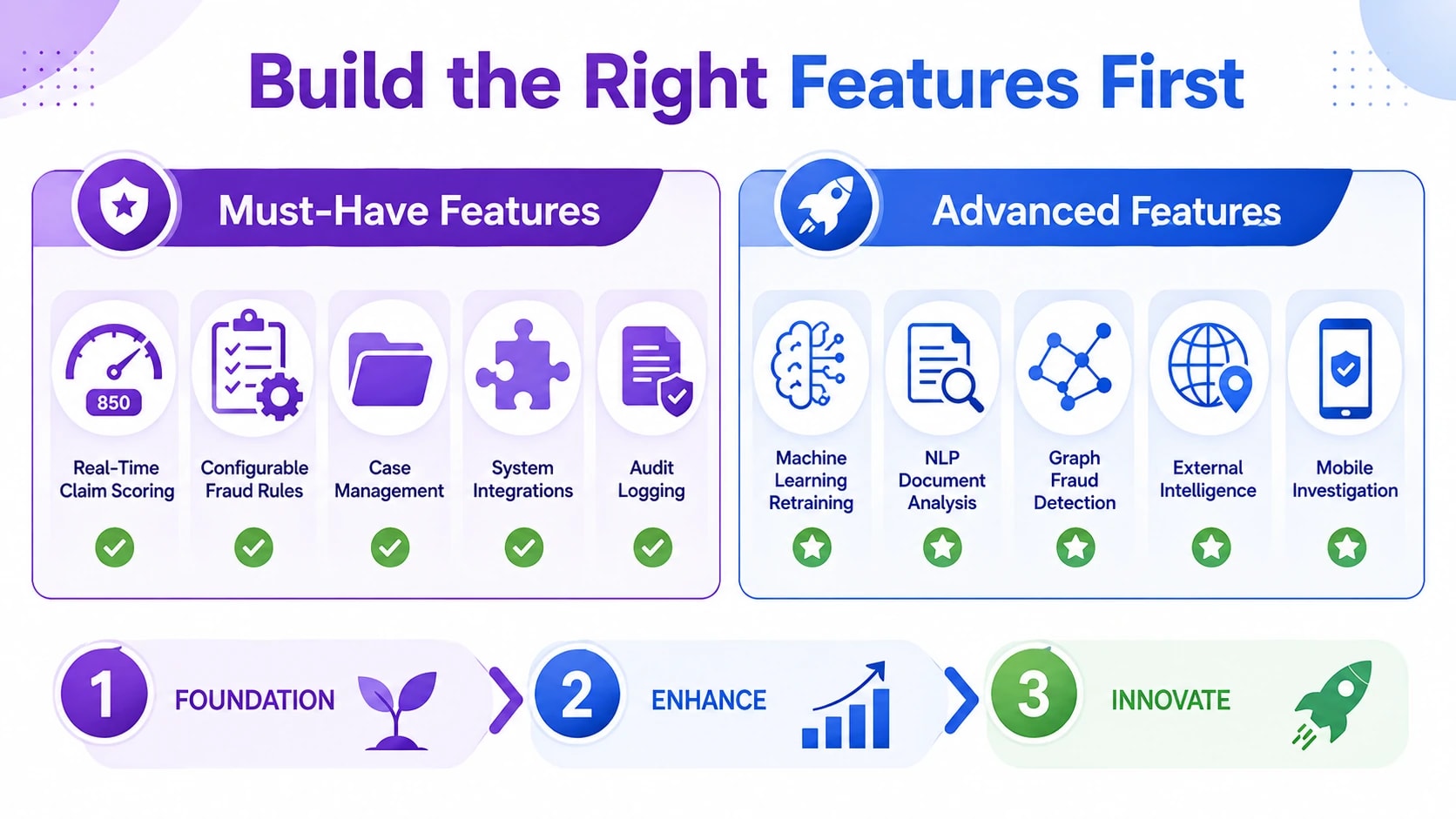
One of the most common mistakes companies make when starting a fraud detection software project is trying to build every feature at once. This leads to bloated timelines, budget overruns, and a system that does many things at an average level rather than core things extremely well. A disciplined build priority framework focuses early development on the features that directly reduce fraud losses, with secondary features phased in as the system matures and the team learns from real-world performance.
Must-have features are those without which the system cannot function as a fraud detection tool. These include real-time claim scoring, a configurable rules engine that allows fraud analysts to update detection logic without engineering support, a case management dashboard for investigators, and basic reporting that quantifies fraud catch rates and false positives over time. Integration with core policy and claims management systems is also non-negotiable, because a fraud engine that cannot read claim data in context is essentially blind.
Nice-to-have features, which should be planned but not built first, include predictive fraud scoring at the underwriting stage, social media and open-source intelligence integrations, mobile-optimized investigator tools, and advanced network visualization for fraud ring mapping. Here is a prioritized feature breakdown to guide development sprints:
- Phase 1 (Core, build first): Real-time claim scoring engine, configurable rules management, case management dashboard, claims and policy system integration, basic audit logging
- Phase 2 (High value, build second): Machine learning model retraining pipeline, adjuster alert workflow, document and NLP analysis module, fraud analyst reporting suite
- Phase 3 (Advanced, build when stable): Graph-based fraud ring detection, underwriting risk scoring, external data source integrations, mobile investigator app
Development Cost, Timeline, and Build vs. Buy Trade-offs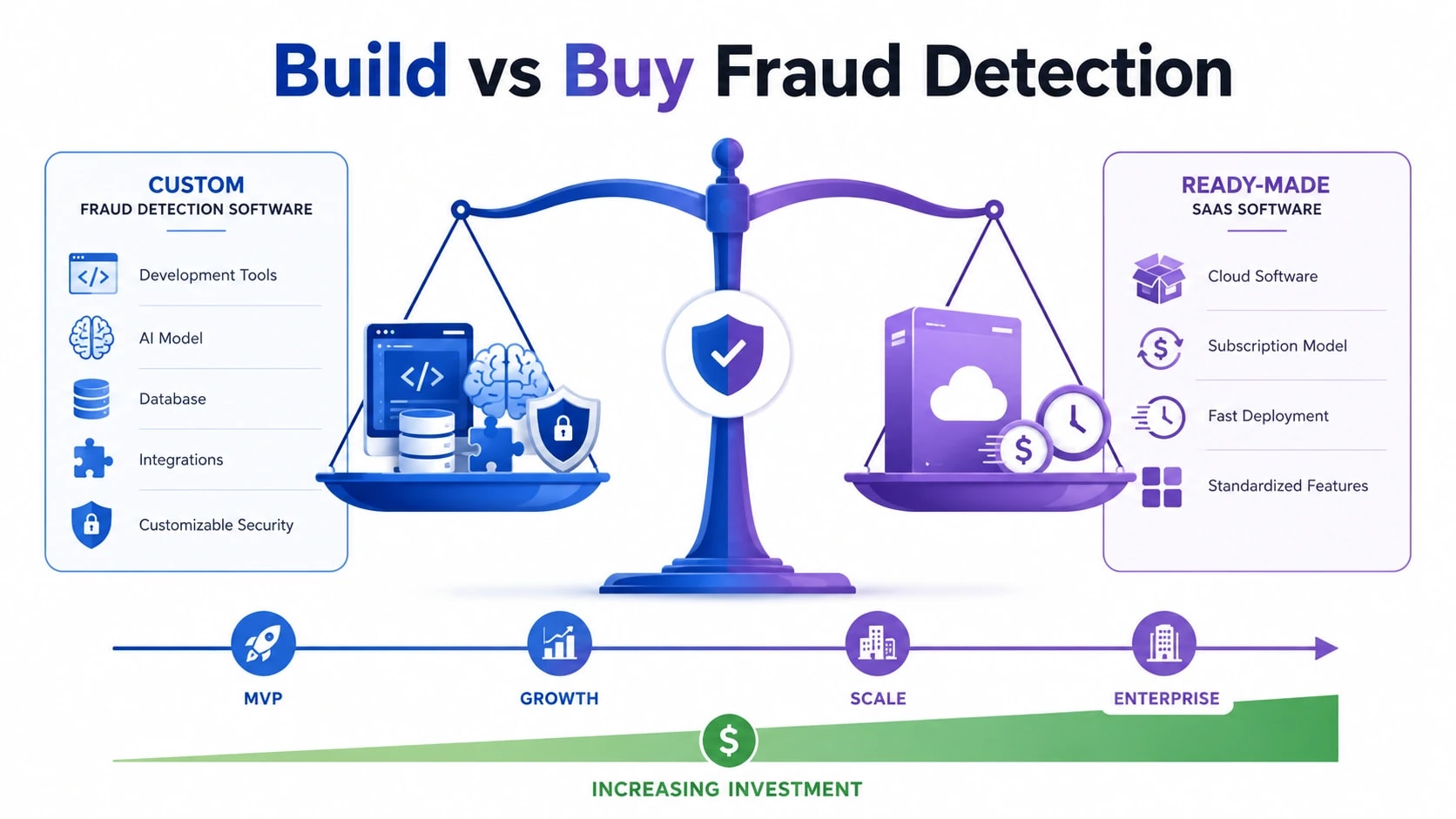
The build versus buy decision for insurance fraud detection software is rarely straightforward. Off-the-shelf vendor solutions can get a basic system live in weeks, but they come with significant trade-offs: rigid data models that do not match your claims structure, per-claim licensing fees that scale uncomfortably as volume grows, and limited ability to customize detection logic for your specific insurance lines. For carriers with standard commercial lines and modest claim volumes, a vendor solution may be adequate. For specialty insurers, MGAs with unique product structures, or companies processing tens of thousands of claims monthly, a custom-built system typically delivers better ROI within 18 to 24 months.
Custom development timelines vary based on the scope of integrations and the complexity of the ML pipeline. A focused Phase 1 build covering core claim scoring, rules management, and a basic investigator dashboard typically takes four to six months with a dedicated team. Full-featured systems with advanced ML, graph analytics, and external data integrations generally require nine to fourteen months. The cost ranges below reflect typical software development engagements and should be treated as planning benchmarks rather than fixed quotes:
| Build Scope | Estimated Timeline | Approximate Cost Range |
|---|---|---|
| Phase 1 MVP (core scoring and dashboard) | 4 to 6 months | $80,000 to $180,000 |
| Mid-tier system with ML pipeline and NLP | 7 to 10 months | $180,000 to $380,000 |
| Full enterprise platform with graph analytics | 10 to 14 months | $380,000 to $700,000+ |
| Vendor SaaS solution (off-the-shelf) | 4 to 8 weeks setup | $2,000 to $15,000+ per month |
The hidden cost that most budget discussions miss is data readiness. Fraud detection models are only as good as the historical claims data they train on. Many insurers discover during development that their existing claims data is inconsistently labeled, lacks fraud outcome fields, or is siloed across systems that do not talk to each other. Budgeting two to three months for data audit, cleaning, and pipeline work before model development begins is not optional; it is what determines whether the final system actually works in production.
Regulatory Compliance and Data Privacy Requirements for Fraud Detection Software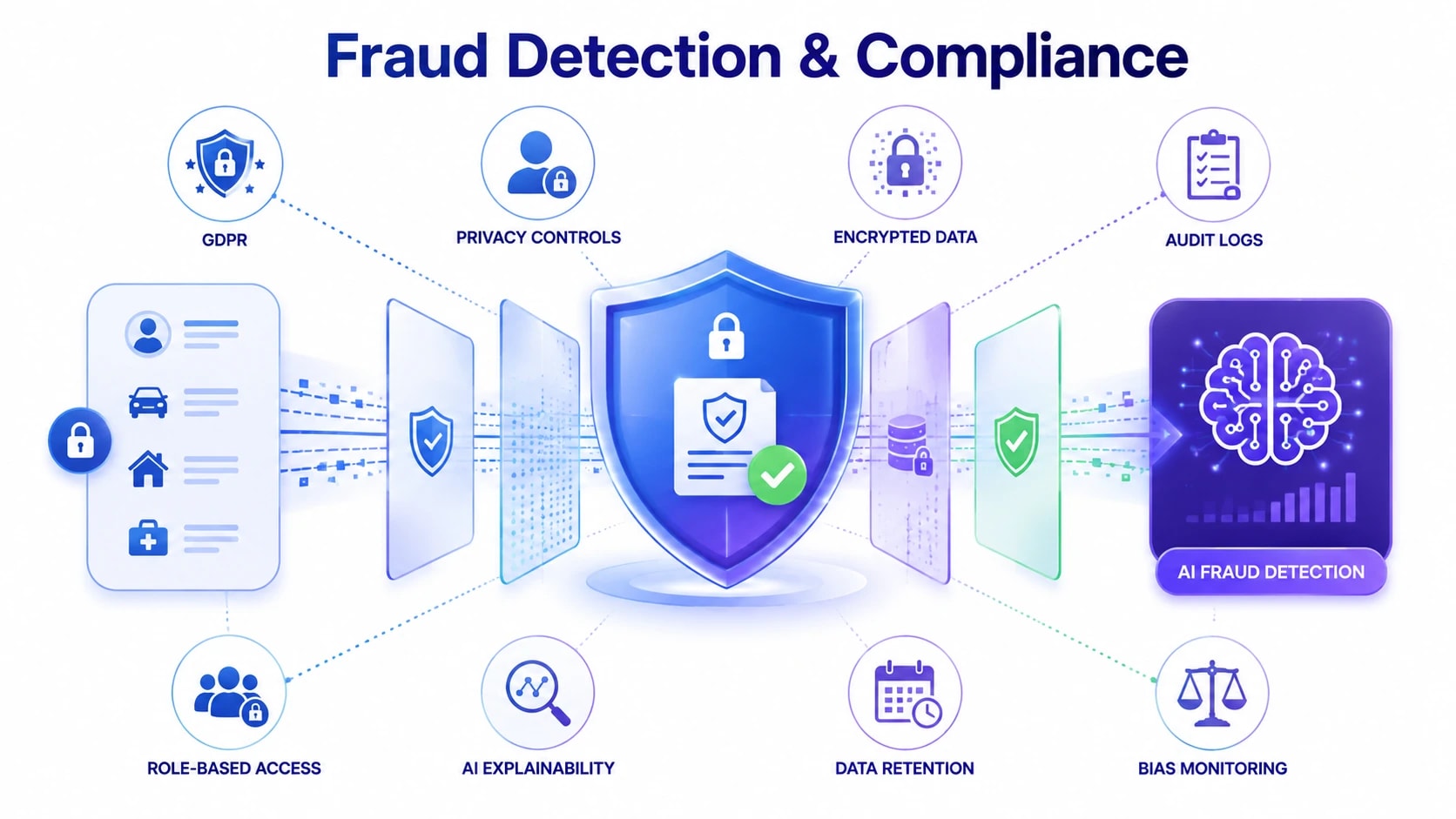
Building fraud detection software for the insurance industry is not purely a technical challenge. Compliance with data privacy laws and industry regulations is not optional, and getting it wrong can expose your company to fines, lawsuits, and reputational damage that far outweigh the cost of the fraud you were trying to prevent. Every architectural decision, every data pipeline, and every model output must be designed with regulatory requirements in mind from day one.
The regulatory environment varies significantly by geography and insurance segment, which means your software must be built to adapt rather than conform to a single ruleset.
Key Regulations That Impact Fraud Detection Software
- GDPR (Europe): Requires explicit consent for personal data processing, the right to explanation for automated decisions, and strict data retention limits. AI-driven fraud flags that affect a claimant must be explainable and contestable.
- CCPA (California): Gives consumers the right to know what data is collected, to opt out of its sale, and to request deletion. Fraud detection pipelines that ingest third-party data must account for these rights.
- HIPAA (Health Insurance): Health insurers must apply strict controls over protected health information used in fraud scoring, including access logs, encryption at rest and in transit, and business associate agreements with any vendors in the data chain.
- NAIC Model Laws: The National Association of Insurance Commissioners publishes model acts on fraud, data security, and algorithmic fairness that many US states have adopted in varying forms.
- EU AI Act: Fraud detection systems used in insurance are likely classified as high-risk AI applications under this regulation, requiring conformity assessments, human oversight mechanisms, and documentation of training data.
- Fair Credit Reporting Act (FCRA): If your system uses credit data or third-party consumer reports in scoring decisions, FCRA obligations around adverse action notices and dispute handling apply.
Compliance Features That Must Be Built Into the System
Compliance is not a layer you add on top of a finished product. It must be woven into the data model, API design, and workflow logic from the beginning. The features below represent the minimum viable compliance foundation for any production fraud detection system.
| Compliance Requirement | What to Build | Why It Matters |
|---|---|---|
| Data minimization | Collect only fields required for scoring; mask or tokenize sensitive identifiers. | Reduces breach exposure and satisfies GDPR Article 5 |
| Audit logging | Immutable logs of every model prediction, analyst action, and data access event | Required for regulatory review, legal discovery, and internal accountability |
| Explainability output | SHAP values or rule traces attached to each fraud score | Enables human review and satisfies right-to-explanation mandates |
| Data retention controls | Configurable retention schedules with automated deletion pipelines | Keeps you within GDPR, CCPA, and HIPAA storage limits |
| Role-based access control | Granular permissions per user role, with MFA for sensitive data access | Limits insider risk and satisfies NAIC data security model act requirements |
| Bias monitoring | Ongoing demographic parity checks on model outputs across protected classes | Prevents discriminatory flagging patterns and supports EU AI Act conformity |
Practical Steps for Building a Compliance-Ready System
- Appoint a data protection lead early. A developer or product manager with compliance authority should be present in architecture review sessions, not brought in after the fact.
- Map your data flows before writing code. Document every data source, transformation, and storage location. This data flow diagram becomes the foundation of your compliance documentation and your incident response plan.
- Use privacy-by-design patterns. Pseudonymization at ingestion, encryption at every layer, and field-level access controls are cheaper to build in than to retrofit.
- Build a consent and preference management module. For consumer-facing data collection, you need a mechanism to record consent, honor withdrawal requests, and propagate deletions across all downstream systems.
- Plan for third-party vendor compliance. Any external data provider, cloud platform, or analytics vendor your system depends on must be evaluated for their own compliance posture, and contracts must include appropriate data processing agreements.
- Schedule regular model audits. Compliance is not a one-time checklist. Set quarterly reviews of model performance, bias metrics, and data handling practices, and document the results.
Insurance regulators are paying closer attention to automated decision systems than ever before. Building compliance into your fraud detection software from the start is both a legal requirement and a competitive advantage, since it builds trust with underwriters, claimants, and partners who need to know your system treats people fairly.
Conclusion
Insurance fraud detection software is one of the more technically demanding products a development team can take on. It sits at the intersection of real-time data processing, machine learning, regulatory obligation, and operational workflow, and it has to get all of those things right simultaneously. The companies that succeed with it treat the build as a long-term product investment rather than a one-time implementation. They start with a focused core, instrument everything carefully, and evolve the system as fraud patterns and regulations change. The build-versus-buy decision matters less than the quality of the underlying architecture and the depth of domain knowledge embedded in the detection logic.
If your organization is ready to move beyond generic fraud tools and build something that actually fits your claims environment, the path forward starts with a clear technical specification and a development partner who understands both the engineering and the insurance context. Whether you need a full custom platform or a targeted detection layer integrated into your existing claims management system, getting the architecture right early will save significant time and cost down the road. Techlad works with insurance companies and insurtech startups to design and build fraud detection systems that are scalable, compliant, and built around real operational needs. Reach out to discuss what the right solution looks like for your specific context.
Frequently Asked Questions
How long does it take to build insurance fraud detection software from scratch?
A minimum viable fraud detection system with core scoring, a case management interface, and basic integrations typically takes four to six months. A full-featured platform with real-time ML models, network analysis, and compliance tooling can take nine to fifteen months depending on data complexity and regulatory requirements.
Can existing claims management systems be integrated with a custom fraud detection layer?
Yes, most modern claims platforms expose APIs or support webhook-based event triggers that a fraud detection layer can hook into. The integration complexity depends on how well-documented the existing system is and whether real-time or batch processing is required for your fraud scoring workflow.
What data is needed to train a fraud detection machine learning model?
You need historical claims records with confirmed fraud labels, ideally spanning at least two to three years. The more data you have on claimant behavior, provider patterns, and claim outcomes, the better the model performs. Imbalanced data, where fraud cases are rare, requires specific sampling and weighting techniques during training.
Is it possible to build fraud detection software that works across multiple insurance lines?
Yes, but it requires a modular architecture where shared infrastructure handles data ingestion and scoring pipelines, while line-specific rule sets and models are configured separately. Auto, health, and property fraud have very different signal patterns, so a single generic model rarely performs well across all three without customization.
What is the biggest technical mistake companies make when building fraud detection software?
The most common mistake is optimizing for model accuracy in isolation without building the explainability and human review workflow around it. A highly accurate model that analysts cannot interpret or override quickly loses trust, gets ignored, and creates compliance problems when its decisions cannot be justified to regulators or claimants.